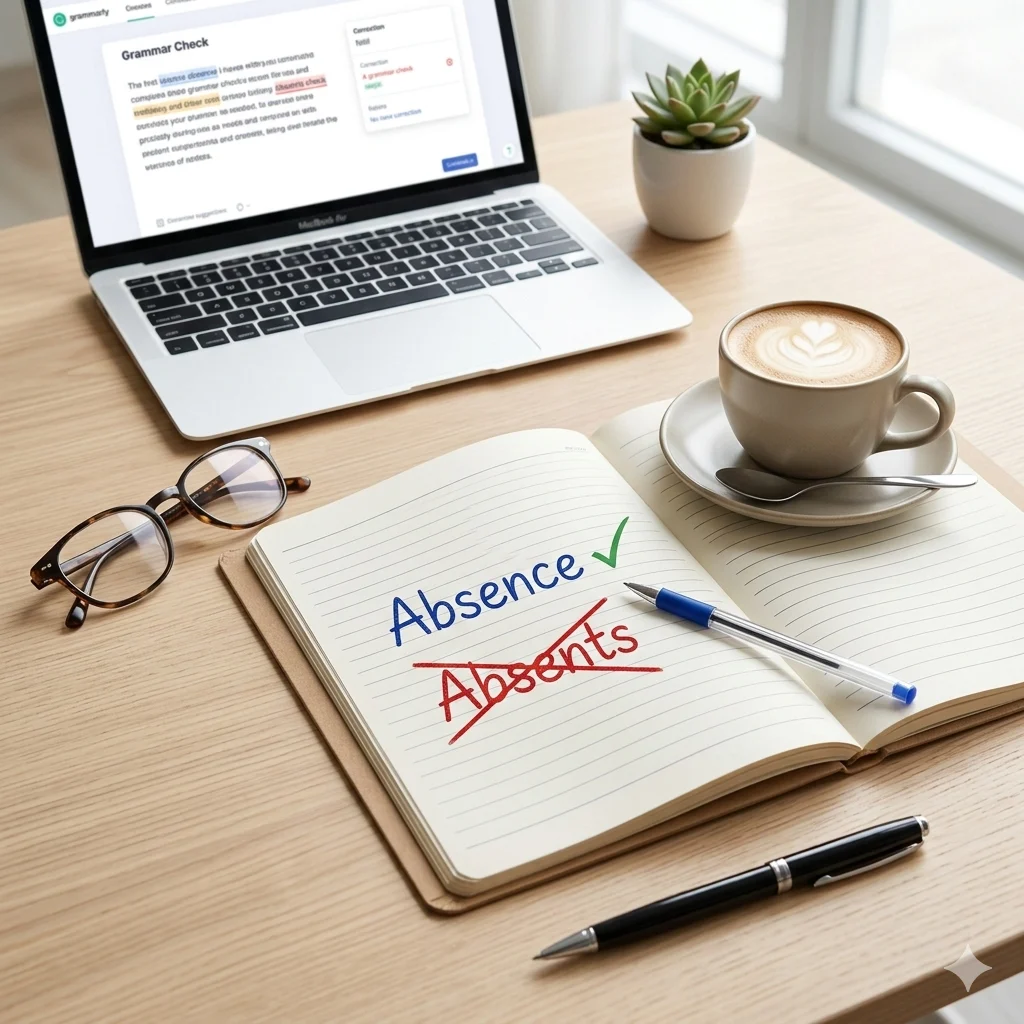
“Absence is a noun meaning ‘not present,’ while absents is a verb used rarely in the third person singular form.”
Ever wondered why some sentences get marked wrong when you use “absents” instead of “absence”? You’re not alone! Many English learners confuse these two because they look similar but are used differently.
- Absence is a noun meaning the state of not being present. Example: “Her absence was noticeable in class.”
- Absents is a verb, used only in the third person singular and usually reflexively. Example: “He absents himself from meetings.”
In most everyday writing, absence is the correct and safe choice. To help you remember, this article explains the key differences, grammar rules, usage tips, and common mistakes, along with easy tricks to avoid confusion. You’ll also find a quick reference table for faster understanding, making your English both accurate and natural.
Absents or Absence meanings
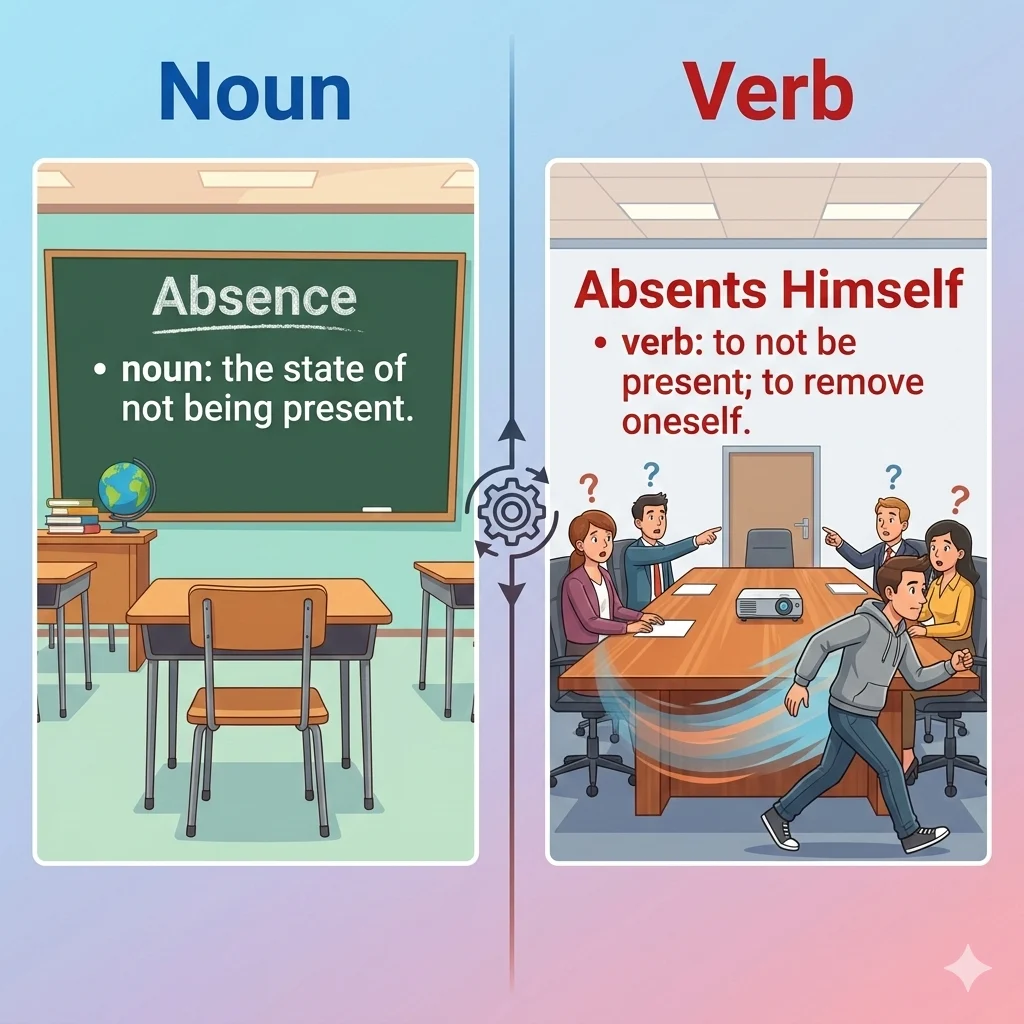
Here is the simplest way to distinguish between the two: “Absence” is a noun (a thing), and “Absents” is a verb (an action).
- Absence (Noun): This refers to the state of being away. It is the “what.”
- Example: Your absence from the party was noted.
- Example: The teacher was concerned about the student’s frequent absence.
- Absents (Verb): This is the third-person singular form of the verb “to absent,” meaning to deliberately stay away or withdraw. It is the “action” someone takes.
- Example: He absents himself from meetings whenever the budget is discussed.
- Example: She absents herself from social media during exams.
Think of it this way: You have an absence (noun) when you absent (verb) yourself.
The Origin of Absence and Absents
To understand why these two words cause so much trouble, we have to look at where they came from. Both words trace their roots back to the Latin word “abesse,” which combines “ab-“ (away) and “esse” (to be). Essentially, it means “to be away.”
As Latin evolved into Old French and then into Middle English, the word split into two distinct paths:
- The Noun Path: The Latin word “absentia” (the state of being away) evolved into the Old French “absence,” which English adopted. This is why the noun ends in “-ence.” It has remained a noun for over 700 years.
- The Verb Path: The Latin verb “absentare” (to cause to be away) evolved into the verb “to absent.” In English, we conjugate verbs. For he/she/it, we add an “s.” Thus, “to absent” becomes “he absents.”
The spelling differences exist because English borrowed words from different French dialects and Latin roots at different times. While the noun stuck with the French “-ence” spelling, the verb followed the standard English rule of adding an “s” for the third person.
British English vs American English Spelling
When it comes to “absence” and “absents,” there is a surprising lack of drama between the US and the UK. Unlike “color” versus “colour,” this pair is treated almost identically on both sides of the Atlantic. However, the usage and common contexts can vary slightly.
- Absence: In both American and British English, “absence” is spelled the same way. It is universally accepted as the correct noun form.
- Absents: In both dialects, “absents” is the correct verb conjugation. However, in British English, you are slightly more likely to see “absents” used in formal institutional settings (like university registers or parliamentary records) than in American English, where the verb form is often replaced with phrases like “is absent.”
Spelling Comparison Table
| Word | Part of Speech | American English Usage | British English Usage | Common Context |
|---|---|---|---|---|
| Absence | Noun | “His absence was excused.” | “Her absence from the meeting was noted.” | School, work, presence/state |
| Absents | Verb (3rd person) | “He absents himself from conflict.” | “The member absents himself from the vote.” | Formal withdrawal, deliberate action |
Which Spelling Should You Use?
Choosing the right word depends entirely on what you are trying to say and who your audience is. Here is a simple guide based on your location and intent:
- For a US Audience (General Public): Stick to absence whenever possible. Americans tend to use the verb form “absents” less frequently in everyday conversation, preferring instead to say “He is absent.” Use “absents” only in formal or legal writing.
- For a UK / Commonwealth Audience: You have more flexibility. Absence is still the primary word you will use (for the state of being away). However, absents is perfectly acceptable in formal contexts, such as board meeting minutes or academic records (e.g., “The record shows he absents himself”).
- For Global / Online Writing: When writing for a global audience (like a blog or an international company email), prioritize clarity. Use absence as the noun. If you need to use the verb, rephrase the sentence to avoid confusion. Instead of “He absents himself,” write “He is often absent.”
Common Mistakes with Absents or Absence
Because they sound so similar, people frequently mix these up. Here are the most common errors and how to fix them.
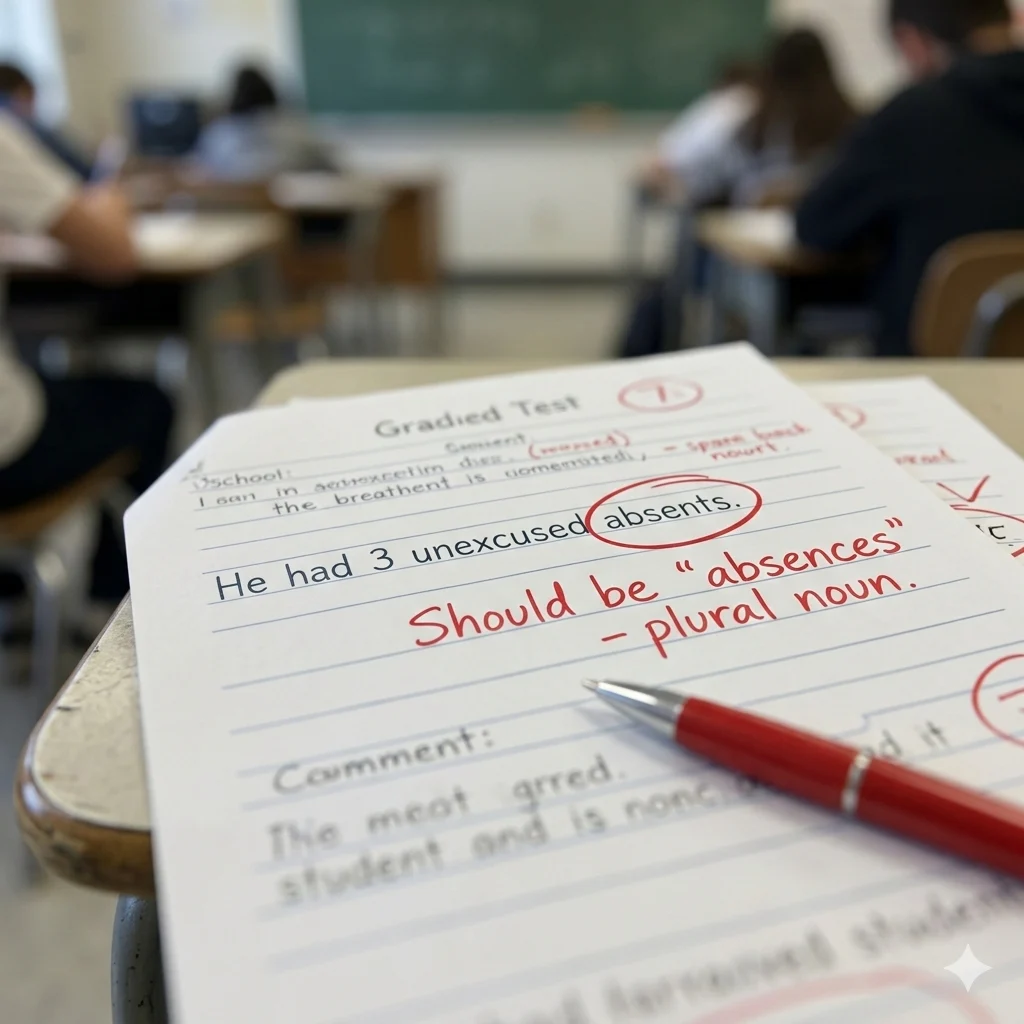
Mistake 1: Using “Absents” when you need the plural of “Absence.”
- Incorrect: “He had three unexcused absents this semester.”
- Why it’s wrong: Here, you are counting the number of times a person was away. You need a noun. The plural of “absence” is “absences.”
- Correct: “He had three unexcused absences this semester.”
Mistake 2: Using “Absence” when you need an action verb.
- Incorrect: “He purposely absence himself from the discussion.”
- Why it’s wrong: “Absence” is a noun and cannot be used as a verb.
- Correct: “He purposely absents himself from the discussion.”
Mistake 3: Confusing “Absent” (adjective) with “Absents” (verb).
- Context: “Absent” is also an adjective meaning “not present.”
- Example: “The student was absent.” (Adjective)
- Example: “The student absents himself.” (Verb)
- The Mix-up: People often forget the “s” on the verb. Remember: He is absent (adj) today, so he absents (v) himself from the class.
Absents or Absence in Everyday Examples
Seeing the words in their natural habitat helps solidify the difference. Here is how they appear in real life.
In Emails (Professional)
- Correct (Noun): “Dear Manager, Please excuse my absence from the team meeting yesterday.”
- Correct (Verb): “John routinely absents himself from the weekly sync-up, which is causing communication issues.”
In News Headlines (Journalism)
- Noun Usage: “The Senator’s absence from the crucial vote raised eyebrows in Washington.”
- Verb Usage: “The CEO absents himself from the negotiations, leaving his deputy in charge.”
On Social Media (Informal)
- Noun Usage: “My brain is taking a temporary absence today. #MondayBlues”
- Note: You almost never see the verb “absents” on social media unless it is a quote. It sounds too formal. People usually say “skips” or “ditches.”
In Formal Writing (Academic/Legal)
- Noun Usage: “The study recorded the number of student absences over the academic year.”
- Verb Usage: “If a director absents himself from three consecutive board meetings, the board may vote to remove him.”

Absents or Absence – Google Trends & Usage Data
If we look at global search data, the word “absence” is searched for significantly more often than “absents.” This makes sense because people are usually trying to figure out how to spell the noun (e.g., “absence from work” or “absence letter”).
- “Absence” dominates search queries in English-speaking countries like the United States, Canada, Australia, and the UK. It is a high-frequency word in educational and HR contexts.
- “Absents” sees a spike in searches when people are looking for the verb conjugation, often in countries where English is a second language, as learners grapple with grammar rules. It is also searched for in specific professional contexts related to law and governance.
The data confirms that most of the confusion arises when people try to pluralize “absent” (incorrectly) or when they try to use the verb form. The need to search for this keyword spikes at the beginning of the school year and during tax season (when dealing with leave of absence forms).
(FAQs)
1. Is it correct to say absences?
Yes, absolutely. “Absences” is the standard plural form of the noun “absence.” You use it when referring to more than one instance of someone being away. For example: “Due to his frequent absences, he was held back a grade.”
2. What’s the difference between absent and absence?
The main difference is the part of speech. Absent is usually an adjective describing someone who is not there (e.g., “She is absent”). Absence is a noun representing the state of being absent (e.g., “Her absence was noticed”). “Absent” can also be a verb in its base form (“to absent”).
3. What is the plural form of absent?
The word “absent” is primarily an adjective. Adjectives in English do not have plural forms. You cannot have “two absents.” If you need to talk about multiple people who are not there, you use the plural noun “absentees” (people who are absent) or the plural noun “absences” (instances of being absent).
4. Is it 2 absences or 2 absents?
It is 2 absences. Because you are counting two separate events or instances of being away, you need the plural noun. “Absents” is a verb and cannot be used to count things.
5. Leave of absence or absent?
It is leave of absence. This is a fixed phrase. “Leave” in this context means permission, and “absence” is the state of being away. It refers to a period of time you are officially allowed to be away from work. Saying “leave of absent” is grammatically incorrect.
6. What is the difference between absents and absentees?
This is a great question. Absents (verb) is the action of staying away (e.g., “He absents himself”). Absentees (noun) are the people who are absent (e.g., “The absentees will be marked late”).
7. How do you use ‘absence’ in a sentence?
You use it as you would any other noun. It can be the subject or the object of a sentence. “The absence of evidence is not evidence of absence.” Or, “I am taking over her duties during her absence.”
Conclusion
Navigating the nuances of English can be tricky, but the rule for “absents or absence” is surprisingly solid. To summarize, remember the core function of each word: Absence is a noun. It is the thing you experience when you are not somewhere. If you can put “the” in front of it (“the absence”), you are on the right track. Absents is a verb. It is the action someone takes to remove themselves. If you are talking about “he,” “she,” or “it” doing the action, you need the “s.”
For daily use—writing an email to a teacher, a note to your boss, or a post on social media—absence will be your go-to word. Save absents for those rare moments of formal writing where you need to describe a specific, deliberate action. By keeping this simple distinction in mind, you can write with confidence and clarity, ensuring your message is professional and grammatically correct every time.

Eli Metaphor blends creativity with wit, crafting articles that make language feel alive. Known for his clever comparisons and modern writing style, Eli helps readers understand how figurative language shapes emotion and meaning. He’s the analytical heart of SimileMind — where logic meets lyricism.