“Brooch (pronounced ‘broach’) is the correct spelling for a decorative pin, while ‘broche’ is a misspelling and not used in standard English.”
Stop! Don’t pin the wrong word — is it broche or brooch? If you’ve ever hesitated while writing this word, you’re not alone. The correct spelling is “brooch,” which refers to a decorative pin you attach to your clothes for style or elegance.
Many people get confused because of the pronunciation — it’s said “broach”, not how it looks. On the other hand, “broche” is a common misspelling and isn’t used in standard English.
Imagine sending an invitation or caption with the wrong spelling… cringey, right? For example: “She wore a beautiful brooch on her dress.”
In this guide, you’ll discover the correct spelling, pronunciation tips, real-life examples, and an easy trick to remember it, so you’ll never mix up broche or brooch again. Keep reading to master it and make your writing flawless!
Brooch or Broche meanings
The short answer is: The correct spelling for the piece of jewelry is “brooch.”
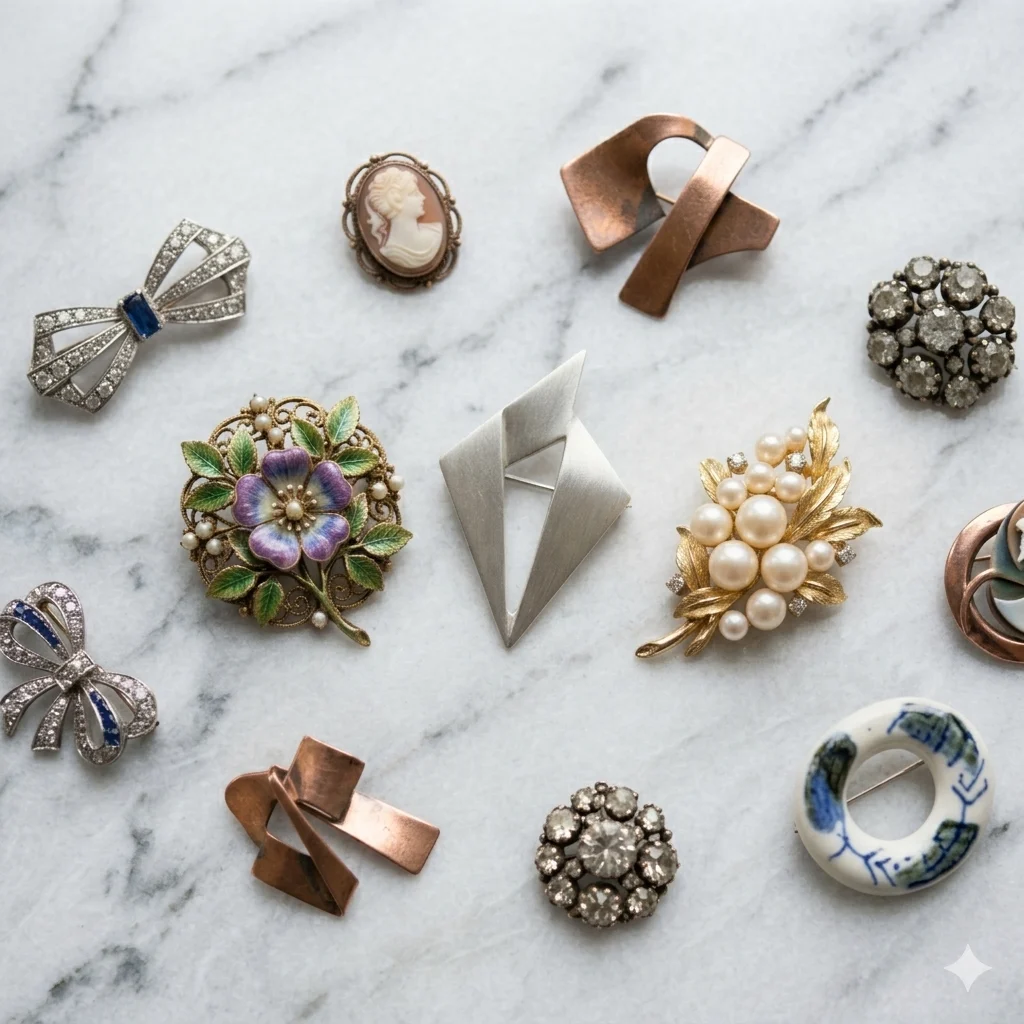
“Brooch” is a noun that refers to a decorative jewelry item designed to be attached to clothing, typically fastened by a pin and clasp.
Examples of “Brooch” in a sentence:
- She wore a beautiful antique brooch on her coat lapel.
- The diamond brooch was the family heirloom passed down for generations.
- He bought a silver brooch for his mother as a birthday gift.
“Broche” is generally considered a misspelling of “brooch” in modern English. However, it is important to note that “broché” (with an accent) is a French word used in the fashion and textile industry to describe a specific type of woven fabric with a raised pattern, similar to brocade.
Example of “Broché” in a sentence:
- The evening gown was made of luxurious silk broché.
For 99% of English speakers looking for the jewelry item, the word you want is brooch.
The Origin of the Word “Brooch”
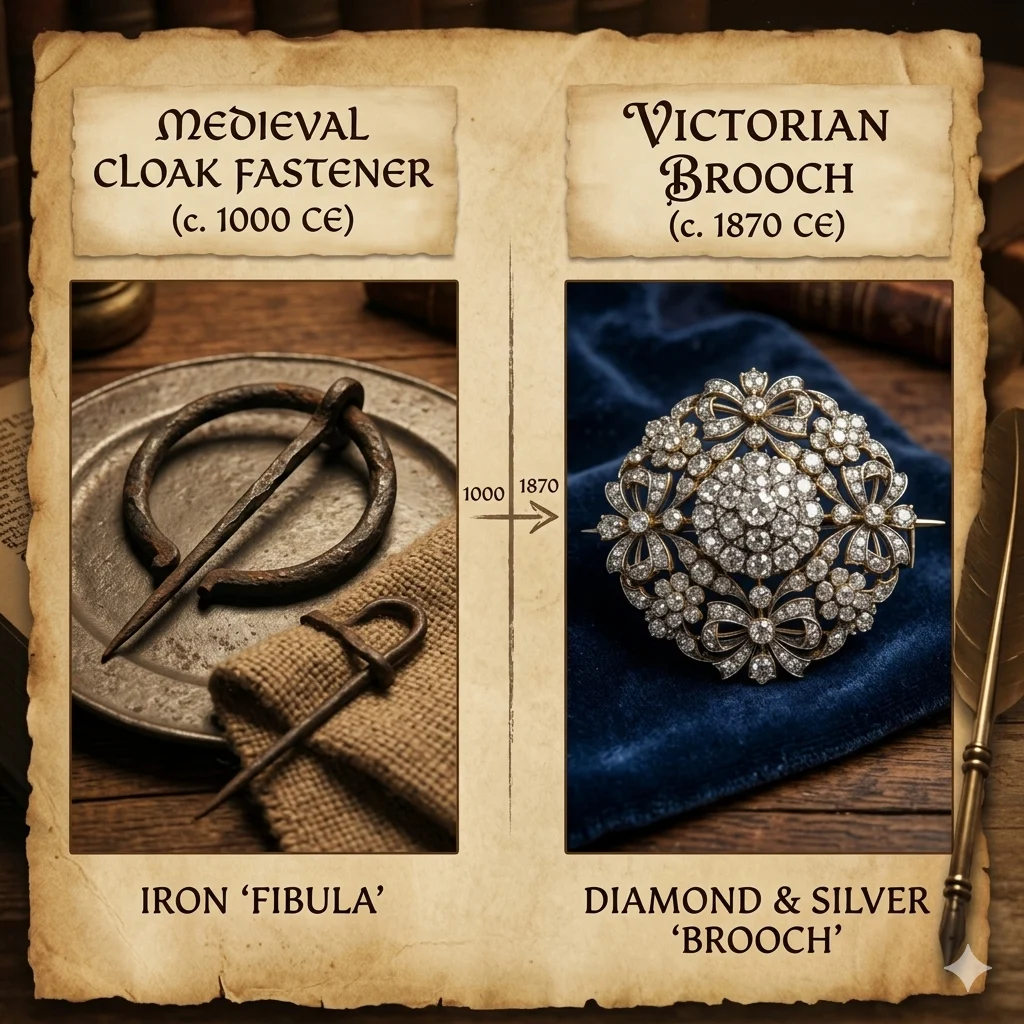
To understand why the spelling is so confusing, we have to look at the history of the word. The word “brooch” and the word “broach” (which means to pierce or to introduce a topic) actually share the same root. Both come from the Old French word broche, which meant a “long needle” or a pointed tool. In medieval times, jewelry items were often long, pin-like objects used to pierce and fasten clothing.
Over centuries, as jewelry design evolved from simple functional pins into more decorative and ornamental pieces, the language evolved with it. In English, the spelling split to reflect the different meanings:
- Broach retained the original meaning related to piercing or opening up (e.g., “to broach a subject” or “to broach a cask”).
- Brooch took on the specific meaning of the ornamental jewelry item.
The spelling “broche” is essentially a fossil from this Old French origin. When people spell it “broche” today, they are unknowingly reverting to the medieval French root. The pronunciation often stayed similar for all three words in some dialects, which is the primary reason for the ongoing confusion between broche or brooch.
British English vs American English Spelling
This is where it gets interesting. While both the UK and the US agree that the jewelry is a “brooch,” the pronunciation differs significantly, which often leads to spelling errors.
In American English, the word “brooch” is most commonly pronounced as “brōch” (rhyming with “poach” or “roach”). Because it sounds like it has an “e” at the end, Americans are more likely to mistakenly spell it “broche.”
In British English, the traditional and most common pronunciation is “brōch” as well, but a very common alternative pronunciation rhymes with “smooch” or “pooch.” Despite this different pronunciation, the standard spelling remains brooch.

Here is a simple table to break down the differences:
| Feature | Brooch (Correct) | Broche (Common Misspelling) |
|---|---|---|
| Part of Speech | Noun | Usually an incorrect spelling; sometimes the French root word. |
| Definition | A decorative jewelry item with a pin. | A misspelling of the jewelry; or a type of fabric (broché). |
| American English | Standard spelling. Pronounced to rhyme with “poach.” | Common phonetic misspelling based on US pronunciation. |
| British English | Standard spelling. Can be pronounced to rhyme with “poach” or “smooch.” | Common misspelling due to historical French influence. |
| Example | “She pinned the brooch on her dress.” | “He bought her a silver broche.” (Incorrect) |
Inate or Innate? ThevTiny Secret You’re Always Getting Wrong 💡
Which Spelling Should You Use?
Choosing the correct spelling depends entirely on your audience and the context.
- If you are in the United States: Always use brooch. While many Americans pronounce it with a long ‘o’ sound, the standard written form is universally “brooch” in dictionaries, jewelry stores, and fashion magazines.
- If you are in the United Kingdom, Australia, New Zealand, or Canada: Always use brooch. The Commonwealth countries stick firmly to the traditional spelling. Using “broche” would be immediately flagged as an error.
- If you are writing for a global audience: Stick with brooch. It is the internationally recognized standard in the English language for the jewelry item.
- If you are in Pakistan or India: The correct spelling in educational and professional contexts (like when checking a brooch price in pakistan online or looking for a brooch for men) is brooch. While “broche” might appear in local searches due to common misspellings, reputable jewelers and product listings will use the correct spelling.
- If you are referring to fabric: Only use broché (with the accent) if you are specifically talking about textiles. For example, a fashion designer might describe a jacket as “silk broché.”
Common Mistakes with “Brooch” and “Broche”
Even native speakers frequently make mistakes with this word. Here are the most common errors and how to correct them:
- The Phonetic Trap: This is the biggest culprit. Because of the American pronunciation rhyming with “poach,” people write what they hear: broche.
- Incorrect: “Her antique broche was worth a fortune.”
- Correct: “Her antique brooch was worth a fortune.”
- Confusing it with “Broach”: As mentioned in the origin section, these words are cousins, but they have different jobs.
- Incorrect: “She decided to brooch the subject of marriage.” (You cannot “brooch” a subject).
- Correct: “She decided to broach the subject of marriage.” (Here, “broach” means to bring up a topic).
- Pronunciation leading to Doubt: Many people know the spelling “brooch” but hear others say “broche,” leading them to doubt their own memory.
- Advice: Remember the spelling by linking it to “brooch” and “smooch” (the UK rhyme). Visualize someone giving a kiss (smooch) to the person wearing the beautiful jewelry (brooch).
Brooch in Everyday Examples
Seeing how the word is used in different contexts can solidify your understanding.
- In a Formal Email:
- “Dear Mrs. Kapoor, I am writing to confirm that the valuation of your diamond brooch has been completed. It is indeed an exceptional piece.”
- In Social Media (Instagram Caption):
- “Adding a vintage touch to my blazer with this gorgeous floral brooch from the local market. #OOTD #VintageStyle #BroochLover”
- In a News Headline:
- “Royal Heist: Duchess’s £2 Million Sapphire Brooch Stolen from London Mansion.”
- In an E-commerce Product Description (Pakistan):
- “Explore our latest collection of brooch for ladies, featuring intricate enamel work and cubic zirconia stones. Check the brooch price in pakistan and order your favorite design today.”
- In a Fashion Blog:
- “Brooches for men are making a major comeback. Forget the old-fashioned image; a modern metal brooch on a suit lapel is a powerful style statement.”

Brooch – Google Trends & Usage Data
An analysis of search data reveals a clear picture of the broche or brooch debate.
- Global Volume: The search term “brooch” has significantly higher global search volume than “broche.” This indicates that the correct spelling is the one people are actively trying to find.
- The “Broche” Phenomenon: Searches for “broche” are often highest in regions where the word is pronounced with a long ‘o’ sound, suggesting users are typing what they hear. It is a “phonetic search.”
- Contextual Searches: When people search for specific products, they often use the correct spelling. For example, look at these related search terms:
- “brooch for ladies” : This is a high-volume, commercially driven search using the correct spelling.
- “brooch for men” : A growing trend showing the resurgence of men’s jewelry.
- “brooch pakistan” : A geographic search showing demand in the South Asian market, using the correct spelling to find local sellers.
- “brooch pronunciation british” : This is a popular “how-to” search, proving that people know the spelling but are unsure of the different ways to say it.
- The “Perfume” Anomaly: Searches for “broche or brooch perfume” are interesting. This usually refers to a specific type of jewelry called a “perfume locket” or “perfume brooch,” which is a hollow piece designed to hold a scented pad. In this niche category, both terms are used, but “perfume brooch” is the more standard and recognizable term.
(FAQs)
Here are answers to the most common questions people have about this topic.
1. Is it brooch or broche?
The correct spelling is brooch. “Broche” is a common misspelling. In very specific contexts, “broché” refers to a type of fabric.
2. What is a broche?
In English, “broche” is almost always a misspelling of the word “brooch.” Historically, it is the Old French root word for a pointed tool or needle.
3. How do you spell brooch in the UK?
In the UK, it is spelled brooch. It is often pronounced to rhyme with “smooch,” but the spelling remains the same.
4. What is a broché?
“Broché” (pronounced bro-shay) is a French term used in textiles. It describes a fabric, usually silk, that has an extra weft thread to create a raised, patterned effect, similar to brocade.
5. How do you pronounce “brooch”?
There are two common pronunciations:
- American English: rhymes with “poach” ( /broʊtʃ/ ).
- British English: can rhyme with “poach” or with “smooch” ( /bruːtʃ/ ). Both are correct in the UK.
6. Can men wear brooches?
Absolutely. Brooches for men are a timeless accessory. From simple kilt pins to ornate lapel pins and modern minimalist designs, brooches are a stylish way for men to add personality to their attire.
7. What is the price of a brooch in Pakistan?
The brooch price in pakistan varies widely based on material and craftsmanship. You can find simple fashion brooches for as low as PKR 300-500, while silver or gold-plated pieces with artificial stones can range from PKR 1,500 to PKR 10,000. Antique or genuine gold brooches will cost significantly more.
8. Is “broche” ever the correct spelling for jewelry?
No, in modern English dictionaries, “broche” is not listed as an alternative spelling for the jewelry item. Always use “brooch.”
9. Why do people spell it “broche”?
People spell it “broche” primarily because of pronunciation. In American English, it sounds like it should end with an ‘e’. Others may be influenced by the French origin of the word.
10. What is a “brooch for ladies” typically made of?
Brooches for ladies can be made from a wide range of materials including gold, silver, platinum, copper, brass, enamel, and adorned with precious or semi-precious stones, crystals, pearls, or even fabric and feathers.
Conclusion
Navigating the world of broche or brooch doesn’t have to be difficult. The key takeaway is simple and clear: when you are talking about the beautiful pin you wear on your clothes, the correct spelling is always brooch. The word “broche” is a ghost of the past—a remnant of the word’s Old French origin that lives on as a common typo.
Whether you are shopping for a brooch for ladies online, checking the brooch price in pakistan, or looking for a stylish brooch for men, using the correct spelling ensures clarity and shows attention to detail. Remember the context: jewelry equals “brooch.” Textiles might be “broché.” And if you are bringing up a topic, you “broach” it. By keeping these simple rules in mind, you can confidently use the word in emails, social media, or conversation, knowing you have mastered one of English’s most persistent spelling puzzles.

Noah Syntax is a linguistics lover who finds beauty in structure and rhythm. His writing combines precision with playfulness, decoding the secrets of language for everyday readers. At Simile Mind, Noah brings clarity, humor, and insight to every metaphor he explores.