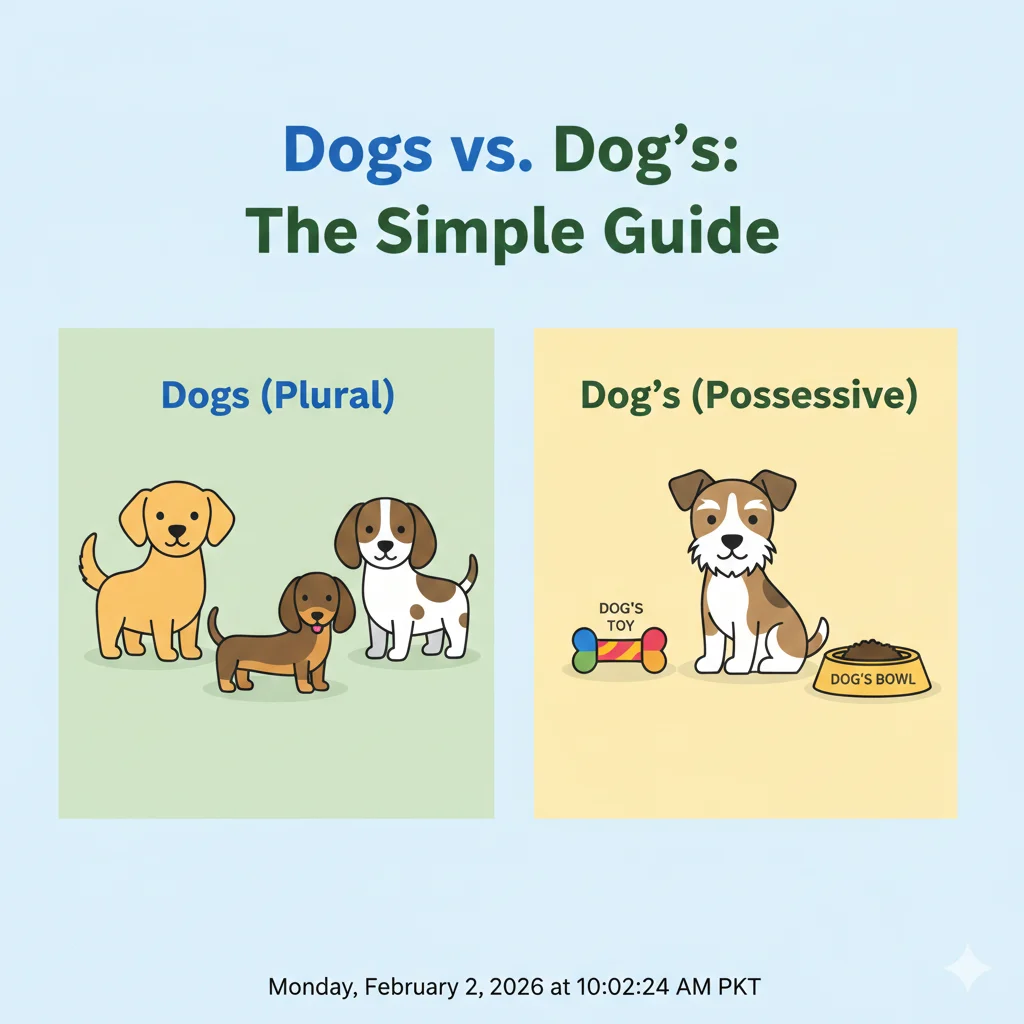
Dogs is the plural form of “dog,” while dog’s shows possession (something that belongs to one dog).
The confusion between dogs and dog’s is one of the most common grammar mistakes in English, mainly because of the incorrect use of the apostrophe (’). Many learners wrongly believe that an apostrophe is used to make a word plural, but this is not true.
In fact, dogs simply means more than one dog, whereas dog’s is used to show ownership, such as the dog’s tail. Adding to the confusion, learners also struggle with dogs’ (plural possessive), which refers to something belonging to more than one dog.
Using the wrong form can change the meaning of a sentence, lower marks in exams, and make writing look unprofessional in academic, professional, or online content.
In this article, you will clearly learn the difference between dogs, dog’s, and dogs’, when to use each correctly, and how to avoid apostrophe mistakes, so you can write accurate, confident, and grammatically correct English every time.
Dogs or Dog’s –
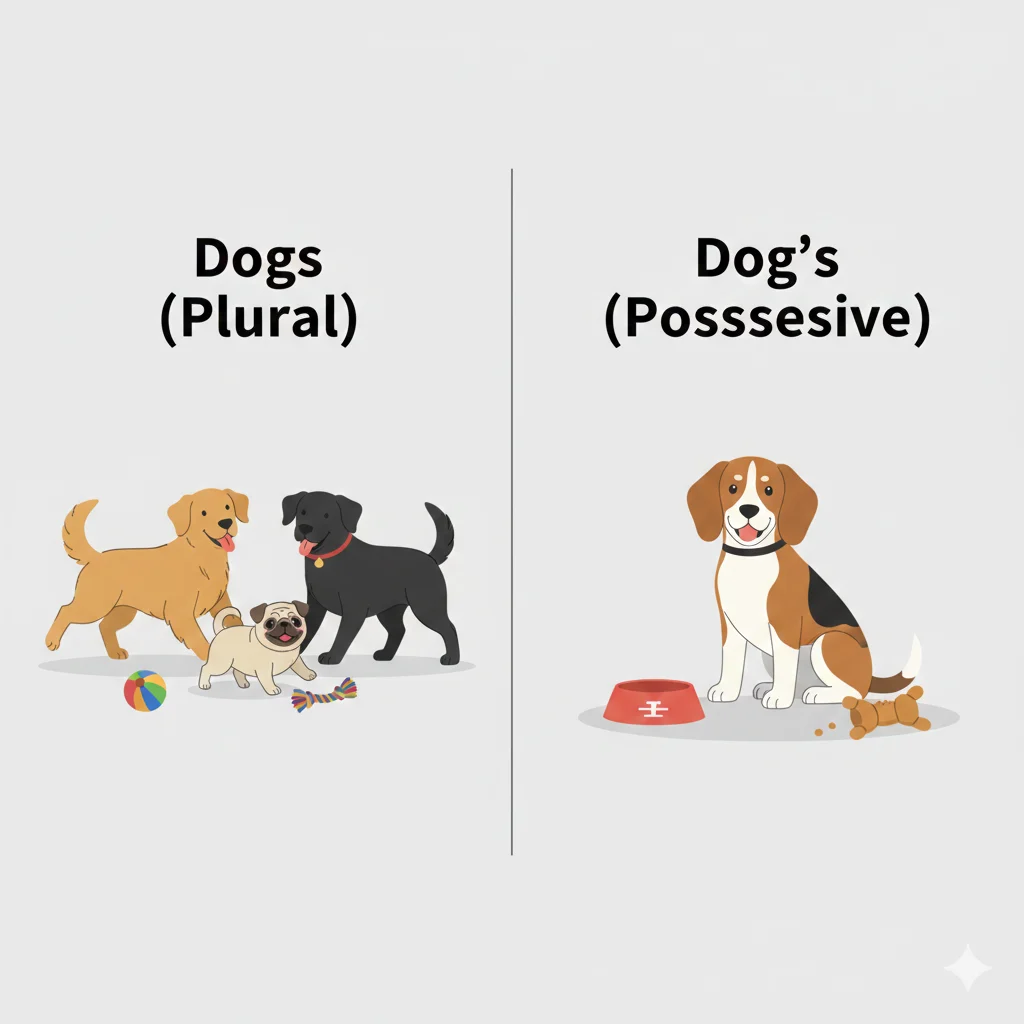
The quick answer is that “dogs” is the plural form (more than one dog). “Dog’s” is the possessive singular form (something belonging to one dog) or a contraction for “dog is.” Here are simple examples:
- Dogs (Plural): “The dogs are playing in the park.” (Multiple dogs).
- Dog’s (Possessive): “The dog’s leash is tangled.” (The leash belongs to the dog).
- Dog’s (Contraction): “The dog’s very happy.” (The dog is very happy).
For possessive plural (when something belongs to multiple dogs), you write “dogs’” with the apostrophe after the ‘s’: “The dogs’ bowls are empty.”
The Origin of “Dog”
The word “dog” itself has a somewhat mysterious origin. Unlike many English words with clear Latin or Germanic roots, “dog” (Old English docga) appeared in the late Old English period, referring to a powerful breed of canine. It gradually replaced the older, more common word “hound” (from Old English hund) as the generic term for our four-legged friends. Why the spelling differences like “dogs” and “dog’s” exist is a matter of English grammatical evolution. The “-s” plural has Germanic origins, becoming standard for most nouns. The apostrophe-s for possession developed later, around the 17th and 18th centuries, likely as a shortened form of the Old English possessive ending “-es.” This historical development naturally led to the homophonic but grammatically distinct forms we use today. So, when we talk about dog breeds from A-Z, we’re using the plural “dogs,” a convention solidified centuries ago.
British English vs. American English Spelling
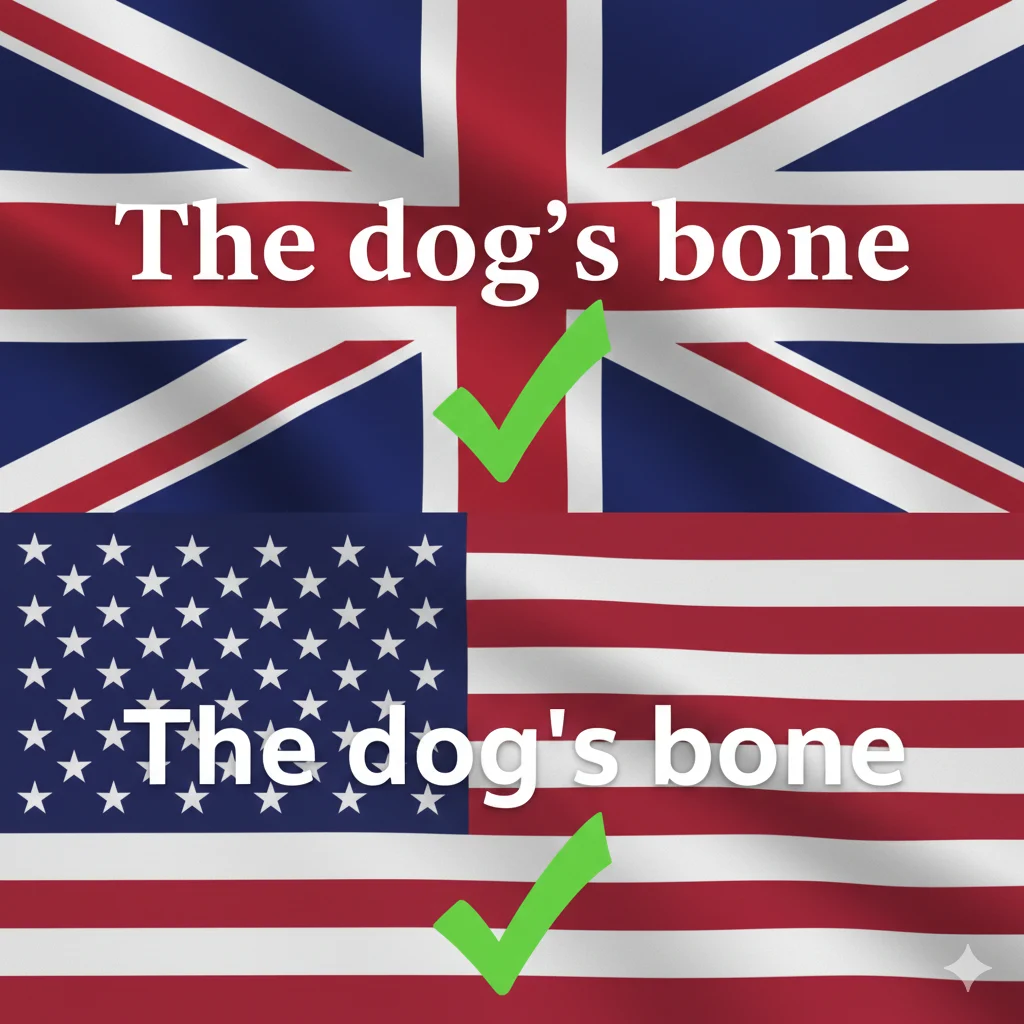
Fortunately, for the keyword dogs / dog’s, there is no difference between British and American English spelling rules. The plural is always “dogs,” and the possessive singular is always “dog’s” on both sides of the Atlantic. The confusion is purely grammatical, not regional.
However, related terms in the wider category of dog breeds can have minor variations. For instance, the possessive form of breed names ending in ‘s’ might be treated slightly differently in formal writing, but the core rule remains consistent. The following table clarifies the universal application:
| Form | Function | Example (US & UK) |
|---|---|---|
| Dog | Singular | I have one dog. |
| Dogs | Plural | I have two dogs. I love all dog breeds. |
| Dog’s | Possessive Singular / Contraction | The dog’s collar is blue. / The dog’s (dog is) barking. |
| Dogs’ | Possessive Plural | The dogs’ playground is large. |
Which Spelling Should You Use?
Your choice depends entirely on your intended meaning, not your location.
- For a US, UK, or Global Audience: The rules are the same. Use “dogs” when referring to more than one. Use “dog’s” when indicating ownership by one dog or shortening “dog is.” For example, an article about all 340 dog breeds with pictures would use the plural “dogs” throughout.
- In Academic or Formal Writing: Avoid the contraction form (“dog’s” for “dog is”) for a more professional tone. Clearly distinguish between plural and possessive. If listing 7 types of dog (or 7 types of dogs, both are acceptable), ensure consistent plural usage.
- In Informal Writing (Social Media, Texts): Both the contraction and possessive are fine, but clarity is still key. “My dog’s cute” is understood, but “My dogs cute” (missing the apostrophe) is incorrect.
Common Mistakes with Dogs or Dog’s
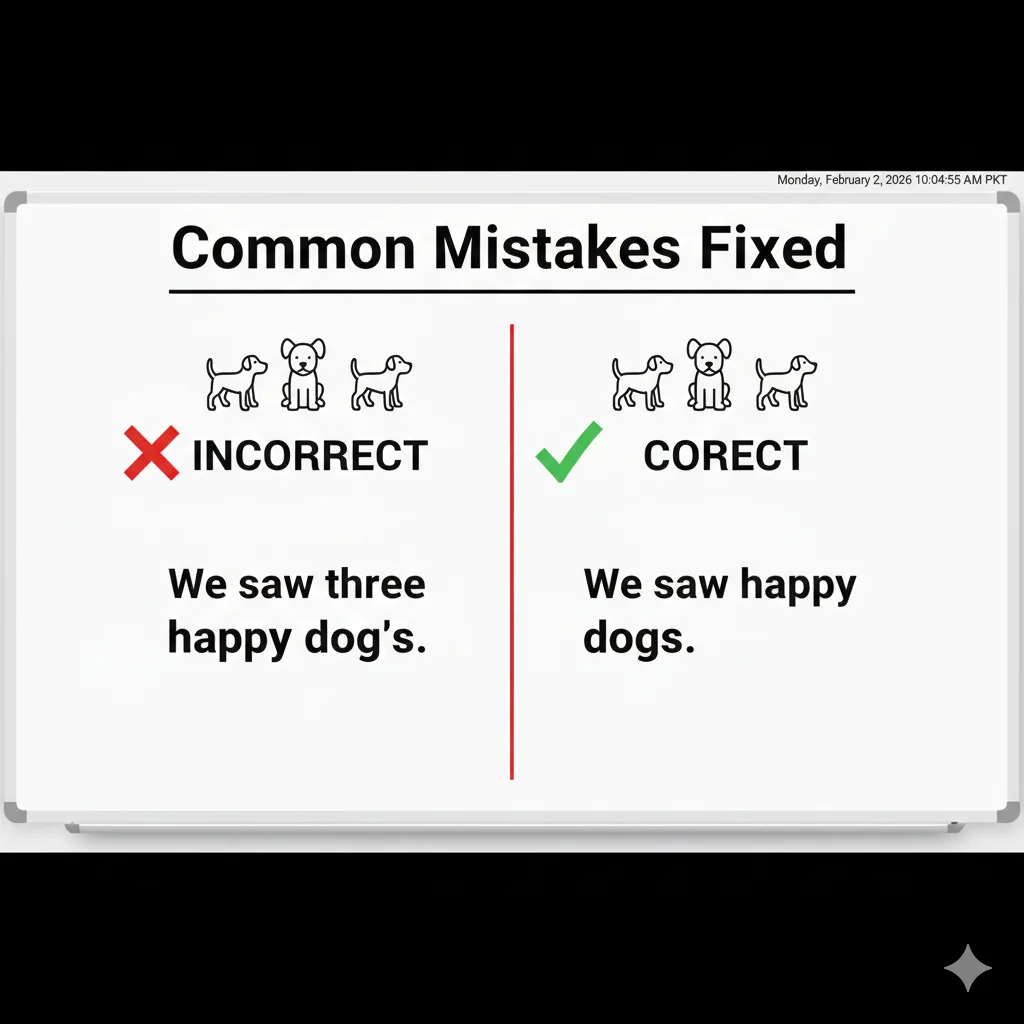
- Using “dog’s” as a plural: ❌ Incorrect: “I have two dog’s.” ✅ Correct: “I have two dogs.”
- Using “dogs” for possessive singular: ❌ Incorrect: “The dogs bowl is full.” (This implies multiple dogs own one bowl). ✅ Correct: “The dog’s bowl is full.” (One dog’s bowl).
- Misplacing the apostrophe in possessive plural: ❌ Incorrect: “The dog’s toys are everywhere.” (If referring to multiple dogs). ✅ Correct: “The dogs’ toys are everywhere.”
- Confusing “its” (possessive) with “it’s” (it is): While not our main keyword, this is a related common error. “The dog wagged its tail.” vs. “It’s a happy dog.”
Dogs or Dog’s in Everyday Examples
- Email (Professional): “Please ensure the dog’s vaccination records are emailed before the appointment.” (Possessive).
- News Headline: “Local Dogs Rescue Hiker Lost in Woods.” (Plural).
- Social Media Post: “This is Bruno. Dog’s living his best life! #DogBreeds #HappyDog” (Contraction).
- Formal Writing/Report: “The study observed the dogs’ behavioral changes over six months.” (Possessive Plural).
- Website Content (like a breeds list): “Explore our complete Dog breeds A-Z list with detailed profiles.” (Plural as an adjective).
Dogs or Dog’s – Google Trends & Usage Data
Analysis of search data consistently shows that the plural term “dogs” receives exponentially higher global search volume than the grammatical query “dog’s.” This reflects the broader public interest in topics like dog breeds, care, and pictures, rather than the specific punctuation rule. Searches for “dogs” peak consistently in English-speaking countries like the US, UK, Canada, and Australia. The specific phrase “dog’s” or “dogs vs dog’s” sees predictable spikes during academic semesters, coinciding with students seeking grammar help. Interestingly, visual searches for dog breeds A-Z with pictures or all 340 dog breeds with pictures have seen a steady increase, aligning with Google’s algorithm preferences for high-quality, user-friendly visual content. This tells us that while mastering “dogs / dog’s” is essential for accurate writing, the world’s primary interest lies in the wonderful animals themselves.

FAQs:
1. When to use dogs vs. dog’s?
Use “dogs” when talking about more than one dog. Use “dog’s” when showing something belongs to one dog (the dog’s toy) or when contracting “dog is” (the dog’s friendly).
2. What is the plural of dog?
The standard plural of dog is dogs. Words like “dogges” are archaic and not used in modern English.
3. Why are dogs called dogs?
The exact origin is unknown, but it comes from the Old English word docga, a powerful canine breed, which eventually replaced “hound” as the common term.
4. What is the top 10 rarest dog breed?
While lists vary, some of the rarest breeds often include the Telomian, Norwegian Lundehund, Mudi, Lagotto Romagnolo, Azawakh, Otterhound, Thai Ridgeback, Chinook, Peruvian Inca Orchid, and the Catalburun. Availability changes, so check with major kennel clubs.
5. Is it ‘7 types of dog’ or ‘7 types of dogs’?
Both are grammatically correct and used naturally. “7 types of dog” focuses on the category, while “7 types of dogs” slightly emphasizes the individual animals. You can use either.
6. How is ‘cat’ different in its plural and possessive forms?
It follows the exact same rule: cats (plural), cat’s (possessive singular/contraction), cats’ (possessive plural). The grammar for dogs / dog’s applies to most regular nouns.
7. Where can I find a reliable dog breeds A-Z with pictures?
Reputable sources include the websites of major kennel clubs like the American Kennel Club (AKC), The Kennel Club (UK), and the Fédération Cynologique Internationale (FCI). These sites provide authoritative breed standards, pictures, and information, aligning with principles.
Conclusion
Mastering the distinction between dogs and dog’s is a small but significant step toward precise and effective communication. As we’ve seen, the rule is straightforward: “dogs” for plural, “dog’s” for possession or contraction. This rule holds true universally, whether you’re writing for an American, British, or global audience. The common mistakes are easy to avoid once you pause to consider whether you’re indicating more than one or belonging to one.
Remember, in the age of sophisticated Google algorithms that prioritize clear, high-quality content, such attention to detail naturally enhances the credibility and professionalism of your writing, whether it’s a blog post about 100 types of dogs or a formal document. The next time you type the word, you can do so with absolute confidence, knowing your meaning will be perfectly clear. After all, in writing about dogs, our goal is to let the love for these amazing animals shine through, without grammatical errors clouding the message.

Ava Quillstone is a passionate wordsmith who turns everyday language into art. With a deep love for creative writing and poetic expression, Ava explores the magic of metaphors, similes, and the hidden emotions behind words. When she’s not writing for SimileMind, she’s sipping tea by a window and dreaming up new literary worlds.