Let me tell you something embarrassing. Years ago, I applied for a dream job at a British company. My resume was perfect. My cover letter was impressive. But in the closing line, I wrote: “I hope to become one of your favorite candidates.” The interview never happened. A friend later told me, “In the UK, it’s favourite with a ‘u’.” That single letter cost me an opportunity. Since that day, I have studied this simple but critical difference carefully. And now, I am going to teach you everything so you never make the same mistake.
“‘Favourites’ is British English, and ‘favorites’ is American English; use the correct version depending on your audience and writing style.”
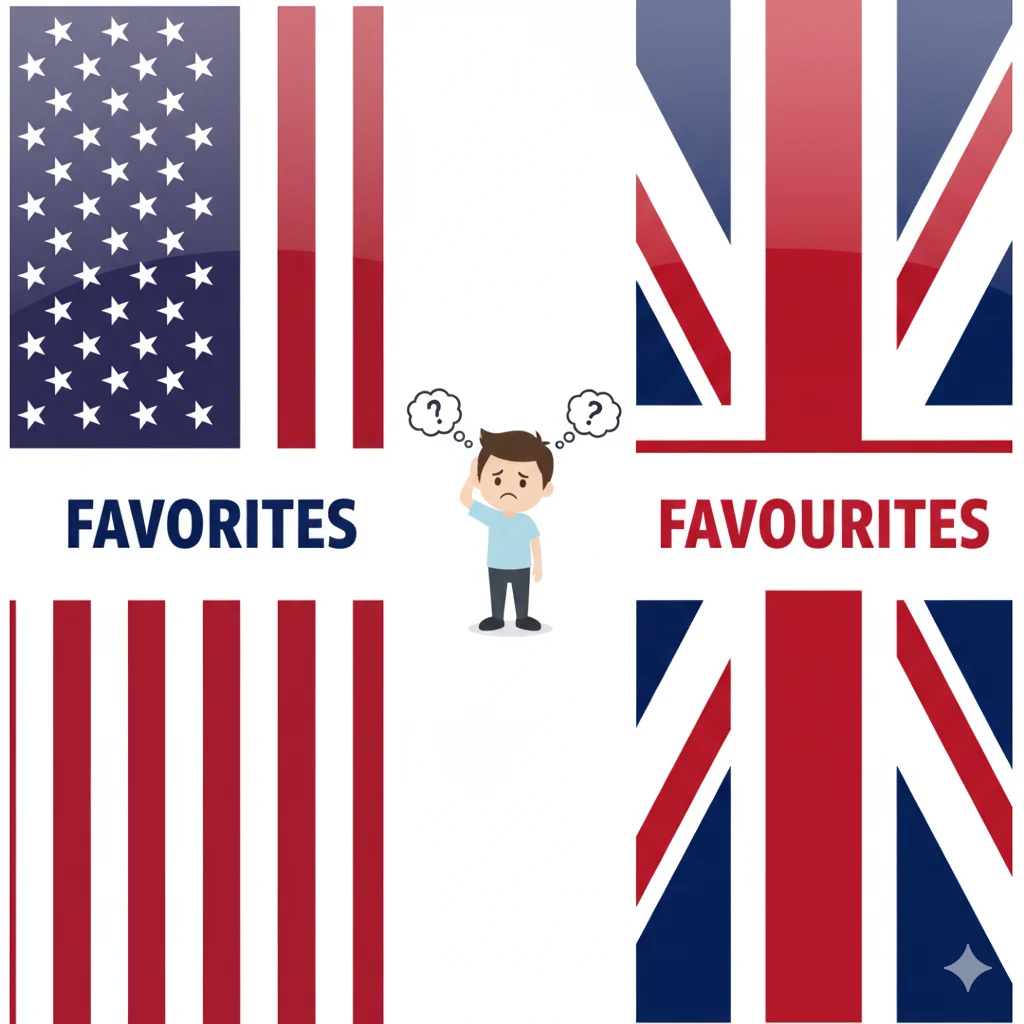
Are you spelling it wrong without realizing it? Many people get confused between favourites and favorites, but the difference is simple: it’s all about regional spelling, not meaning.
- British English: favourites
“Chocolate and tea are my favourite treats.” - American English: favorites
“Pizza and movies are my favorites.”
💡 Tip: Always stay consistent within a single piece of writing — switching between the two can look sloppy.
Common areas where mistakes happen:
- Academic essays
- Blog posts and articles
- Social media captions
- Emails and professional writing
Reminder:
- Singular: favourite → favorite
- Plural: favourites → favorites
This article will show you:
- Why British and American English spellings differ
- When to use each version correctly
- Practical examples for everyday writing
- Style guide tips to avoid confusion
By the end, you’ll confidently choose between favourites and favorites for any context — whether it’s formal writing, casual posts, or social media captions — making your writing professional, clear, and audience-appropriate.
Favourites or Favorites meanings
Here is the simple truth: Both spellings are 100% correct. The difference is only about where your reader lives.
| If your reader is from… | You should write… |
|---|---|
| United States | favorites |
| United Kingdom | favourites |
| Australia | favourites |
| New Zealand | favourites |
| Canada | favourites (usually) |
| Anywhere else | Pick one and stay consistent |
Simple examples:
- American: “I saved my favorite songs to my playlist.”
- British: “I saved my favourite songs to my playlist.”
Same meaning. Same word. Just one tiny letter “u” making all the difference.
The Origin of Favourites or Favorites
Words have fascinating life stories. The word “favorite” traveled across countries and centuries before landing in our keyboards today.
The French Connection
The word came from Old French favorit, which meant “one who is favored.” The French got it from Italian favorito. When English speakers adopted this word hundreds of years ago, they kept the French spelling style. That is why it originally had a “u” – favourite. English loved borrowing French words and keeping their fancy spelling.
The Man Who Changed Everything
Then came Noah Webster. In the late 1700s and early 1800s, America was a new country wanting its own identity. Webster thought, “Why should Americans spell like the British we just fought a war against?”
So he created the first American dictionaries. His mission was simple: make spelling simpler and more logical. Words with extra letters? Remove them. Words that looked French? Make them look American.
- Colour became color
- Honour became honor
- Flavour became flavor
- And favourite became favorite
Webster’s dictionaries became the standard in American schools. Within decades, Americans were spelling “favorite” without the “u” without even thinking about it. Meanwhile, Britain kept the original spelling. And that is how one man created a spelling difference that still confuses millions of people today.

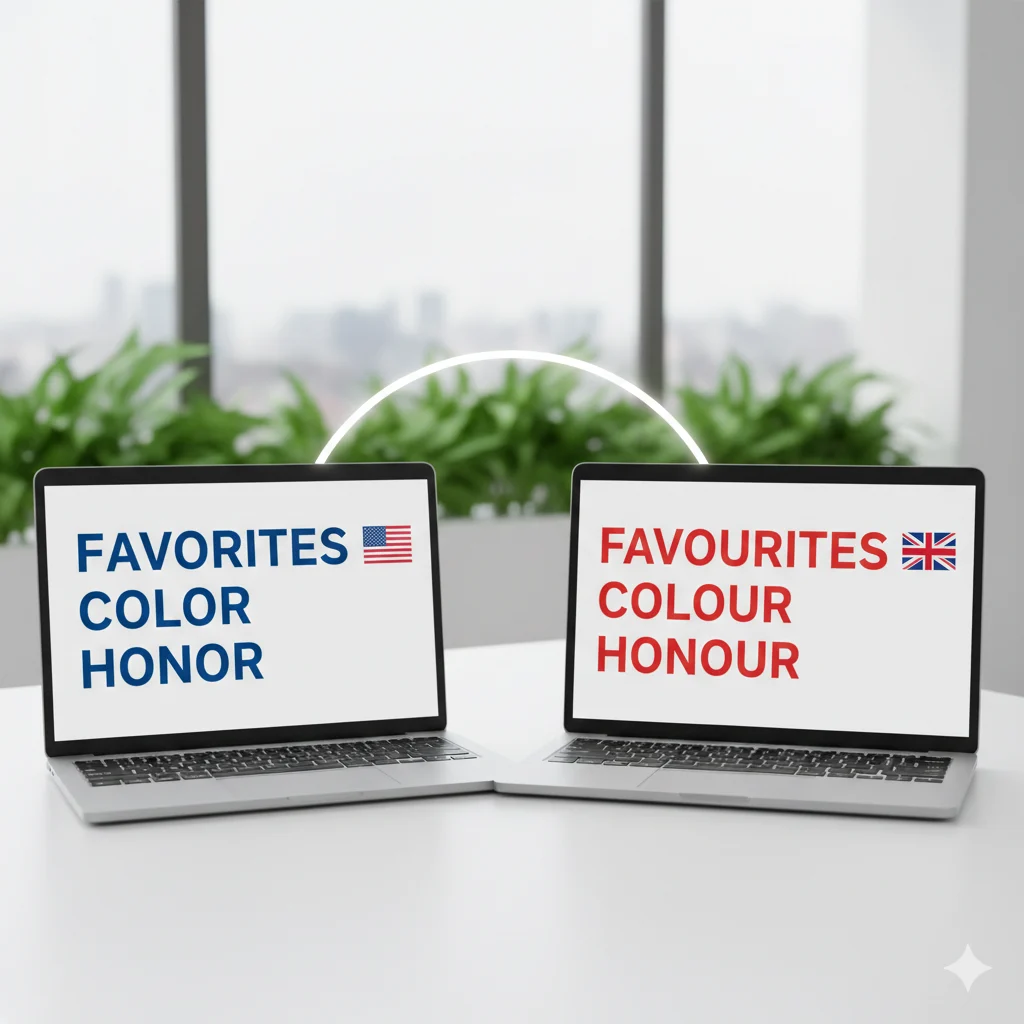
British English vs American English Spelling
This is not just about one word. It is a whole pattern. Once you understand this pattern, you will never be confused again.
The “Our” vs “Or” Rule
In British English, many words end in -our. In American English, they end in -or.
| British Spelling | American Spelling | Example (British) | Example (American) |
|---|---|---|---|
| Favourites | Favorites | My favourites are tea and biscuits. | My favorites are coffee and donuts. |
| Colour | Color | The colour red is lovely. | The color red is lovely. |
| Behaviour | Behavior | His behaviour was kind. | His behavior was kind. |
| Neighbour | Neighbor | My neighbour is friendly. | My neighbor is friendly. |
| Labour | Labor | Labour Day is a holiday. | Labor Day is a holiday. |
Memory Trick
Think of it this way:
- British English keeps the “u” because the UK has “U” in its spelling tradition.
- American English drops the “u” because America wanted to be “U-nique” and different.
Which Spelling Should You Use? A Complete Guide
This is the million-dollar question. Here is exactly how to decide every single time.
1. Writing for Americans 🇺🇸
Use favorites (no “u”).
- Emails to American clients
- Applications to US companies
- Content for American websites
- School work for US teachers
- Social media targeting US audience
Example: “Check out my new blog post about my summer reading favorites!”
2. Writing for British Readers 🇬🇧
Use favourites (with “u”).
- Emails to UK companies
- Applications to British universities
- Content for UK websites like BBC or The Guardian
- Writing for Australian or New Zealand audiences
- Canadian formal documents
Example: “One of my all-time favourite books is Harry Potter.”
3. Writing for Canadians 🇨🇦
Canada is interesting. They officially use British spelling. So “favourites” is the standard in government documents, schools, and formal writing. However, because Canada is so close to the US, many Canadians see American spelling daily and accept it. When in doubt, use favourites for Canadian audiences.
4. Writing for Global Audience 🌏
Here is the rule: Choose one and be consistent.
Do not write:
❌ “My favorite foods are pizza and pasta. My favourite restaurant is Italian.”
Do write:
✅ “My favorite foods are pizza and pasta. My favorite restaurant is Italian.” (American style)
✅ “My favourite foods are pizza and pasta. My favourite restaurant is Italian.” (British style)
Most international companies choose British English as their default because it is used in more countries. But American English is also perfectly fine. Just pick your team and stick with it.
Common Mistakes with Favourites or Favorites
Even native English speakers make these mistakes. Learn them now and avoid looking unprofessional.
Mistake 1: Mixing Spellings in One Document
This is the most common error. You write “favorite” in paragraph one and “favourite” in paragraph three. It looks careless.
Fix: Use your word processor’s “Find” function. Search for both spellings. If you find both, pick one and replace all the others.
Mistake 2: Apostrophe Confusion
People get very confused about where to put the apostrophe.
| You want to say… | Correct spelling | Example |
|---|---|---|
| One thing you like | favorite (singular) | Pizza is my favorite. |
| Multiple things you like | favorites (plural) | These are my favorites. |
| Something belonging to one favorite | favorite’s | My favorite’s color is red. |
| Something belonging to multiple favorites | favorites’ | My favorites’ prices increased. |
Test yourself:
- My dog is one of my ______. (favorites ✅)
- That ______ owner is my neighbor. (favorite’s ✅)
- All my ______ covers are torn. (favorites’ ✅)
Mistake 3: Forgetting Proper Nouns
If a company, product, or brand uses a specific spelling, you must respect that.
- The British brand “Favourite Things” is not “Favorite Things”
- The American browser bookmark folder is often called “Favorites”
- If someone’s Instagram handle is @my_favourites, do not tag them as @my_favorites
Mistake 4: Thinking One Is “Wrong”
Some Americans think “favourites” looks fancy or old. Some British people think “favorites” looks lazy or incorrect. Neither is wrong. They are just different. Respect the difference.
Favourites or Favorites in Everyday Examples
Seeing words in real contexts makes the rule stick. Here are examples from different situations.
In Professional Emails
To an American boss:
“Hi Sarah, I have attached the list of client favorites for this quarter. Please let me know if any of your personal favorites are missing from the document.”
To a British client:
“Dear Mr. Thompson, thank you for your enquiry. One of our most popular favourites is the classic English breakfast tea. We are confident it will become one of your favourites too.”
On Social Media
American influencer:
“Just posted my new video about drugstore makeup favorites! Link in bio. The lipstick is definitely one of my top favorites right now. #makeupfavorites #beauty”
British influencer:
“Spent the afternoon at my favourite café in London. Their scones are absolute favourites of mine. Highly recommend! #londonlife #favourites”
In News Headlines
American news:
“President’s Supreme Court favorites narrowed to three candidates, sources say.”
British news:
“The Queen’s racing favourites include several horses from the Royal Stables.”
In Formal Writing
Academic paper (American):
“Participants listed their five favorite classical compositions. Analysis of these favorites revealed a strong preference for Mozart.”
Academic paper (British):
“The study examined children’s favourite books. Among the favourites were works by Roald Dahl and JK Rowling.”
In Text Messages
American:
“omg this new coffee shop is my new favorite. Want to go Saturday?”
British:
“Just discovered my new favourite coffee shop. You’d love it. Saturday?”
Favourites or Favorites Quiz
Test yourself. Choose the correct spelling for each situation.
Question 1: You are writing a job application to a company in Sydney, Australia.
- a) My favorite skills include…
- b) My favourite skills include… ✅
Question 2: You are posting on your blog. Your readers are mostly from the United States.
- a) Here are my top ten favorites from 2025. ✅
- b) Here are my top ten favourites from 2025.
Question 3: Which sentence is correct for international readers?
- a) My favorite foods are Italian. My favourite desserts are chocolate.
- b) My favorite foods are Italian. My favorite desserts are chocolate. ✅
- c) My favourite foods are Italian. My favourite desserts are chocolate. ✅
(Both b and c are correct as long as they are consistent.)
Question 4: What is the plural possessive of “favourite”?
- a) favourites
- b) favourite’s
- c) favourites’ ✅
Question 5: You see a British brand called “Favourite Cakes.” How do you write about them?
- a) I love Favorite Cakes products.
- b) I love Favourite Cakes products. ✅
- c) I love favourite cakes products.
Favourites or Favorites – Google Trends & Usage Data
Numbers tell interesting stories. Let us look at what the data shows about these two spellings.
Global Search Volume
Worldwide, “favorites” (American spelling) gets more Google searches than “favourites.” Why? Because the United States has a massive population and dominates English-language internet content. When people search for help, they often type the American spelling without thinking.
Country-by-Country Breakdown
- United States: “favorites” wins by 99% (as expected)
- United Kingdom: “favourites” wins by 95%
- Australia: “favourites” wins by 90%
- New Zealand: “favourites” wins by 92%
- Canada: Mixed, but “favourites” has a slight edge (about 60-40)
- India: Mixed, leaning toward British English in formal contexts
- Philippines: American spelling is more common
What This Means for You
If your website or content targets a specific country, use that country’s spelling. If you target multiple countries, consider creating separate versions for US and UK audiences. Many large websites do exactly this.
(FAQs)
1. Is it correct to say “favourites”?
Yes, absolutely. “Favourites” is the correct spelling in British English, Australian English, New Zealand English, and most Commonwealth countries. It is not wrong; it is just different.
2. What is the difference between favorites and favourites?
There is zero difference in meaning. The only difference is spelling. “Favorites” is American English. “Favourites” is British English. They mean the exact same thing: things that are preferred above others.
3. When should I use favourites?
Use “favourites” when your audience uses British English. This includes readers in the United Kingdom, Australia, New Zealand, and often Canada. Also use it when writing for international organizations that prefer British style.
4. What is the plural of favorite?
The plural of “favorite” (American) is “favorites.” The plural of “favourite” (British) is “favourites.”
- One favorite → Two favorites
- One favourite → Two favourites
5. What does “favourites” mean?
Favourites” means things or people that are preferred over others. It is the plural noun form. For example: “Among my favourite movies, The Godfather and Casablanca are my top favourites.”
6. Can I use both spellings in one article?
No. Never mix them in the same document. It looks unprofessional and confuses readers. Choose one spelling and use it consistently from start to finish.
7. How do I set my computer to check British spelling?
In Microsoft Word: Go to Review > Language > Set Proofing Language. Choose “English (United Kingdom).” In Google Docs: Go to File > Language and select “English (UK).” The spell-check will now flag American spellings as errors.
8. Is “favourite” or “favorite” used in Canada?
Canada officially prefers British spelling. So in government documents, schools, and formal writing, “favourite” is standard. However, because of proximity to the US, many Canadians use and accept “favorite” in casual contexts.
9. Does spelling affect SEO (search engine rankings)?
If your audience is in one country, using that country’s spelling helps your SEO. Google shows results based on the user’s location. A user in the UK searching for “favourite recipes” is more likely to see pages using British spelling.
10. What are other words like this?
Many! Here is a quick list:
| British | American |
|---|---|
| Colour | Color |
| Honour | Honor |
| Flavour | Flavor |
| Neighbour | Neighbor |
| Labour | Labor |
| Behaviour | Behavior |
| Humour | Humor |
Cheat Sheet: Quick Reference Guide
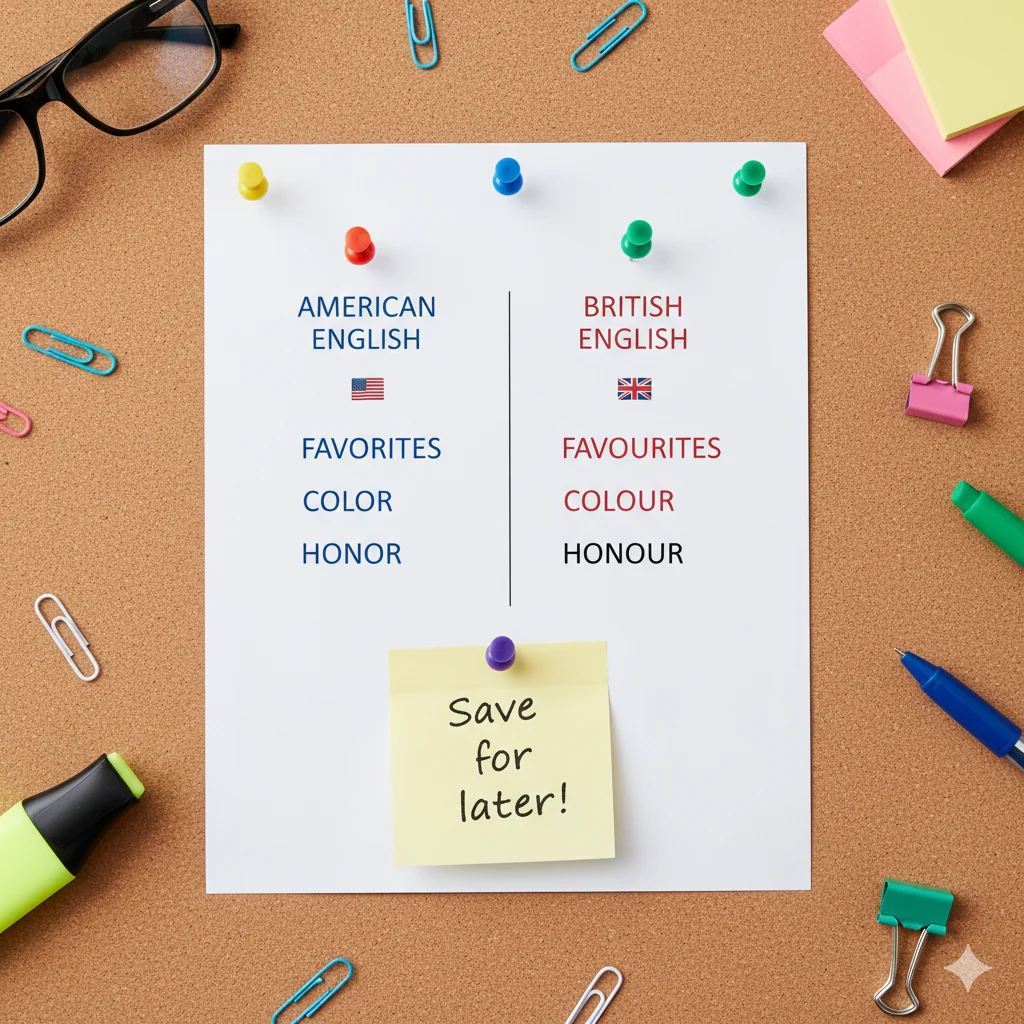
Print this or save it for future reference.
| Situation | Correct Spelling | Example |
|---|---|---|
| Writing to someone in the USA | favorites | “These are my favorites.” |
| Writing to someone in the UK | favourites | “These are my favourites.” |
| Writing to someone in Australia | favourites | “These are my favourites.” |
| Writing to someone in Canada | favourites | “These are my favourites.” |
| Writing for a global website | Pick one and stick to it | Be consistent! |
| Talking about one thing you like | favorite / favourite | “Pizza is my favorite.” |
| Talking about multiple things | favorites / favourites | “Pizza and pasta are my favorites.” |
| Something belongs to one favorite | favorite’s / favourite’s | “My favorite’s taste is great.” |
| Something belongs to multiple favorites | favorites’ / favourites’ | “My favorites’ prices went up.” |
| Referring to a brand name | Use their spelling | “I love Favourite Cakes.” |
Conclusion
Let me take you back to that job application story I shared at the beginning. That single missing “u” cost me an opportunity I really wanted. But you know what? It taught me a lesson I have never forgotten. Spelling is not just about being correct. It is about respecting your reader. It is about showing that you care about the little details. It is about communicating effectively.
Now you know everything. You know that both favourites and favorites are correct. You know that favorites is for American audiences and favourites is for British and Commonwealth readers. You know the history behind the difference. You know the common mistakes to avoid. You know how to use apostrophes correctly. You have seen real examples. You have tested yourself with a quiz. You have a cheat sheet to reference.
The next time you write, you will not hesitate. You will know exactly which spelling to use based on who is reading. That one little letter “u” will never confuse you again.
And maybe, just maybe, this knowledge will help you land that dream job, impress that important client, or simply look a little smarter in your next email.
Remember: When in doubt, ask yourself: “Who is my reader?” The answer will tell you everything you need to know.