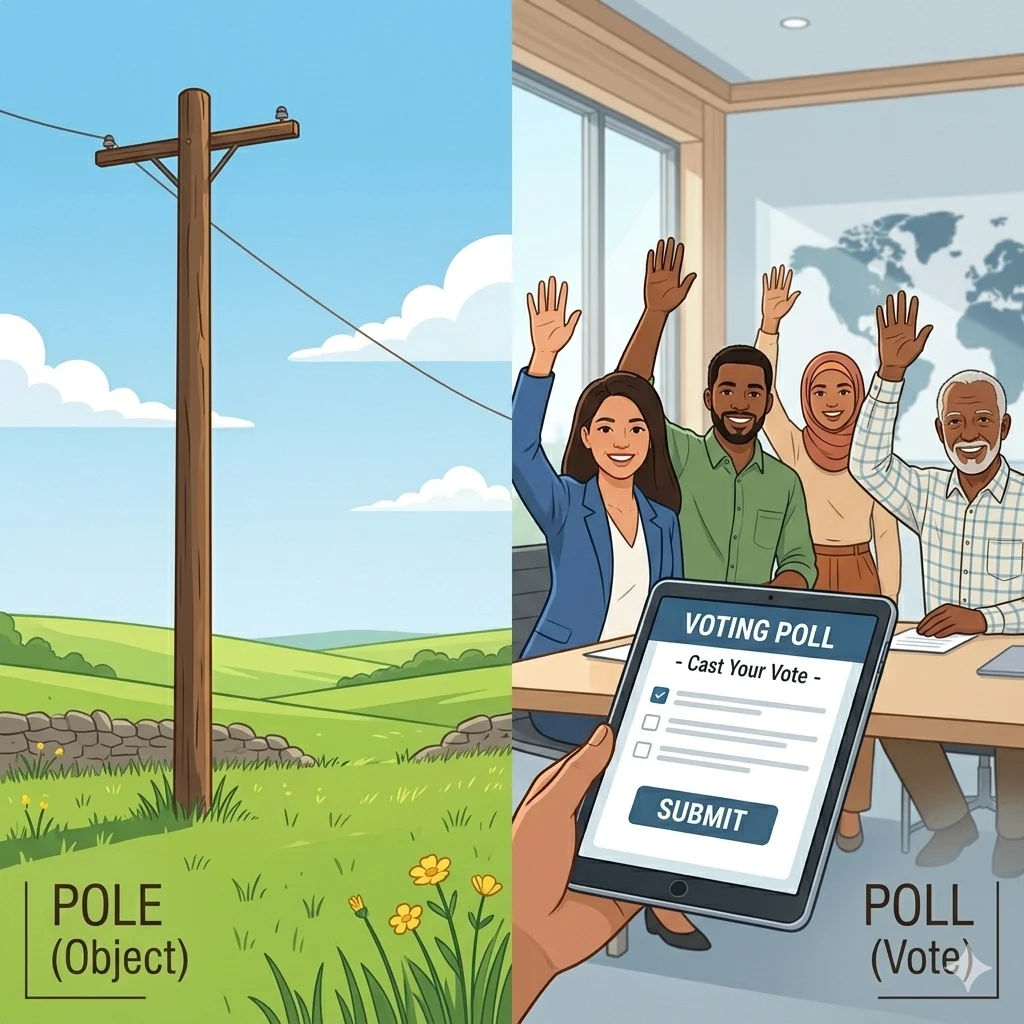
“Pole refers to a physical object like a rod or stick, while poll refers to collecting votes or opinions; both sound the same but have different meanings.”
Confused between “pole” and “poll”? Even a single letter can completely change your meaning. These two words sound identical but are used in very different contexts. A pole refers to a long, thin object such as a rod, stick, or post—like a flagpole or a support pole.
For example, “The flag is attached to the pole” or “He leaned against the pole.” In contrast, a poll is used when collecting opinions, votes, or survey results, such as “The election poll showed surprising results” or “We conducted a poll to gather feedback.”
Understanding the difference between pole vs poll helps you write clearly and avoid common spelling mistakes in school, work, and everyday communication. A simple way to remember is this:
think of “poll” as related to people and opinions, while “pole” is something physical you can see and touch. In this guide, you’ll quickly learn the meanings, differences, and real-life examples so you can confidently use both words without confusion.
Pole meaning
When you see the word pole, think of something physical. It generally refers to a long, slender, rounded piece of wood or metal. It is a tangible object.
- Examples: A telephone pole, a fishing pole, a tent pole, or the North Pole.
- In Context: “We need a longer pole to reach the apples at the top of the tree.”
- Special Use: In racing, pole position refers to the top qualifying spot on the starting grid. While this use is metaphorical, it comes from the physical idea of being on the “pole” (the inside lane marker).
Poll meaning
When you see the word poll, think of data or people. It most commonly refers to the process of voting in an election or a survey of public opinion.
- Examples: To take a poll, a straw poll, to go to the polls (voting place).
- In Context: “The latest opinion poll shows the candidate is ahead by 5%.”
- As a Verb: “We will poll the audience to see which song they prefer.”
The Origin of Pole and Poll
To understand why these words are so confusing, it helps to look at where they came from. Understanding the origin explains why they sound the same but are spelled differently.
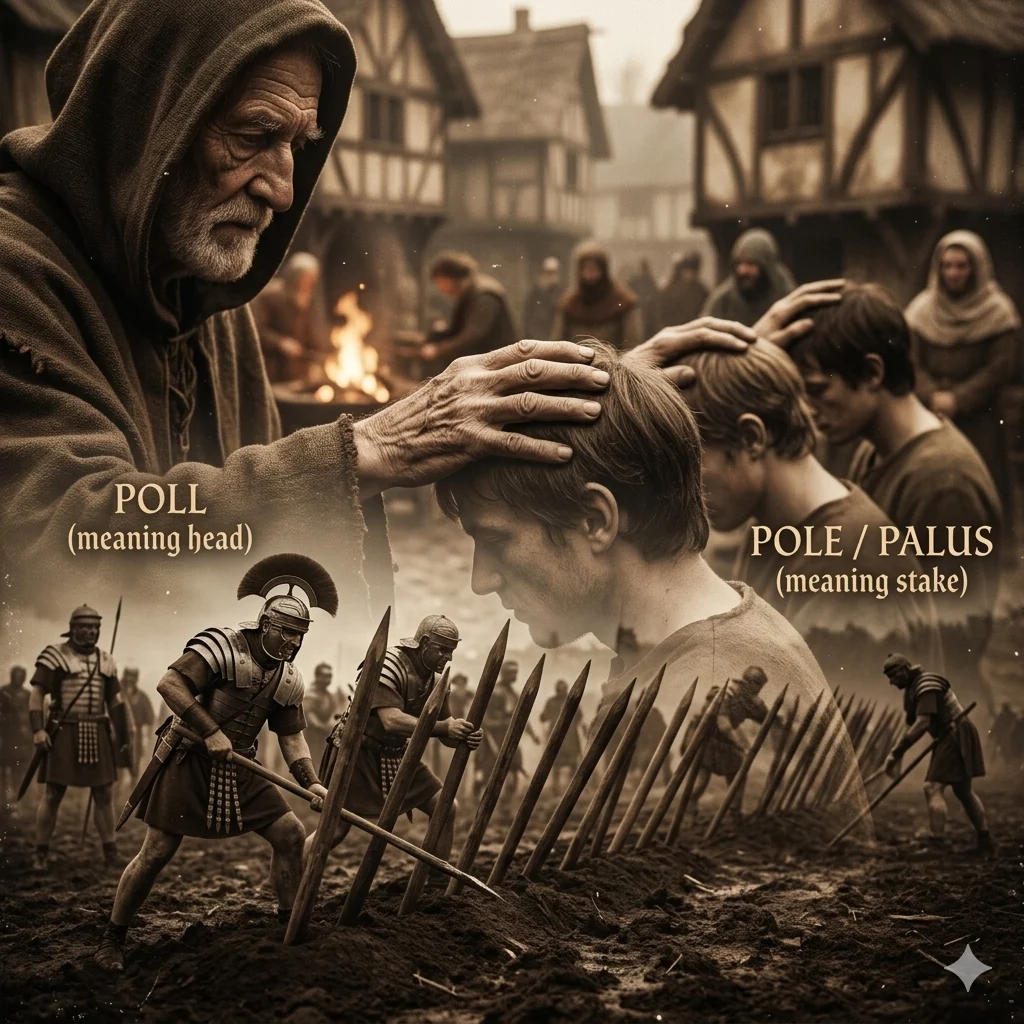
Pole has a long history, tracing back to the Old English word pāl, which meant a stake or a post. This word was borrowed from the Latin palus, also meaning a stake. The meaning has remained remarkably stable for over a thousand years—it always referred to a long, thin piece of wood.
Poll has a different and more interesting history. It comes from the Middle Low German word pol, which meant “head” or “top of the head.” This is why, historically, “poll” was used to refer to counting people. In medieval times, voting was often done by “counting heads.” Over time, the word evolved from referring to the head itself, to the act of counting heads (voting), and finally to the survey of opinion we know today.
The spelling differences exist simply because they entered the English language from different routes (Latin vs. German) and have maintained their distinct spellings to differentiate their meanings, even as their pronunciations merged.
British English vs American English Spelling
This is one area where there is good news: Pole and Poll are spelled the same in both American and British English. The confusion is not regional; it is purely grammatical and contextual. However, the usage frequency and context can sometimes differ.
- In the UK, you are more likely to hear about “opinion polls” regarding politics, and references to the “North Pole” in geography. The term “polling station” is standard.
- In the US, the terms are used similarly, though you might hear “precinct” for a polling place. “Pole vault” is a common track and field event.
The real difference lies in the context, not the country. Here is a quick comparison table to see them side-by-side:
| Word | Part of Speech | Primary Meaning | Example Sentence |
|---|---|---|---|
| Pole | Noun | A long, thin stick or post | “He used a pole to steady the canoe.” |
| Pole | Noun | One of two opposite ends of a magnet or axis | “The magnetic North Pole is shifting.” |
| Poll | Noun | A survey of public opinion | “The latest poll shows a tight race.” |
| Poll | Noun | The places where voting takes place (plural) | “Voters will go to the polls on Tuesday.” |
| Poll | Verb | To sample opinions or receive votes | “They plan to poll 1,000 registered voters.” |
Which Spelling Should You Use?
Deciding whether to use pole or poll depends entirely on your audience and your subject matter. Here is a simple guide:
- If you are in the US or UK writing for a general audience: Focus on the topic. If you are writing about sports, geography, or construction, pole is your word. If you are writing about politics, market research, or elections, poll is your word.
- In Academic or Formal Writing: Precision is key. Using the wrong word here is a significant error. For example, a political science paper must use poll when discussing survey data. A physics paper must use pole when discussing magnetism.
- Global Audience (ESL/EFL): If you are writing for an audience learning English, it is best to provide clear context. Avoid idioms like “I wouldn’t touch that with a ten-foot pole” as they can be confusing for non-native speakers. Stick to literal uses when possible.
Common Mistakes with Pole and Poll
Even native speakers make mistakes with these homophones. Here are the most frequent errors and how to correct them:
- Mistake: “We need to take a pole to decide where to go for lunch.”
- Correction: “We need to take a poll to decide where to go for lunch.” (Unless you literally need a stick to help you decide!)
- Mistake: “He won poll position for the big race.”
- Correction: “He won pole position for the big race.” This is one of the most common sports writing errors. Remember, it refers to the position on the track, not a vote.
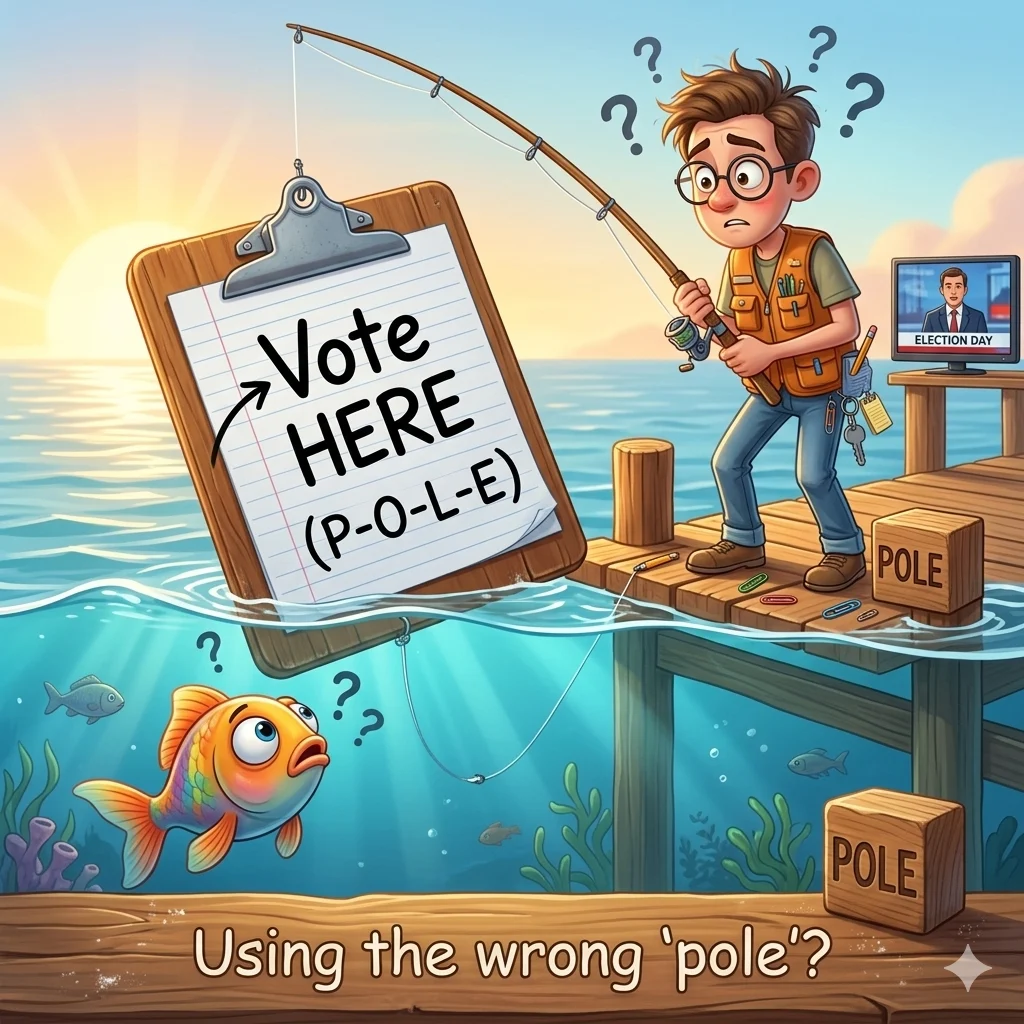
- Mistake: “The fisherman cast his poll into the water.”
- Correction: “The fisherman cast his pole into the water.” (Unless he threw a survey into the lake!)
- Mistake: “The poll was so high we couldn’t hang the flag.”
- Correction: “The pole was so high we couldn’t hang the flag.” (A flag hangs on a physical pole.)
Pole and Poll in Everyday Examples
Seeing these words used correctly in different contexts is the best way to internalize the difference.
1. In Emails (Informal Writing)
- “Hi team, I’ve set up a quick online poll to choose the date for the next meeting.”
- “I need to buy a new curtain pole for the living room windows.”
2. In News Headlines
- “New Poll Shows Voters Concerned About Economy.” (Survey)
- “Norwegian Explorer Reaches South Pole.” (Geography)
3. On Social Media
- “I’m running a poll on my stories—cheesecake or chocolate cake? Go vote!”
- “The internet cables are down in my area; a utility pole got knocked over by a truck.”
4. In Formal Writing (Reports/Business)
- “The company will conduct an employee satisfaction poll next quarter.”
- “The construction plans require a steel support pole to be installed every ten meters.”

Pole vs Poll – Google Trends & Usage Data
While both words are common, data shows that poll tends to spike in search volume during major election cycles (like in 2020 and 2022 in the US, and during UK general elections). People are searching for “opinion polls,” “exit polls,” and “polling data.”
Pole maintains a steady, consistent search volume year-round because it is tied to evergreen topics like geography (“North Pole”), fitness (“pole dancing”), and sports (“pole vault,” “fishing pole”).
Geographically, searches for poll are highest in English-speaking countries with active political landscapes (USA, UK, Canada, Australia). Searches for pole are more evenly distributed, though they spike in regions known for outdoor activities or specific cultural references.
Contextual Data:
- Is it pole or poll to vote? The data overwhelmingly points to “poll.” Every major election guide uses “polling place” and “poll worker.”
- Is it pole position or poll position? Search data for “pole position” is massive, driven by F1 racing and other motorsports. Searches for “poll position” are usually followed by users asking for clarification, proving it is a common error.
(FAQs)
1. Is it pole or poll to vote?
It is poll. The act of voting is called “going to the polls.” The place you vote is a “polling station” or “polling place.”
2. Is it pole position or poll position?
It is pole position. This term comes from horse racing, where the top-qualifying horse was placed on the inside next to the starting pole. It has nothing to do with surveys.
3. What is poll and pole?
A poll is a survey of people’s opinions or the act of voting. A pole is a long, thin stick or a geographical/magnetic extreme (like the North Pole).
4. What does “take a poll” mean?
To “take a poll” means to ask a group of people for their opinion on a specific subject to gather data. For example, a company might take a poll to see which product color customers prefer.
5. What does “pole” mean in racing?
In racing, the “pole” or “pole position” refers to the first-place starting spot on the grid, given to the driver with the fastest qualifying time.
6. Can “poll” be used as a verb?
Yes. For example: “The news network will poll voters as they leave the station.” This is called an exit poll.
7. Why do “pole” and “poll” sound the same?
They are homophones. Over centuries of language evolution, their pronunciations merged even though their origins (etymologies) and spellings remained different.
8. What is a “straw poll”?
A “straw poll” is an unofficial vote or survey used to show the general opinion of a group. It is not binding but is used to gauge sentiment.
Conclusion
Navigating the world of pole or poll doesn’t have to be difficult. The key takeaway is to distinguish between the physical and the abstract. If you are talking about something you can hold, a geographical location, or a starting line in a race, pole (with an ‘e’) is your word. If you are talking about gathering opinions, conducting surveys, or participating in an election, poll (with two ‘l’s) is the correct choice.
Remembering the simple hint that poll is about people (both start with ‘p’) can save you from embarrassing writing mistakes. Whether you are setting up a quick poll for your friends or looking at a pole vaulter in the Olympics, you now have the knowledge to use these words with confidence. Pay attention to the context, and you will always choose the right one.

Eli Metaphor blends creativity with wit, crafting articles that make language feel alive. Known for his clever comparisons and modern writing style, Eli helps readers understand how figurative language shapes emotion and meaning. He’s the analytical heart of SimileMind — where logic meets lyricism.