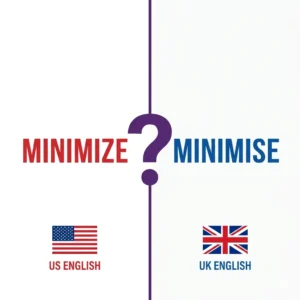
Recognisable and recognizable are both correct spellings, but they belong to different varieties of English.
This spelling difference often confuses learners because both words have the same meaning—something that is easy to identify or recognize—yet their usage depends on British vs American English conventions. Recognisable is the preferred spelling in British English, while recognizable is standard in American English.
Although the difference may seem minor, using the wrong form for your audience can make writing appear inconsistent or careless, especially in exams, academic work, professional documents, blogs.
In this article, you will learn which spelling is correct in which context, why this difference exists, common mistakes to avoid, and how to choose the right form confidently based on your target audience. Understanding this distinction will help you write clear, accurate, and polished English without second-guessing your spelling choices.
Recognisable or Recognizable
Here is the quick, direct answer you likely searched for: Both recognisable and recognizable are correct. The choice depends entirely on your version of English.
- Recognisable (with an ‘s’) is the standard spelling in British English. This is used in the UK, Australia, New Zealand, and most Commonwealth countries.
- Recognizable (with a ‘z’) is the standard spelling in American English. This is used in the United States and in countries influenced by US education and media.
The meaning of both words is identical: able to be recognized or identified. The spelling difference follows a consistent pattern seen in words like organise/organize and realise/realize.
Examples in a sentence:
- “The actor wore a disguise but his walk was still recognisable.” (UK spelling)
- “Her leadership style is recognizable to anyone in the industry.” (US spelling)

The Origin of the Word
To understand why two spellings exist, we look to history. The word comes from the verb ‘to recognise/recognize’, which entered English from Old French, tracing back to the Latin recognoscere (to know again).
The split began with Noah Webster, the influential American lexicographer. In the early 19th century, Webster published his American Dictionary of the English Language. He championed spelling reforms to create a distinct American English identity. One key change was standardizing the “-ize” suffix over the British “-ise”, arguing it was closer to the Greek root -izo. This is why the ‘z’ became standard in the US for recognizable, organizable, and others.
British English largely retained the “-ise” ending, which also aligns with French spelling influences. This historical divergence gives us the two accepted forms we use today.
British English vs. American English Spelling
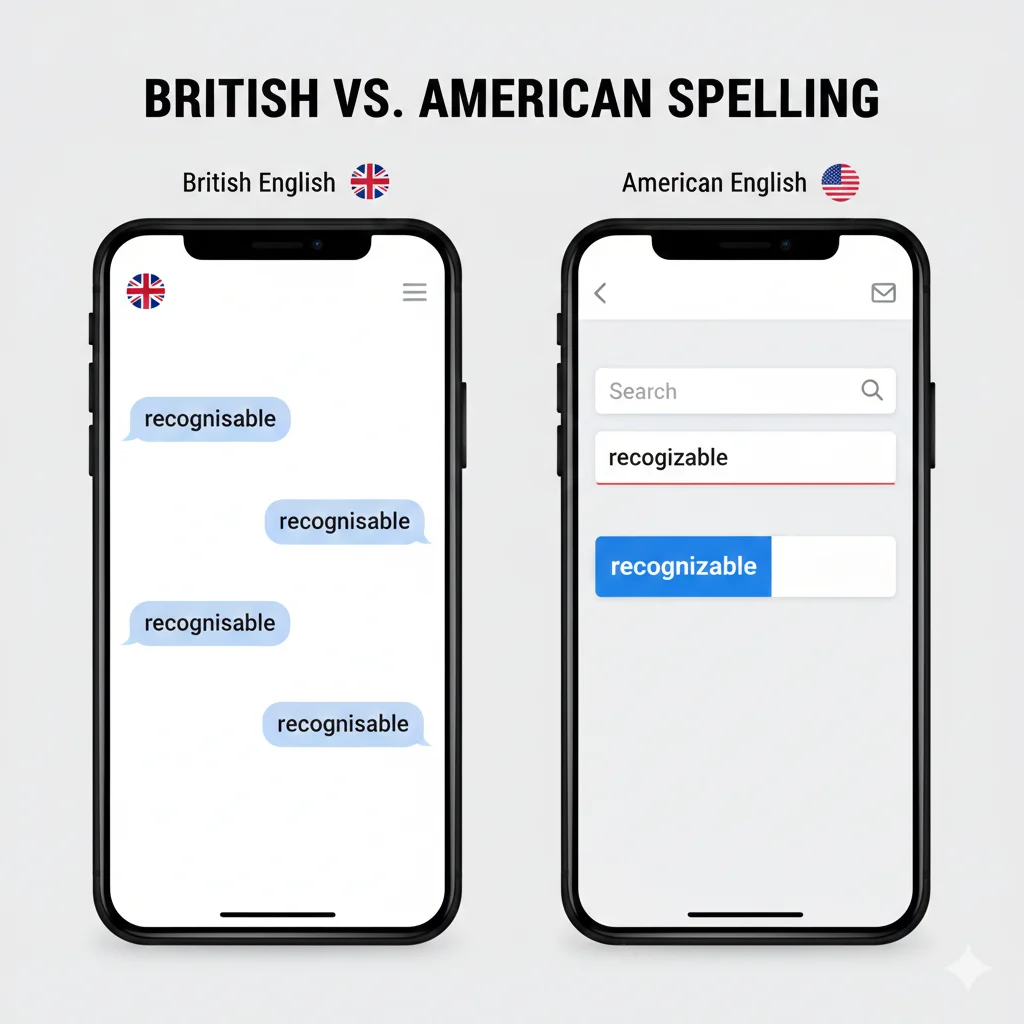
The -isable vs. -izable difference is a perfect example of systematic spelling variation. It’s not random; it applies to a whole family of verbs and their related adjectives.
British English (UK, AU, NZ) prefers -s-:
- Recognise → Recognisable
- Apologise → Apologisable
- Organise → Organisable
American English (US) prefers -z-:
- Recognize → Recognizable
- Apologize → Apologizable
- Organize → Organizable
Comparison Table:
| Feature | Recognisable (British English) | Recognizable (American English) |
|---|---|---|
| Spelling | Uses ‘s’ (-isable). | Uses ‘z’ (-izable). |
| Primary Regions | UK, Australia, NZ, India, South Africa. | USA, Philippines, countries using US English. |
| Common Dictionaries | Oxford, Collins. | Merriam-Webster, American Heritage. |
| Verb Form | To recognise. | To recognize. |
| Example Sentence | “The tune was faint but recognisable.” | “The logo is recognizable globally.” |
Else’s vs Elses: The Tiny Grammar Detail Everyone Gets Wrong
Which Spelling Should You Use? Let Your Audience Decide
Your choice isn’t about right or wrong; it’s about audience and consistency. Here’s a simple guide:
- For a Clearly American Audience: Use recognizable without exception. This includes writing for US companies, websites, publications, or in academic work following APA style.
- For a Clearly British or Commonwealth Audience: Use recognisable. This is expected in the UK, Australia, and related regions, and in academic styles like Harvard (UK).
- For a Global or Mixed Audience: Consistency is your most important tool. Choose one variant and stick with it throughout the entire document. Many global organisations choose one style guide (e.g., “We use US English for all external communications”). You can also use region-specific web pages (like /us/ or /uk/). If you must pick one, recognizable appears more frequently online due to the volume of US-based content, but always state your chosen dialect.
Common Mistakes and How to Avoid Them
The most frequent errors are easy to fix once you know the rules.
- The Inconsistent Mix-Up: “Our organization (US) aims to have a recognisable (UK) brand.” This mix within one sentence looks sloppy.
- Correction: Be consistent. “Our organization aims to have a recognizable brand.” OR “Our organisation aims to have a recognisable brand.”
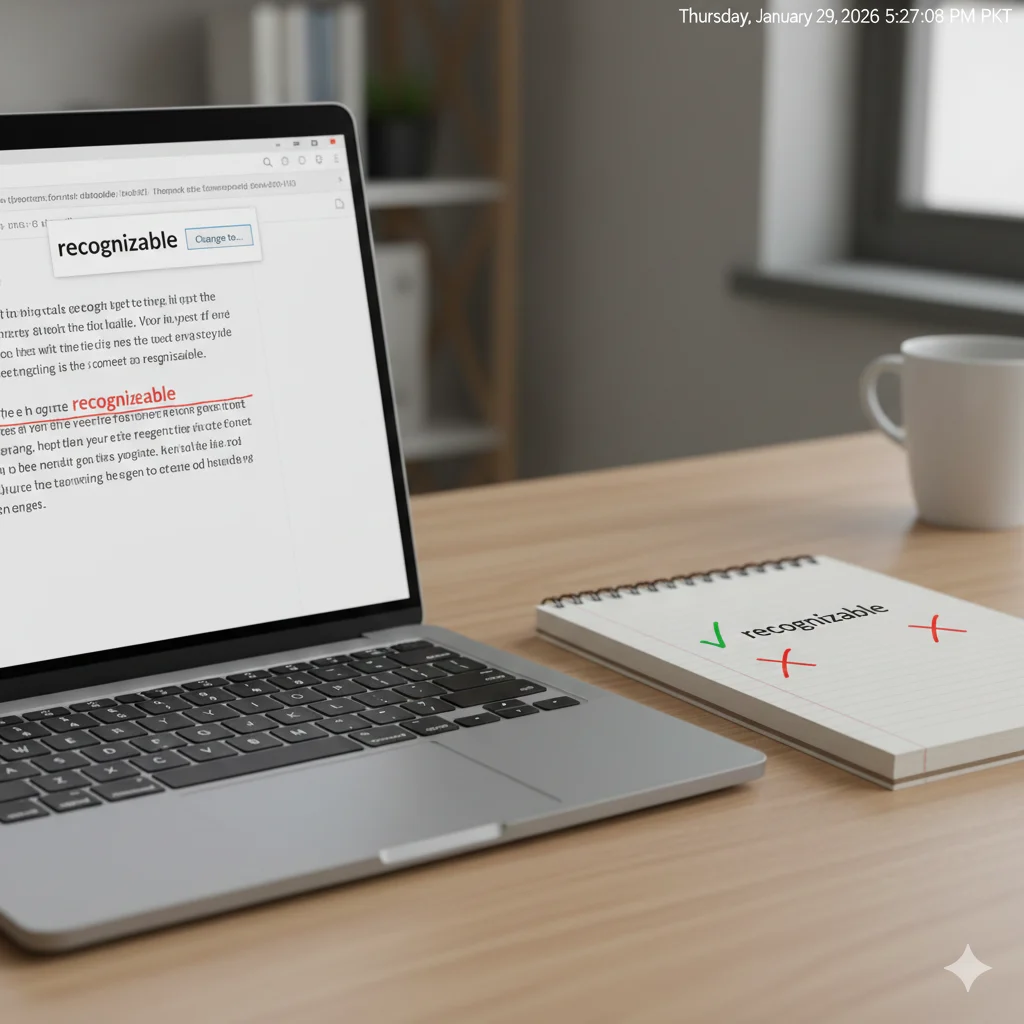
- The Extra ‘e’ Error: Writing “recognizeable” is always incorrect. The rule is simple: the verb (recognize/recognise) + able. No extra ‘e’ is added.
- Over-applying the Rule: The -ise/-ize rule only applies to a specific set of verbs. Don’t change words like “advertise” to “advertize.” The correct adjective is “advertisable,” not “advertizable.”
Everyday Examples in Context
Seeing the word used naturally helps cement understanding. Here are examples in a sentence across different contexts.
- Formal Report (UK): “There was a recognisable shift in market sentiment after the announcement.”
- News Headline (US): “City Skyline Becomes Less Recognizable After New Development.”
- Social Media Bio: “Award-winning designer creating recognizable brand identities. #LogoDesign” (Note: Global brands often use US spelling on platforms).
- Email (Business – AU): “We need packaging that is both sustainable and instantly recognisable on the shelf.”
- Casual Conversation: “His voice is so recognisable/recognizable; I’d know it anywhere!” (Pronunciation is identical: /ˈrek.əɡ.naɪ.zə.bəl/).
Google Trends and Modern Usage Insights
Data from tools like Google Trends reveals a clear pattern: the search term “recognizable” has significantly higher global volume than “recognisable.” This reflects the dominant influence of American English online and in global media.
Searches for “recognisable meaning” and “how to spell recognisable” spike predictably in the UK and Australia. This shows active user intent to solve a specific problem. Search engines like Google prioritise content that directly and clearly answers such queries. Providing a comprehensive guide that addresses spelling, meaning, and usage aligns perfectly with modern search algorithms that value. Content that solves user intent effectively, especially on straightforward educational topics, is favoured for ranking well in featured snippets and mobile searches.
FAQs:
1. What is the simple meaning of recognisable/recognizable?
It simply means able to be recognized or identified. Something that is recognisable is familiar enough that you can know what or who it is.
2. Are recognisable and recognizable pronounced differently?
No. The pronunciation is exactly the same: /ˈrek.əɡ.naɪ.zə.bəl/ (sounds like “REK-ug-nize-uh-bull”).
3. What are some good synonyms for recognisable?
Common synonyms include identifiable, familiar, known, distinctive, noticeable, and memorable. For example, “The building has a distinctive (synonym for recognisable) shape.”
4. Is ‘recognisable’ correct in the United States?
In formal American English, “recognisable” is considered a spelling error. The standard and expected spelling is always “recognizable.”
5. Can you give an example using the UK spelling?
Certainly. “Despite the artist’s abstract style, a human form was still recognisable in the painting.”
6. Which spelling is used in Canada?
Canadian English is a mix, but it tends to follow British conventions for “-our” (colour) and “-re” (centre) words. However, for “-ise/-ize,” Canadian usage often accepts both, though “-ize” (recognizable) is frequently seen in government and academic publications.
7. Why is this important for my writing?
Using the correct regional spelling shows attention to detail and respect for your audience. It enhances your professionalism and ensures your writing is polished and credible, making your core message more effective.
Conclusion
In the debate between recognisable vs. recognizable, the winner is always clarity and consistency. The key takeaway is that both spellings are correct within their respective dialects. Your job as a writer is to know your audience and adhere to one system meticulously. For American readers, recognizable is the only choice. For British, Australian, and other Commonwealth readers, recognisable is the expected standard.
As digital communication makes the world smaller, this awareness becomes more valuable. It’s a small detail that speaks volumes about your professionalism. Whether you’re preparing a resume, publishing a blog, or sending a crucial client email, applying this knowledge ensures your words are not only understood but also respected. Let this guide be your reference point. Bookmark it, share it, and return to it whenever that moment of doubt arises. Now, you can write with confidence, knowing your spelling will always be perfectly—and appropriately—recognisable.

Noah Syntax is a linguistics lover who finds beauty in structure and rhythm. His writing combines precision with playfulness, decoding the secrets of language for everyday readers. At Simile Mind, Noah brings clarity, humor, and insight to every metaphor he explores.