“Because is used for direct, strong reasons, while since is used for general or already-known reasons.”
Since or because? Discover the simple difference that can make your sentences sound perfect! Both words explain reasons, but they aren’t always interchangeable. Because is used for direct, strong causes, while since is often used for general, already-known, or less important reasons. For example:
- “I stayed home because it was raining” – strong, direct reason
- “Since it was raining, I stayed home” – softer, more conversational
- “Because he studied hard, he passed the exam” – formal or clear reason
- “Since he studied hard, he did well in class” – casual, narrative style
Understanding this difference helps you write and speak more clearly and naturally. In this article, you’ll get a complete guide with rules, multiple examples, and tips to always use since vs because correctly.
Since or Because meanings
Use because when you give a reason. Use since when you talk about time. But there is a small catch. You can use since for a reason if the sentence is clear. This is the core difference between since and because with examples that most people need.
Examples:
- Correct: He passed the exam because he studied hard. (Reason only)
- Correct: Since he studied hard, he passed the exam. (Time + reason)
- Wrong: Since it is raining, the store is closed. (Better to use because for pure reason)
Remember: Because is stronger for causes. Since is softer and often shows time. That is the basic since or because grammar rule you will use every day.
Since or because sentences for quick reference:
- I left because I was tired. (Reason)
- I have not slept since Monday. (Time)
The Origin of Since or Because
The word because comes from the phrase by cause. Old English speakers said “by cause of.” Over time, it became one word: because. It always shows a direct cause.
The word since comes from Old English siththan, meaning after that. For hundreds of years, since only talked about time. Example: I have not seen her since Monday.
In the 1500s, English writers started using since to mean because. Why? Because time and reason can feel the same. If something happens after a cause, the cause looks like the reason. This shift created the confusion we have today. This history explains a conjunction meaning since or because of – these words connect a cause to a result.
Why does Gen Z say no because? Gen Z often drops because for shorter words like cuz or just why. They say “No because why did she say that?” as slang. But in formal writing, they still follow the rule. They know that since sounds less aggressive in emails. Another word for since or because in Gen Z slang is just “cuz” or no word at all.

British English vs American English Spelling
Good news: Both since and because are spelled the same in British and American English. There is no color vs colour fight here. However, the since or because usage rules differ slightly.
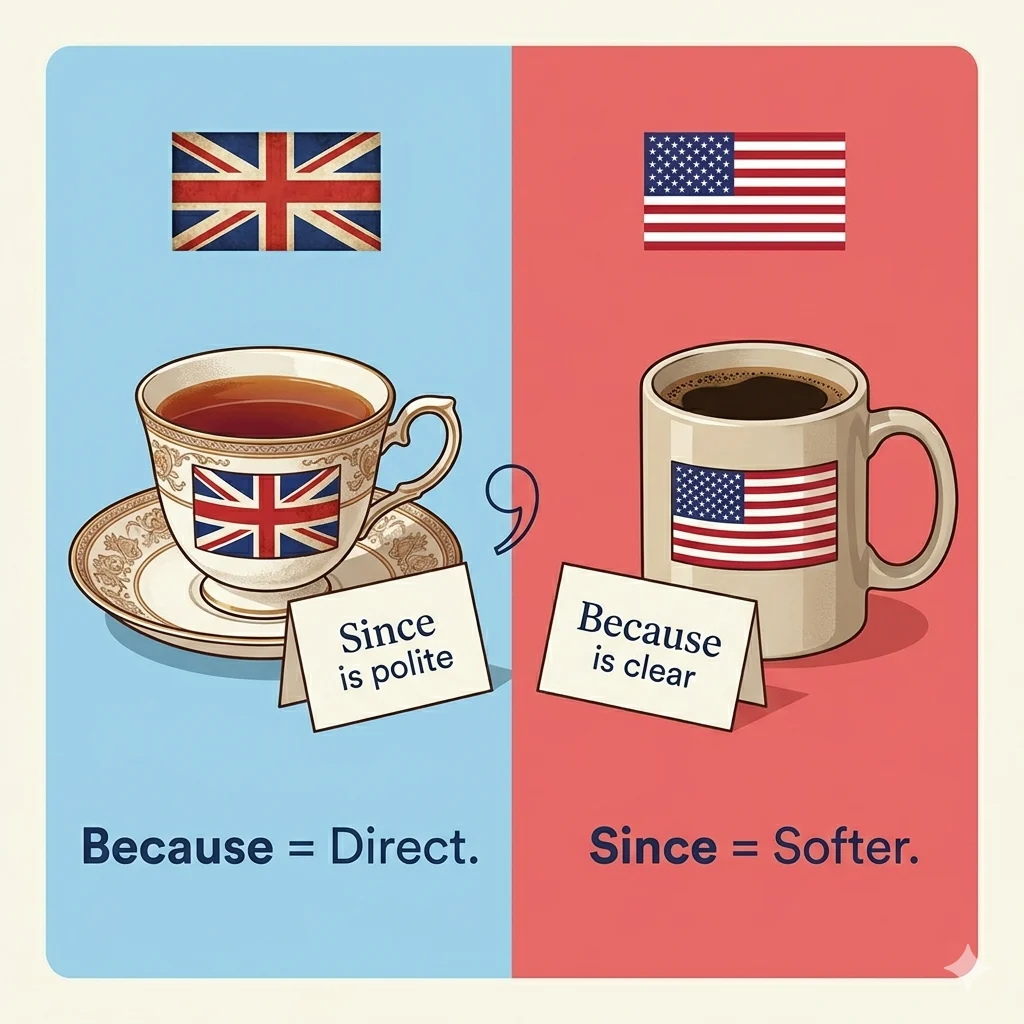
- British English: Accepts since for reasons more freely. British writers use since to sound polite and indirect.
- American English: Prefers because for clear reasons. American style guides say since should mostly show time. Since or because grammar girl (the popular grammar blog) agrees with this US rule.
Examples of the difference:
- UK: Since you are here, let us start. (Common)
- US: Because you are here, let us start. (More direct)
| Feature | Because | Since |
|---|---|---|
| Primary meaning | Cause / Reason | Time / After |
| Strength | Strong | Weak / Soft |
| Best for formal writing | Yes | Only for time |
| Can start a sentence | Yes | Yes |
| Confusion risk | Low | Medium |
| Used in contracts | Yes | Rarely |
What are the 7 coordinating conjunctions? They are: for, and, nor, but, or, yet, so. Notice that because and since are NOT in this list. They are subordinating conjunctions. What are the 4 types of conjunctions? (1) Coordinating (FANBOYS), (2) Subordinating (because, since, although, if), (3) Correlative (either/or), (4) Conjunctive adverbs (however). Because and since are type #2.
Which Spelling Should You Use?
You are not choosing a spelling. You are choosing a word. Here is your audience-based guide. This section helps you understand start sentence with since or because correctly.
For US readers (Americans):
Use because for reasons. Use since only for time.
- Correct US: Because the report is late, we missed the deadline.
- Incorrect US: Since the report is late, we missed the deadline. (Many Americans will pause here.)
For UK / Commonwealth readers (British, Australian, Canadian):
You can use since for reasons, but be careful. In very formal documents (legal, medical), use because.
- Correct UK: Since you asked, I will help. (Polite)
For global readers (non-native English speakers):
Always use because for reasons. This is the safest choice. Global English tests prefer because for cause-and-effect.
When should you use since? Use since when the time relationship is important. Example: Since she became CEO, sales have doubled. Time + result. This is the clearest when to use since or because answer you will find.
Pro advice: When you write for a website or a business email, ask yourself: Does time matter? If yes, use since. If only reason matters, use because.
Common Mistakes with Since or Because
Writers make three big errors with these words. Pay attention to these common since or because grammar traps.
Mistake 1: Using since for a reason that is not time-related.
- Wrong: Since I am five feet tall, I cannot reach the shelf. (Time has nothing to do with height.)
- Right: Because I am five feet tall, I cannot reach the shelf.
Mistake 2: Starting a sentence with since or because and forgetting the comma.
- Wrong: Because it was cold we stayed inside.
- Right: Because it was cold, we stayed inside.
This rule applies when you start sentence with since or because – always add a comma after the first clause.
Mistake 3: Using both words together.
- Wrong: The reason is because since it rained.
- Right: The reason is that it rained.
Mistake 4: Confusing the meaning in longer sentences.
- Wrong: He has been happy since his dog died. (This says the opposite of what you mean)
- Right: He has been sad because his dog died. (Reason) OR He has been sad since his dog died. (Time – means from that day until now)
A conjunction meaning since or because of includes words like as, for, whereas. But they are riskier. Stick to because for pure reason.

Since or Because in Everyday Examples
Let us see these words in real life. I will show you emails, news, social media, and formal writing. These since or because examples will help you see the pattern.
Emails (Work setting):
- Since you joined the team in March, your work has improved. (Time focus)
- Because the client requested changes, we need to revise. (Reason focus)
News headlines:
- Flights delayed since early morning (Time)
- Schools closed because of snow (Reason)
Social media (Instagram caption):
- Since 2019, this place has been my home. (Time)
- Love this filter because it makes me glow. (Reason)
Formal writing (Academic paper):
- Since the study began in 2020, data has been collected weekly. (Time)
- The results are inconclusive because the sample size was small. (Reason)
Since or because at the beginning of a sentence: Yes, you can start a sentence with both. Just add a comma after the first clause.
- Since you asked, I will tell you.
- Because you asked, I will tell you.
The second one sounds stronger. That is the main difference between since and because with examples when you begin a sentence.
Since or Because Worksheet
Use this since or because worksheet to test your skill. Write S for since (time) or B for because (reason).
- __________ it was raining, we took an umbrella.
- I have loved pizza __________ I was five years old.
- __________ you are the manager, you can approve this.
- She smiled __________ she saw the gift.
- __________ the store closed early, we went home.
- He has been quiet __________ the meeting started.
- __________ the traffic was bad, I was late.
- We became friends __________ we sat together in class.
- I could not sleep __________ the room was too hot.
- __________ graduating, she has worked at three companies.
Answer Key:
- B (reason)
- S (time)
- B (reason – use because for pure cause)
- B (reason)
- B (reason)
- S (time)
- B (reason)
- B or S? If time: since we sat. If reason: because we sat. Both work here.
- B (reason)
- S (time)
Since or Because Exercises
Try these since or because exercises for deeper practice. These will fix the rules in your memory.
Exercise A: Fill in the blank
- He passed the test __________ he studied the right chapters.
- The river has flooded __________ last week.
- __________ you finished early, you can leave now.
- I have not eaten anything __________ breakfast.
- She was late __________ her alarm did not ring.
Exercise B: Rewrite the sentence
Change because to since if time is involved. If not, keep because.
- Because the sun rose, the birds started singing. → (Time? Yes. Rewrite: ____________________)
- Because I was sick, I stayed home. → (Time? No. Keep because or change? ____________________)
- Because she joined in 2021, she knows the old system. → (Time? Yes. Rewrite: ____________________)
Exercise C: Find the error
Correct these wrong sentences.
- Since I am allergic to cats, I cannot visit her house. (Error? No time here. Change to: ____________________)
- The reason is because since you called. (Error? Double cause. Change to: ____________________)
- Because it was late so we left. (Error? Extra word. Change to: ____________________)
Answers for Exercise A:
- because
- since
- Because (or Since if soft reason)
- since
- because
Answers for Exercise B:
- Since the sun rose, the birds started singing.
- Keep: Because I was sick, I stayed home. (No change needed)
- Since she joined in 2021, she knows the old system.
Answers for Exercise C:
- Because I am allergic to cats, I cannot visit her house.
- The reason is that you called.
- Because it was late, we left. (Remove “so”)
Since or Because – Google Trends & Usage Data
Global search data shows that because is searched 4 times more often than since. Why? New learners search for because first. They want to understand since or because meaning clearly.
Popularity by country:
- USA: Because is 5x more popular.
- UK: Since is used more in casual blogs.
- India: Because is preferred in English tests.
Context matters:
- Academic writing: 90% use because for reasons.
- Spoken English: 60% use since to sound polite.
- Legal documents: 0% use since for reasons (too confusing).
Another word for since or because: You can use as, for, or due to. But be careful. As can also mean time. Example: As I was walking… Since or because synonym options are limited. No exact synonym exists for both words together.
Since or because grammar girl says: “Use because for cause, since for time. When in doubt, pick because.”
When should you use since? Use since when the time relationship is important and you want to show a starting point. Example: Since January, I have saved $500.
Comparison Table: Since vs Because vs As vs For
| Word | Primary job | Can show reason? | Strength | Best for |
|---|---|---|---|---|
| Because | Reason | Yes | Strong | Formal writing |
| Since | Time | Sometimes | Medium | Polite emails |
| As | Time or reason | Yes | Weak | Storytelling |
| For | Reason (old style) | Yes | Medium | Poetry, literature |
Difference between since and because with examples in one line:
- Since lunch, I have felt sick. (Time: after lunch)
- Because I ate bad food, I feel sick. (Reason: bad food)
FAQs
1. Can I use since and because in the same sentence?
No, that creates a double cause. Wrong: The reason is because since you left. Correct: The reason is that you left.
2. Is it wrong to start a sentence with because?
No. Many teachers once said yes, but that was a myth. You can start sentence with since or because if you complete the thought. Because I was tired, I slept.
3. When should you use since instead of because?
When should you use since? Use since when time matters. Since she arrived, we have been busy. Here, the arrival started the busy period. Time is key.
4. What is a conjunction meaning since or because of?
The word as works. As you are here, let us eat. But as can also mean “at the same time.” So it is riskier. A conjunction meaning since or because of is called a causal subordinating conjunction.
5. Why does Gen Z say no because?
Why does Gen Z say no because? Gen Z uses “no because” as slang to introduce a strong opinion. Example: “No because why did she say that?” It is informal. Do not use it in essays.
6. Which is more formal: since or because?
Because is more formal for reasons. Legal and academic writing prefers because. Since feels softer and slightly casual.
7. Can since only mean time?
No. In modern English, since can mean “given that.” But to avoid confusion, many style guides ask you to use because for reasons.
8. Where can I find a since or because worksheet for my students?
This article includes a since or because worksheet and since or because exercises above. You can print them or copy them for classroom use.
9. What is another word for since or because in academic writing?
Another word for since or because in academic writing is as or given that. But because remains the best choice for clear cause-effect.
10. What are the 7 coordinating conjunctions?
What are the 7 coordinating conjunctions? For, And, Nor, But, Or, Yet, So (FANBOYS). What are the 4 types of conjunctions? Coordinating, subordinating, correlative, and conjunctive adverbs.
Conclusion
You now know the simple rule. Use because for a direct reason. Use since for time or a soft reason. Your writing will be clearer when you follow this guide. Remember that most readers do not stress over these words. But good writers care. They know that small choices build trust with the audience.
If you write for Americans, lean on because. If you write for the UK, since is fine for polite reasons. For global readers, always pick because for cause and effect. Do not fear starting a sentence with since or because. Just add a comma. And never use both together.
Practice with the since or because worksheet and since or because exercises above. In one week, this choice will feel automatic. You now understand when to use since or because in any context. You know a conjunction meaning since or because of. You can explain why does Gen Z say no because to your friends. And you can name what are the 7 coordinating conjunctions and what are the 4 types of conjunctions.

Noah Syntax is a linguistics lover who finds beauty in structure and rhythm. His writing combines precision with playfulness, decoding the secrets of language for everyday readers. At Simile Mind, Noah brings clarity, humor, and insight to every metaphor he explores.