“Always means ‘at all times’ or ‘consistently’; allways is incorrect — learn tips, examples, and rules to always get it right.”
Stop typing “allways” by mistake — learn the simple trick to never mess it up again! The correct spelling is always, meaning at all times, on every occasion, or consistently. Many people accidentally type allways, but it’s incorrect and can make your writing look unprofessional.
Here are some easy-to-remember examples:
- “She always arrives on time.”
- “I always brush my teeth before bed.”
- “They always celebrate her birthday.”
- “Always check your messages before sending.”
- “I always double-check my work for errors.”
Whether you’re a student, writer, or social media user, mastering always will make your writing flawless.
In this article, you’ll find correct spelling rules, common mistakes, and simple tricks to always remember the correct spelling — so allways never sneaks into your writing again.
Always meanings
The correct spelling is always. It has only one “L.” The word “allways” is a common misspelling and is not recognized as a standard English word.
Think of it like this:
- Always = at all times; forever.
- Allways = incorrect.
Examples:
- Correct: “I will always remember this day.”
- Incorrect: “I will allways remember this day.”
If you are asking yourself, is it allways or always, the quick rule is: if you are writing in English, use always. The version with two L’s is a spelling error.
The Origin of Always
To understand why the spelling is always, not “allways,” we must look at its history. The word comes from Old English. It was formed by combining two words: “all” and “way.”
In Old English, the phrase was “alne weg,” which meant “all the way” or “throughout the way.” Over time, these words merged into one word: “alwayes” in Middle English, and eventually, always.
Why does always have only one L?
Because it evolved from a combination of “all” + “way” + the adverbial “-s.” When two words merge, spelling often simplifies. The double L from “all” was dropped to make the word flow better in speech and writing. This history explains why the modern standard is a single “L.”

British English vs American English Spelling
When discussing allways or always, many people wonder if the difference is regional. Is “allways” the British version? The answer is no.
Both British English and American English agree on the spelling always. There is no regional variation for this word.
| Aspect | British English | American English |
|---|---|---|
| Correct Spelling | always | always |
| Incorrect Spelling | allways | allways |
| Usage | Used to mean “every time” or “forever.” | Used to mean “every time” or “forever.” |
Unlike words like “colour” (UK) vs “color” (US), always remains constant. Whether you are in London, New York, or Sydney, the correct spelling is the same. If you see “allways” in a text, it is simply a mistake, not a regional dialect.

Which Spelling Should You Use?
Choosing the right spelling depends entirely on your audience and the context of your writing. Since “allways” is a misspelling, the advice is straightforward.
- If you are in the US: Use always. American English does not recognize “allways” as a correct form.
- If you are in the UK or Commonwealth: Use always. British English standards strictly use the single L version.
- If you are writing for a global audience: Use always. This is the universally accepted standard.
Audience-based advice:
- Formal writing: Resumes, business reports, and academic papers require always.
- Casual writing: Even in text messages or social media, using the correct spelling always shows professionalism and clarity.
If you are ever unsure about allways or always meaning in a dictionary, you will find that only “always” has a definition. “Allways” will simply direct you to the correct spelling or show no results.
Common Mistakes with Always
Spelling errors happen for specific reasons. Here are the most frequent mistakes with the word always and how to fix them.
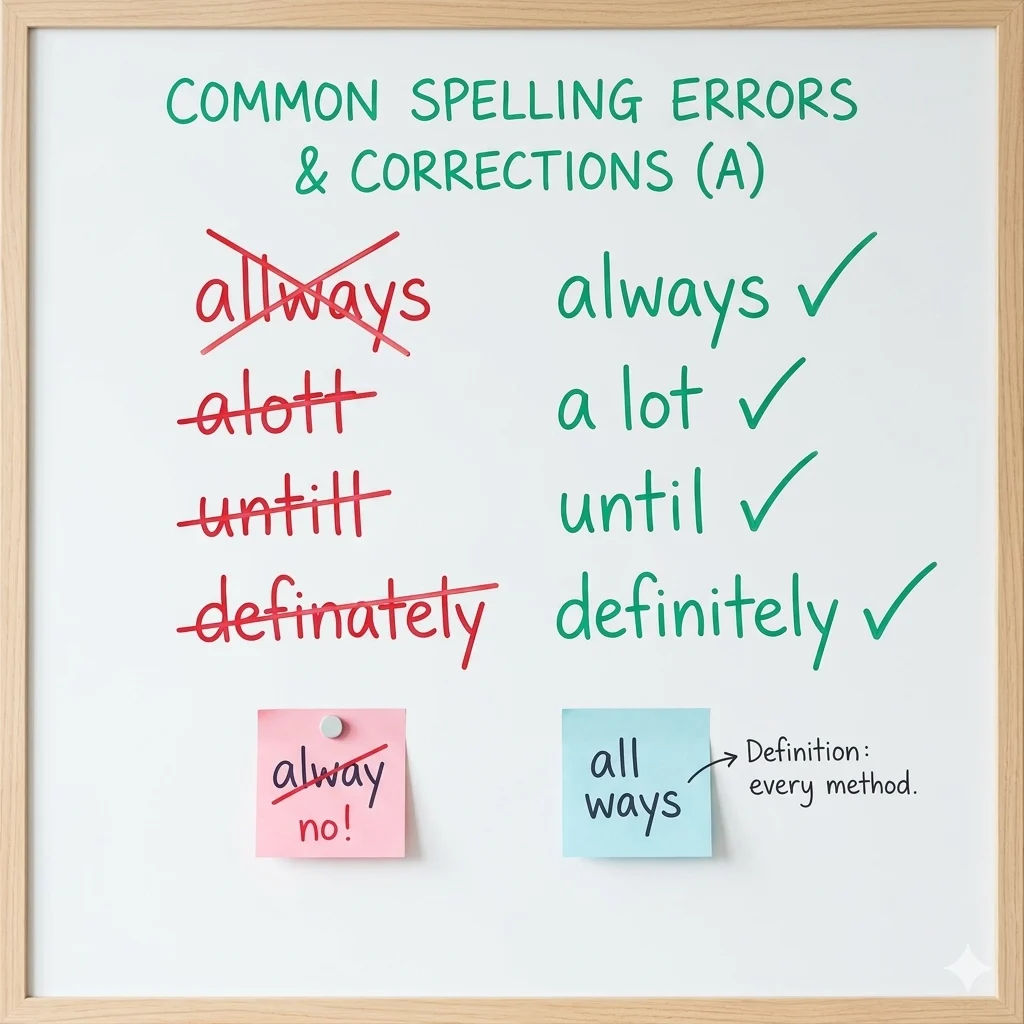
1. Adding an Extra L
Mistake: Writing “allways.”
Why it happens: People think because the word starts with “all” (like in “all right”), it must include two L’s. However, always is a distinct word that evolved separately.
Correction: Remove one L. Always = All + way + s.
2. Confusing “Always” with “All Ways”
Mistake: Using “always” when you mean “all ways.”
Explanation: “All ways” (two words) means “every method” or “every direction.” Always (one word) means “at all times.”
Example:
- All ways: “We tried all ways to solve the problem.” (Every method)
- Always: “We always solve the problem.” (Every time)
3. Forgetting the Final S
Mistake: Writing “alway.”
Why it happens: “Alway” is an archaic form rarely used today. Modern English requires the “s.”
Correction: Always use the “s” at the end.
4. Phonetic Errors
Mistake: Spelling it “allwaze” or “alwayz.”
Why it happens: People write how they hear it.
Correction: Remember the rule: one L, one A, one Y, and an S.
Always in Everyday Examples
Seeing the word used correctly helps solidify the spelling. Here is how always appears in different types of writing.
In Emails:
- “I will always ensure the reports are submitted on time.”
- “Thanks always for your support.”
In News Headlines:
- “Why Safety is Always the Top Priority for Airlines.”
- “The Economy Doesn’t Always Grow, Experts Warn.”
On Social Media:
- “Good vibes always 🌟”
- “She always has the best book recommendations.”
In Formal Writing:
- “The company always adheres to strict ethical guidelines.”
- “It is always essential to verify your sources.”
Using the keyword in a sentence:
To help you understand allways or always in a sentence, look at this: “No matter what, I will always choose the correct spelling.” If you took an allways or always quiz, the rule to remember is that “allways” is a misspelling, while “always” is correct.
Always – Google Trends & Usage Data
Search data reveals that the confusion between allways or always is real. Thousands of people search for this phrase every month, asking which spelling is correct.
- Search Volume: The misspelling “allways” shows significant search volume because people want to verify if it is a real word.
- Popularity by Country: The search for “allways vs always” is highest in English-speaking countries like the United States, the United Kingdom, Canada, and Australia.
- Context: Searches for “is it allways or always” often spike during back-to-school seasons and times when people are writing resumes or cover letters, indicating that users are looking for professional accuracy.
The data confirms that while “always” is the dominant form used in writing, the confusion regarding “allways” is widespread enough to make this a common language query.
Comparison Table: Always vs Allways
This table provides a quick reference for the differences.
| Feature | Always (Correct) | Allways (Incorrect) |
|---|---|---|
| Spelling | One L | Two L’s |
| Dictionary Status | Found in all dictionaries | Not found; considered a typo |
| Meaning | At all times; on every occasion | No meaning in standard English |
| Usage | Formal, informal, professional | Only used by mistake |
| Synonyms | Constantly, forever, perpetually | N/A |
FAQs
1. Which is correct, allways or always?
Always is the correct spelling. “Allways” is a common misspelling and is not a standard English word.
2. Is always correct spelling?
Yes, “always” is the only correct spelling in standard English. It has one ‘l’ and ends with ‘s’.
3. Why do people say albeit?
People say “albeit” to mean “although.” It is a different word from “always.” While “always” refers to time, “albeit” introduces a concession. There is no direct link between the two.
4. Why does always have only one L?
It has only one L because it evolved from the Old English phrase “alne weg” (all the way). Over time, the double L was dropped for simplicity and pronunciation.
5. Allways or always synonym?
If you need a synonym for “always,” use words like: constantly, forever, perpetually, without exception, or every time. “Allways” has no synonym because it is not a real word.
6. My always in all ways meaning in relationship?
The phrase “my always in all ways” is a romantic expression. It means a partner who is there forever (“always”) and in every possible manner (“all ways”). In this context, it uses the correct spelling “always” for eternity, and “all ways” as two words meaning every method.
7. Always in all ways meaning in love?
In love, “always in all ways” means loving someone eternally and completely—every day and in every aspect of life. It emphasizes both time (always) and totality (all ways).
8. What is an example of allways or always in a sentence?
- Correct: “I always drink coffee in the morning.”
- Incorrect: “I allways drink coffee in the morning.”
Conclusion
Choosing between allways or always is simple once you know the rule. Always is the only correct spelling. It is a single word with one ‘L’ that means “at all times” or “forever.” The confusion comes from the word “all” which has two L’s, and the phrase “all ways,” which is a two-word phrase meaning every method. However, in standard English, always stands alone.
Remember the history: it came from “all” and “way” merging together, dropping the extra L for ease. Whether you are writing a love letter, a business email, or a social media post, using the correct spelling makes your writing clear and credible. Do not let the common misspelling “allways” confuse you.

Eli Metaphor blends creativity with wit, crafting articles that make language feel alive. Known for his clever comparisons and modern writing style, Eli helps readers understand how figurative language shapes emotion and meaning. He’s the analytical heart of SimileMind — where logic meets lyricism.