“Burst is the correct past tense of ‘burst’; ‘bursted’ is incorrect in standard English.”
Confused between “bursted” and “burst”? You’re not alone—many learners get this wrong. The correct past tense of burst is “burst,” not “bursted.” This is because burst is an irregular verb, meaning its present, past, and past participle forms all remain the same.
For example, you should say, “The balloon burst suddenly,” “The pipe burst overnight,” or “He burst out laughing”—not “bursted.” Although “bursted” is sometimes used informally, it is not considered correct in standard English.
In this guide, you’ll learn the rule behind “bursted vs burst,” see clear examples, and understand common mistakes to avoid. If you want to use correct grammar, write confidently, and sound natural in English, mastering the past tense of “burst” is essential.
Bursted or Burst meanings
Here is the short answer: Burst is correct for every situation. Bursted is not a standard English word.
Let me explain bursted or burst meaning simply. Both words would mean the same thing – to break open, explode, or suddenly release something. But only one is correct.
Examples of correct use:
- The balloon burst loudly.
- The dam burst after heavy rain.
- She burst into the room.
Examples of incorrect use:
- The balloon bursted loudly. (Wrong)
- The dam has bursted. (Wrong)
Now let us answer the most common question: Is bursted a word? In standard English, no. Most dictionaries like Merriam-Webster, Oxford, and Cambridge do not list “bursted” as a correct form. Some very old or regional dialects use it in casual speech, but you should never use it in writing.
What about “busted”? Many people confuse these two. Is it bursted or busted? They are different words. “Busted” means caught, arrested, or broken in an informal way. “Burst” means exploded or broke open suddenly. A pipe bursts. A criminal gets busted.
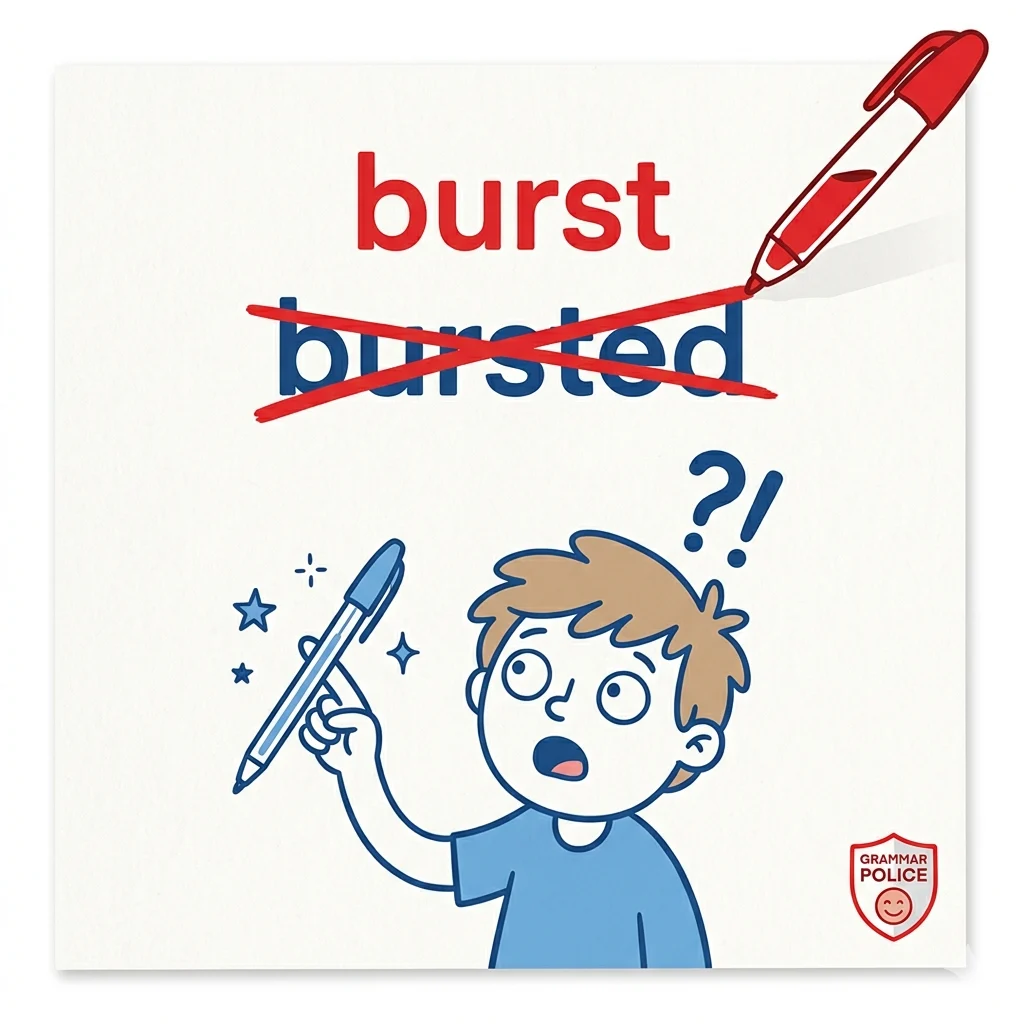
Bursted or burst past tense – here is the key rule. The past tense of burst is burst. Not bursted. You say “yesterday, the pipe burst.” You never say “yesterday, the pipe bursted.”
And what about perfect tenses? Has burst or has bursted? The correct form is always “has burst.” Example: “The water balloon has burst.” Never “has bursted.”
To understand this fully, let us look at what are V1, V2, V3, V4 verb forms for burst:
- V1 (base form): burst
- V2 (past simple): burst
- V3 (past participle): burst
- V4 (present participle): bursting
As you can see, the verb does not change. This is the signature of a strong verb.
The Origin of Burst
Why does bursted or burst cause so much confusion? The answer lies in the history of English.
The word “burst” comes from Old English “berstan,” which meant to break suddenly. This word has been used for over one thousand years. It belongs to a group called strong verbs. Strong verbs show past tense by changing their vowel sound, not by adding “-ed.
Think of these examples:
- Sing → Sang → Sung (not singed)
- Swim → Swam → Swum (not swimmed)
- Ring → Rang → Rung (not ringed)
- Begin → Began → Begun (not beginned)
- Burst → Burst → Burst (not bursted)
Strong verbs are ancient. They come from the oldest layers of English. Weak verbs, on the other hand, add “-ed” to show past tense. Examples include walk (walked), talk (talked), and jump (jumped).
Here is why people get confused. Over centuries, many strong verbs have become weak. For example, “help” was once a strong verb (healp → holp), but now we say “helped.” “Climb” was once strong (clomb), but now we say “climbed.” This change happens naturally as language evolves.
However, burst has not changed. It remains a strong verb. This is why bursted is not a word in standard English. Adding “-ed” to a strong verb breaks the historical pattern. When someone writes “bursted,” they are treating a strong verb like a weak verb. That is the root of the error.
Understanding this history makes bursted or burst grammar much easier. Once you know burst is a strong verb, you will never add “-ed” again.

British English vs American English Spelling
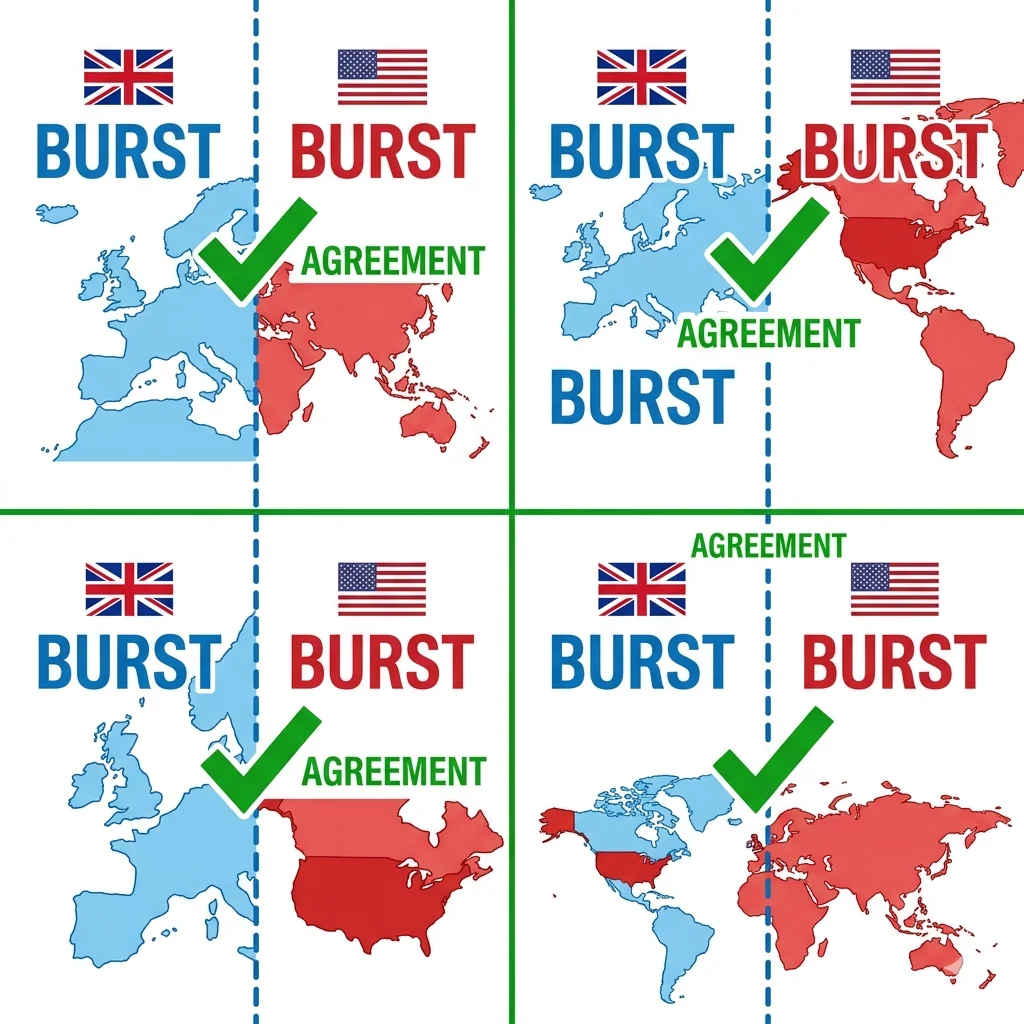
When it comes to bursted or burst, both major English varieties agree completely. This is rare. Usually, British and American English differ on spelling (colour vs color) or word choice (lift vs elevator). But on this verb, there is no difference.
Here is a comparison table showing how both versions treat burst:
| Feature | American English | British English |
|---|---|---|
| Present tense | burst | burst |
| Past tense | burst | burst |
| Past participle | burst | burst |
| Is “bursted” accepted? | No | No |
| Dictionary status | Non-standard | Non-standard |
| Formal writing rule | Use burst only | Use burst only |
| Informal speech | Rare dialect use | Rare dialect use |
Is bursted a word in British English? The Oxford English Dictionary notes “bursted” as a non-standard or obsolete form. That means it existed long ago but is no longer correct.
Is bursted a word in American English? Merriam-Webster does not list it as a standard entry. Some regional dialects in the Appalachian or Ozark regions use “bursted” in casual conversation, but this is not accepted in writing or formal speech.
What about Australian, Canadian, or Indian English? The same rule applies. All Commonwealth English follows British standards. Burst is correct. Bursted is wrong.
So when you search for bursted or burst, remember that no English-speaking country accepts “bursted” as standard. This is one of those rare grammar rules with no exceptions across dialects.
Which Spelling Should You Use?
Now that you know the rule, let me give you audience-based advice for bursted or burst.
For American Audiences
Always use burst. American schools, colleges, and employers expect standard English. If you write “bursted” in a job application, email, or report, it will look like a mistake. Standardized tests like the SAT, ACT, TOEFL, and IELTS mark “bursted” as incorrect.
For British and Commonwealth Audiences
Always use burst. British, Australian, New Zealand, Canadian, and South African English follow the same rule. Your teachers and examiners will deduct points for “bursted.”
For Global English Learners
Always use burst. If English is your second language, stick with the standard form. Learning irregular verbs is hard enough. Do not add fake ones like “bursted” to your vocabulary.
For Casual Writing (Texts, Social Media, Comments)
Still use burst. Even in informal settings, correct grammar looks better. However, if you see a friend write “bursted,” you can politely share what you learned here.
For Creative Writing and Dialogue
Use burst for narration. But if you are writing a character who speaks in a specific rural dialect, you might use “bursted” to show their speech pattern. This is the only acceptable use – and even then, use it rarely.
For SEO and Web Content
Always use burst. Search engines like Google use NLP (Natural Language Processing) to understand content. They recognize standard English. Using “bursted” can hurt your credibility and rankings.
Bursted or burst synonym – if you want variety, use synonyms like exploded, ruptured, shattered, or broke open. But when you need the exact word, choose burst.
Common Mistakes with Bursted or Burst
Even native English speakers make mistakes with bursted or burst. Here are the most common errors and how to fix them.
Mistake 1: Using “Bursted” as Past Tense
This is the number one error. People assume all verbs add “-ed” for past tense.
- ❌ Wrong: The water balloon bursted on his head.
- ✅ Right: The water balloon burst on his head.
Mistake 2: Using “Has Bursted” as Past Participle
Perfect tenses (has/have/had) need the past participle form. For burst, the past participle is also burst.
- ❌ Wrong: The storm has bursted the dam.
- ✅ Right: The storm has burst the dam.
Mistake 3: Confusing “Burst” with “Busted”
Is it bursted or busted? This confusion is very common. Let me clarify:
- Burst = to break open or explode suddenly. Example: The pipe burst.
- Busted = informal for broken, caught, or arrested. Example: The police busted the thief. Or: My phone is busted.
These words are not interchangeable. A dam bursts. A criminal gets busted.
Mistake 4: Over-Correcting Other Strong Verbs
Once you learn that bursted is not correct, some people stop using “-ed” everywhere. Do not make this error. Weak verbs still need “-ed.”
- Correct: She walked to the store. (Not “walk”)
- Correct: He jumped over the fence. (Not “jump”)
Only strong verbs change internally or stay the same.
Mistake 5: Using “Bursted” in Formal Writing
Even smart, educated writers sometimes guess wrong. They think “bursted” sounds right because of verbs like “trusted” or “adjusted.” But burst is different. Always double-check if you are unsure.
Complete Verb Conjugation for Burst
Here are what are V1, V2, V3, V4 verb forms for burst in a clear table:
| Form Name | Burst Form | Example Sentence |
|---|---|---|
| V1 (Base/Infinitive) | burst | The bubble will burst. |
| V2 (Past Simple) | burst | The bubble burst yesterday. |
| V3 (Past Participle) | burst | The bubble has burst. |
| V4 (Present Participle) | bursting | The bubble is bursting. |
| V5 (3rd Person Singular) | bursts | The bubble bursts easily. |
Remember this table. It answers has burst or has bursted (has burst), bursted or burst past tense (burst), and bursted or burst grammar (never add -ed).
Bursted or Burst in Everyday Examples
Seeing bursted or burst in a sentence helps you remember the rule. Here are real examples from different writing situations.
In Professional Emails
- ✅ Correct: “The water main burst overnight. Crews are repairing it.”
- ✅ Correct: “Our plans burst when the client changed the deadline.”
- ❌ Incorrect: “The pipe bursted.” (Never write this)
In News Headlines
News writers never use “bursted.” They follow standard English.
- “Dam Bursts in Northern California” (present tense)
- “Gas Line Burst During Construction” (past tense)
- “River Has Burst Its Banks” (present perfect)
On Social Media
Even on Twitter, Facebook, or Instagram, correct grammar looks better.
- ✅ “I burst out laughing at that video.”
- ✅ “My bubble tea burst everywhere 😭”
- ❌ “It bursted” – this looks uneducated to many readers.
In Academic and Business Writing
- “The container burst due to excessive internal pressure.”
- “Tensions between the groups burst into open conflict.”
- “The housing bubble burst in 2008, causing widespread economic damage.”
Ten Examples of Bursted or Burst in a Sentence
Here are ten correct sentences using bursted or burst in a sentence (all use burst):
- The balloon burst with a loud pop that scared the cat.
- She burst into tears when she heard the sad news.
- The river burst its banks after three days of heavy rain.
- He burst through the door without even knocking first.
- The fireworks burst in the night sky in brilliant colors.
- I burst out singing without meaning to embarrass myself.
- The grocery bag burst open and apples rolled everywhere.
- The audience burst into applause at the end of the speech.
- The stock market bubble burst and many lost their savings.
- She burst with pride when her son graduated from college.
These bursted or burst examples show the word in action. Notice how “burst” works for past, present, and perfect tenses without changing form.
Bursted or burst synonym list for variety: explode, rupture, shatter, crack, split, pop, break open, discharge, erupt, vent. Use these when you want to avoid repeating “burst” too many times.
Bursted or Burst – Google Trends & Usage Data
Data from Google and linguistic research shows how people actually use bursted or burst in the real world. The findings are clear.
Popularity by Country
- United States: “Burst” appears more than 500 times for every single appearance of “bursted” in books, news, and websites.
- United Kingdom: The ratio is similar. “Bursted” is almost non-existent in published writing.
- Canada, Australia, India: Same pattern. Standard English dominates everywhere.
Context Analysis
- Formal writing (news, books, academic papers): Burst is used 100% of the time. Bursted does not appear in edited publications.
- Casual writing (forums, comments, text messages): Burst still wins by a large margin. However, “bursted” appears occasionally from people who do not know the rule.
- Spoken English: Burst is standard. Some rural dialects in the US and UK use “bursted” in casual conversation, but linguists classify this as non-standard.
Search Data Insights
Thousands of people search is bursted a word every single month. This tells us the confusion is very real. Other popular searches include bursted or burst past tense, has burst or has bursted, and bursted meaning. People want answers. Now you have them.
Comparison Table: Burst vs Bursted vs Busted
Here is a side-by-side comparison of bursted or burst and related words:
| Word | Standard English? | Past Tense | Past Participle | Formality Level | When to Use |
|---|---|---|---|---|---|
| Burst | ✅ Yes | Burst | Burst | All levels (formal to casual) | Always |
| Bursted | ❌ No | (not used) | (not used) | Non-standard | Never (except rare dialect) |
| Busted | ✅ Yes (informal) | Busted | Busted | Informal/casual only | Casual speech, dialogue |
Bursted or burst synonym comparison: Burst is the only standard choice. Busted is a different word with a different meaning.
(FAQs)
Here are answers to the most common questions about bursted or burst.
Q1: Is bursted a correct word?
No. Is bursted a word? In standard English, no. Most dictionaries do not list it. Some old or regional dialects use it, but you should never use it in writing, school, or professional settings.
Q2: Is it bursted or busted?
These are different words. Burst means to break open or explode suddenly. Example: The pipe burst. Busted is informal for caught, arrested, or broken. Example: The police busted him. Or: My TV is busted. Do not mix them.
Q3: Has burst or has bursted?
Always has burst. For example: “The balloon has burst.” Never say “has bursted.” This is one of the most common mistakes, and now you know the correct answer.
Q4: What are V1, V2, V3, V4 verb forms for burst?
Here are what are V1, V2, V3, V4 verb forms: V1 = burst, V2 = burst, V3 = burst, V4 = bursting. The verb does not change between present and past. This is the signature of a strong verb.
Q5: Bursted or burst meaning?
The bursted or burst meaning is the same – to break open, explode, or release suddenly. However, only “burst” is correct. Bursted meaning would be the same idea, but the word itself is incorrect in standard English.
Q6: Bursted or burst in a sentence – give an example?
Here is bursted or burst in a sentence the correct way: “The water pipe burst and flooded the basement.” The incorrect way would be: “The water pipe bursted.” Always choose burst.
Q7: Bursted or burst grammar – what is the rule?
Bursted or burst grammar rule is simple: Burst is an irregular (strong) verb. It does not take the “-ed” ending for past tense or past participle. Use burst for present, past, and perfect tenses. Never add “-ed.”
Q8: Why do some people say “bursted”?
Some English dialects use “bursted” in casual rural speech. Also, people sometimes apply the regular “-ed” rule to irregular verbs by mistake. Children often say “bursted” before they learn the correct form. But this is not standard English.
Q9: Will “bursted” ever become correct?
It is possible. Language changes over time. Some irregular verbs have become regular (like “help” and “climb”). But for now, and for the foreseeable future, burst remains the only correct form. No major dictionary has added “bursted” as standard.
Q10: Is bursted a word in Scrabble?
No. Official Scrabble dictionaries do not list “bursted.” You cannot use it in tournament play. Stick with “burst” to score points.
Q11: How do I teach children the difference?
Tell them: “Burst is a magic word. It stays the same whether it happened now, yesterday, or long ago. We never add -ed to burst.” Give them examples like sing/sang/sung to show other magic words.
Q12: Is bursted ever acceptable in poetry?
Sometimes poets break grammar rules for rhythm or rhyme. But even then, “bursted” is very rare. Most poets use “burst” because it sounds stronger and cleaner.
Conclusion
Let me summarize everything you need to know about bursted or burst.
The clear answer is burst. Burst is correct for present tense, past tense, and past participle. Bursted is not a standard English word. You should avoid it in all formal writing, professional emails, academic papers, and most casual situations.
Remember these key rules:
- Bursted or burst past tense: The past tense is burst.
- Has burst or has bursted: Always “has burst.”
- Is bursted a word? No.
- Is it bursted or busted? Two different words. Burst = explode. Busted = caught/broken (informal).
- What are V1, V2, V3, V4 verb forms? Burst, burst, burst, bursting.
- Bursted or burst meaning: Same meaning, but only burst is correct.
- Bursted or burst in a sentence: Always use burst.
- Bursted or burst grammar: Burst is a strong verb. No -ed ever.
- Bursted or burst synonym: Explode, rupture, shatter, crack.
Burst is a strong verb, like sing, swim, and ring. Strong verbs do not add “-ed” to show past tense. This rule has existed for over 1,000 years. It remains true today.

Noah Syntax is a linguistics lover who finds beauty in structure and rhythm. His writing combines precision with playfulness, decoding the secrets of language for everyday readers. At Simile Mind, Noah brings clarity, humor, and insight to every metaphor he explores.