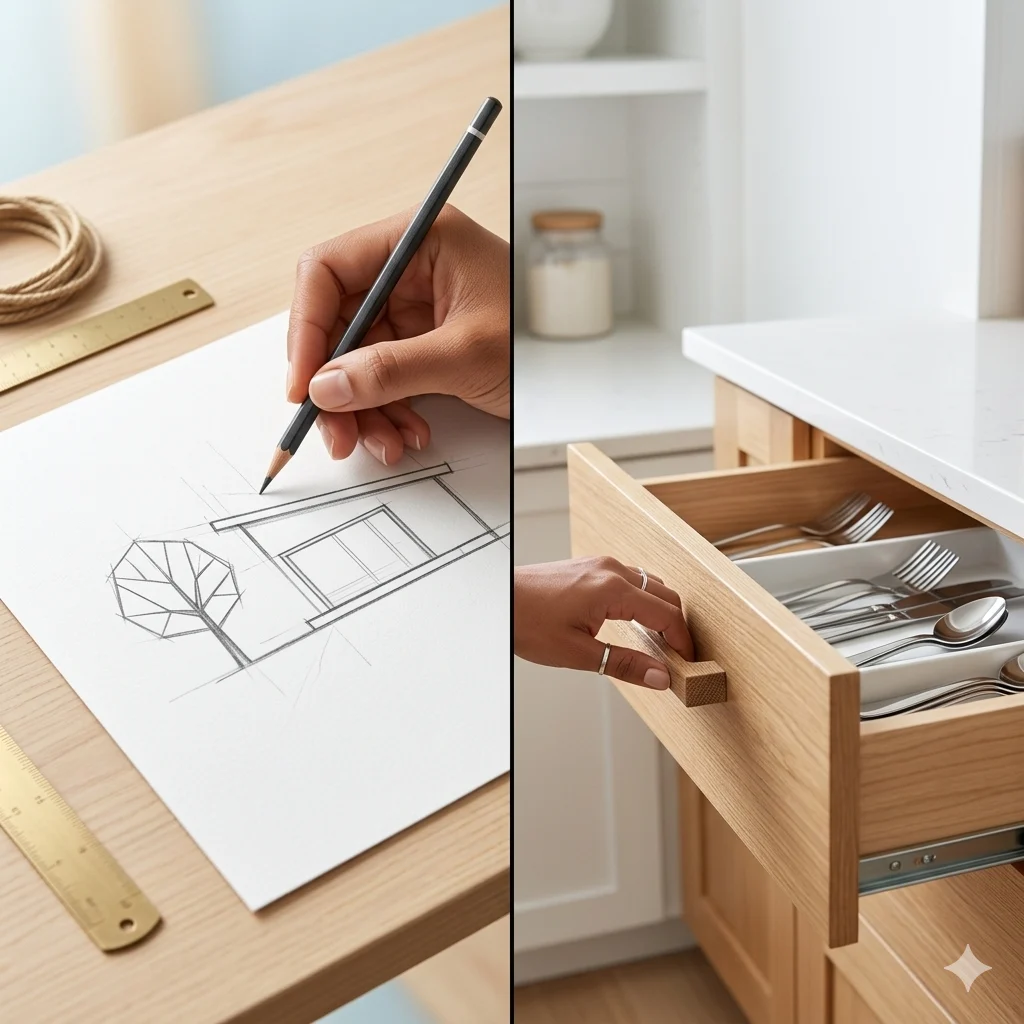
Draw = verb (to sketch, pull, or attract); Drawer = noun (a sliding storage compartment in furniture).
Draw or Drawer — do you know which word is correct? Many English learners, students, and even experienced writers confuse these two words every day. Although they look and sound similar, draw and drawer have completely different meanings and roles in a sentence.
- Draw is a verb meaning to sketch, pull, or attract. For example, you might draw a picture, draw the curtains, or draw attention to your idea.
- Drawer is a noun referring to a sliding storage compartment in furniture, such as a desk, dresser, or cabinet. For instance, you might put your socks in a drawer or open the kitchen drawer.
Understanding the difference between draw vs drawer helps you avoid common writing mistakes and communicate clearly. In this article, you’ll learn the exact meanings, multiple examples, common mistakes to avoid, and simple tips to remember when to use draw and when to use drawer correctly.
Draw or Drawer meaning
The quick answer is simple: both words are correct, but they have completely different meanings.
- Draw is a verb that usually means to create a picture with a pen or pencil, or to pull something.
- Example: “I love to draw landscapes.”
Example: “They will draw the winner’s name at noon.”
- Example: “I love to draw landscapes.”
- Drawer is a noun. It is the sliding compartment in furniture, like a desk or a chest, that you pull out to store things.
- Example: “Please find a pen in the top desk drawer.”
- Example: “I keep my socks in the bottom drawer of the dresser.”
The confusion happens because many people pronounce “drawer” as if it rhymes with “draw,” especially in casual conversation. This makes it tricky to know if you should write draw or drawer.
The Origin of Draw and Drawer
To understand why these two words are so confusing, it helps to look at where they come from. Their history explains why the spelling is different even though the pronunciation often blurs.
The verb draw comes from the Old English word dragan, which meant “to drag, pull, or draw.” This is why we still use it in phrases like “draw the curtains” or “draw a cart.” The artistic meaning—creating a picture—came later. It’s based on the idea of “drawing” a line or “pulling” a pencil across paper.
The word drawer is simply the verb draw with the suffix *-er* added to the end. In English, adding “-er” to a verb turns it into a noun that means “a person or thing that does the verb.” So, a drawer is literally “something that is drawn out.” It refers to a container in furniture that you pull or “draw” out. This is also why a person who draws a picture is technically also called an artist, not a drawer, but the furniture meaning stuck for the storage box. Over centuries, the pronunciation of the “-er” ending softened, causing “drawer” to sound more like “draw” in many accents.
British English vs American English Spelling
The spelling of these words is the same in both British and American English. Draw is always spelled D-R-A-W, and drawer is always spelled D-R-A-W-E-R. There is no difference.
However, the pronunciation is where the main difference lies, and this is the root of the entire draw or drawer confusion.
- In American English: “Drawer” is often pronounced as two syllables, sounding like “draw-er.” However, in fast speech, it can sound very close to “draw.”
- In British English: The pronunciation difference is even more striking. The standard British pronunciation of “drawer” sounds almost exactly like the word “draw.” The “-er” at the end is not strongly pronounced. This is the primary reason why so many people in the UK and Commonwealth countries, like Australia and New Zealand, ask: “Why do British people say draw instead of drawer?” They aren’t saying the wrong word; they are just pronouncing the correct word (“drawer”) in a way that sounds identical to the verb (“draw”).
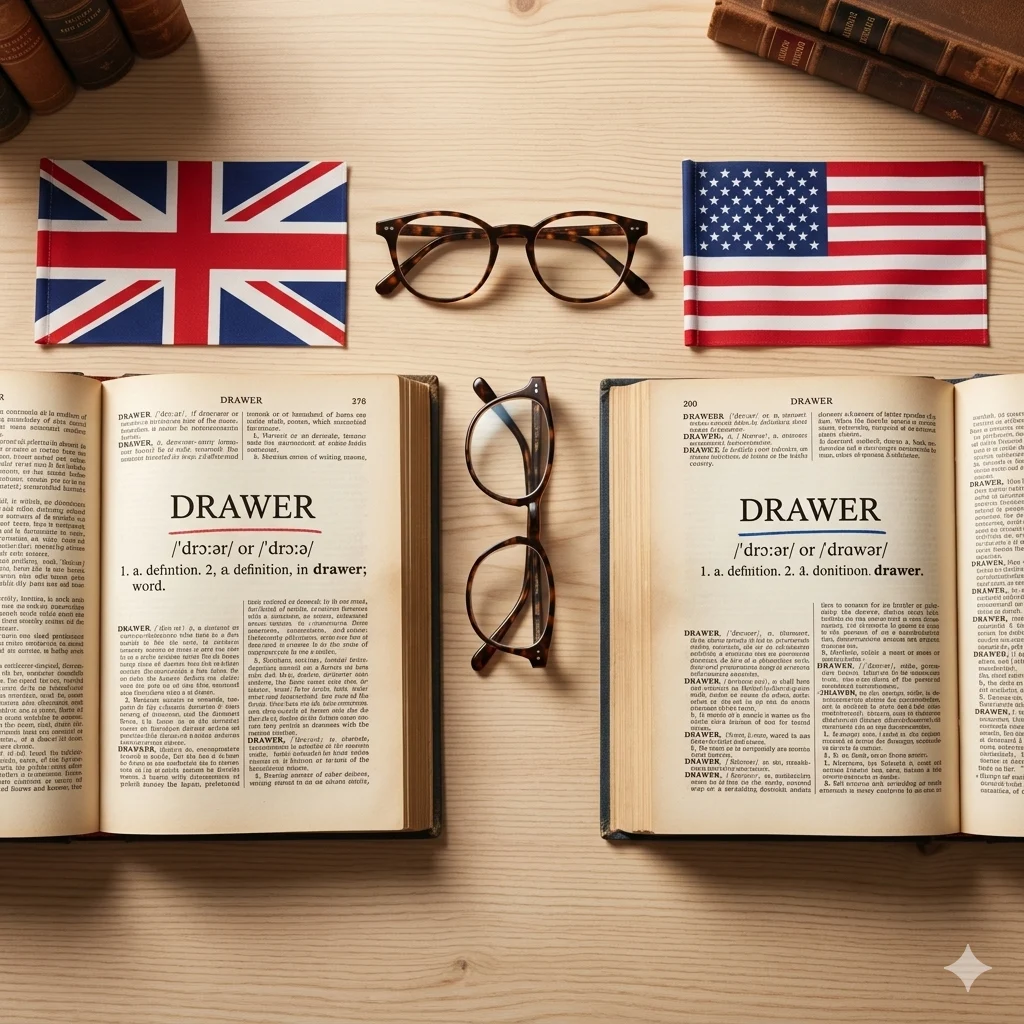
Here is a simple table to show the spelling and pronunciation side-by-side:
| Word | Part of Speech | Meaning | Spelling (UK & US) | Common Pronunciation |
|---|---|---|---|---|
| Draw | Verb (mainly) | To make a picture; to pull or attract. | D-R-A-W | /drɔː/ (drɔ) |
| Drawer | Noun | A box-shaped compartment that slides in and out of furniture. | D-R-A-W-E-R | US: /drɔːr/ (drɔr) UK: /drɔː/ (drɔ) |
Which Spelling Should You Use?
Choosing the correct spelling depends entirely on your audience and what you are trying to say.
- If you are writing for a US audience: You should be careful to spell drawer with the “-er.” While Americans pronounce the ‘r’ more clearly, it’s still easy to make a typo. Always double-check your writing.
- If you are writing for a UK, Australian, or New Zealand audience: Be extra cautious. Because the pronunciation of “drawer” sounds exactly like “draw,” it is a very common spelling mistake, even for native speakers. Always remember the context. If you are talking about furniture, it is drawer.
- If you are writing for a global audience: Clarity is key. The safest rule is to stick to the standard dictionary spellings. Use draw for artistic or pulling actions. Use drawer for the storage compartment in a desk, kitchen, or chest of drawers. If you are referring to a “prize draw or drawer,” it is definitely a “prize draw,” as it refers to the act of pulling a name.
Common Mistakes with Draw or Drawer
Even native English speakers frequently mix these up. Here are the most common errors and how to fix them.
- Mistake: “Can you open the kitchen draw for me?”
- Correction: “Can you open the kitchen drawer for me?” (You are asking for the storage space, not a picture.)
- Mistake: “I keep my important files in my bottom desk draw.”
- Correction: “I keep my important files in my bottom desk drawer.”
- Mistake: “She entered a contest to win a car in a raffle drawer.”
- Correction: “She entered a contest to win a car in a raffle draw.” (Here, it’s the event of picking a name, not a piece of furniture.)
- Mistake: “He is a talented drawer.”
- Correction: “He is a talented artist.” While technically correct (a person who draws), “drawer” is almost never used for a person today. It almost always refers to furniture. Using it for a person will confuse your reader.

Inate or Innate? ThevTiny Secret You’re Always Getting Wrong 💡
Draw or Drawer in Everyday Examples
Seeing the words used in different contexts helps solidify the difference. Here is how you might encounter draw or drawer in real life.
- In an Email:
- Correct: “Please find the signed contract in the top drawer of my filing cabinet.”
- Correct: “We will draw up the final agreement by Friday.”
- On Social Media:
- Correct: “My toddler just learned to draw a smiley face!”
- Correct: “I finally organized the junk drawer in my kitchen.”
- In News Headlines:
- Correct: “The lottery draw will take place at 8 PM.”
- Correct: “The football match ended in a draw.” (Here, “draw” means a tie score).
- In Formal Writing:
- Correct: “The findings draw attention to the need for further research.”
- Correct: “The antique chest of drawers was sold at auction for a high price.”

Draw or Drawer – Google Trends & Usage Data
If we look at search data, the query “draw or drawer” is consistently high in English-speaking countries, but for slightly different reasons.
- In the United States: People search for this to confirm the spelling of the furniture item. They might also be looking for the difference between the verb and the noun.
- In the United Kingdom, Australia, and New Zealand: The search volume is also very high, driven by the pronunciation overlap. Many people in these regions are genuinely unsure if the piece of furniture is spelled “draw” or “drawer” because they pronounce them the same way. This is why you see so many variations of the question online, such as “is it a draw or drawer in the kitchen?” or “chest of draws or drawers?”
The data shows that this isn’t just a question for English learners; it’s a common point of confusion for native speakers too, particularly those with a British-influenced accent.
FAQs:
1. Why do British people say draw instead of drawer?
They aren’t saying “draw” instead of “drawer.” In many British accents, the word “drawer” (the furniture) is pronounced in a way that sounds identical to the verb “draw.” This is a feature of the accent, not a speech error.
2. What’s the difference between draws and drawers?
“Draws” is the third-person singular form of the verb “draw” (e.g., “She draws beautifully”). “Drawers” is the plural form of the noun “drawer,” meaning more than one storage compartment (e.g., “The chest has six drawers“).
3. What does drawer mean?
A drawer is a storage space. It is like a box without a top that slides in and out of a piece of furniture such as a desk, dresser, cabinet, or kitchen counter.
4. Is it chest of draws or drawers?
The correct spelling is “chest of drawers.” This is a piece of furniture containing multiple stacked drawers for storing clothes. Spelling it “chest of draws” is a very common mistake.
5. Is it a prize draw or drawer?
It is a “prize draw.” This refers to an event where a name or ticket is drawn (pulled) at random to win a prize.
6. Is it top draw or drawer?
The correct phrase is “top drawer.” This idiom means something is of the highest quality or social class. For example, “That hotel is top drawer.” It comes from the idea that the most valuable items were kept in the top drawer of a dresser.
7. How do you pronounce drawer correctly?
In American English, it is pronounced “drɔr” (one syllable with a clear ‘r’ sound). In standard British English, it is pronounced “drɔː” (sounds exactly like the word “draw,” with no ‘r’ sound).
Conclusion
Mastering the difference between draw or drawer is a simple but important step to clear and correct English. Remember the core rule: draw is an action (to create art or to pull), and drawer is a physical object (a sliding storage box).
The spelling confusion, particularly in British English, is widespread, but it is easily overcome by focusing on the context of your sentence. If you are talking about your kitchen, your desk, or your clothes, you need the word drawer. If you are talking about sketching, pulling something, or a tie in a game, you need the word draw. By keeping this simple distinction in mind, you can confidently write emails, notes, and documents without making this common error.

Ava Quillstone is a passionate wordsmith who turns everyday language into art. With a deep love for creative writing and poetic expression, Ava explores the magic of metaphors, similes, and the hidden emotions behind words. When she’s not writing for SimileMind, she’s sipping tea by a window and dreaming up new literary worlds.