“‘Business’ is the correct spelling; ‘buisness’ is a common typo that should be avoided in professional writing.”
Business or buisness? Don’t let a typo ruin your professional image! The correct spelling is business, which refers to trade, profession, or an organization providing goods or services. Buisness is a common misspelling that can make your writing look careless. For example:
- “She started her own business last year” ✅
- “Running a small business can be challenging” ✅
- “Many people mistakenly write ‘buisness’ in emails” ❌
Understanding the correct spelling not only ensures accurate writing but also helps you appear professional and credible.
In this article, you’ll learn why business is correct, common mistakes to avoid, and easy tips to remember the spelling. If you want to write confidently and avoid embarrassing errors, knowing business vs buisness is essential.
Business meanings
The correct spelling is business. The spelling “buisness” is always a mistake.
- Correct: I am starting a new business selling handmade candles.
- Incorrect: She is studying buisness management at university.
Think of it this way: the word is built from busi (like “busy”) + ness. However, the “y” in “busy” changes to an “i” when we add the suffix. So, busy + ness = business.
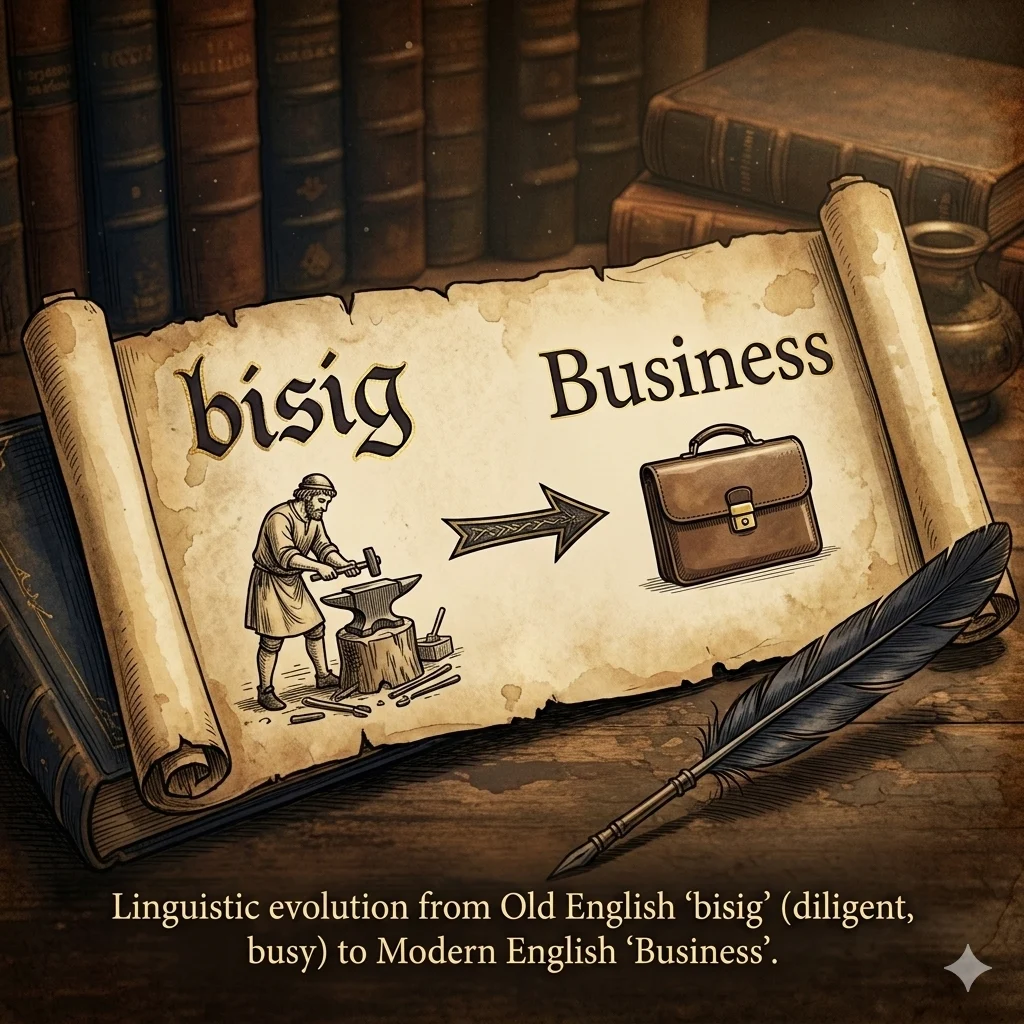
The Origin of Business
To understand why we spell it this way, we have to look at history. The word “business” comes from the Old English word bisignis, which meant “care, anxiety, occupation.” It was derived from bisig, meaning “occupied” (which later became our word “busy”).
Over centuries, the spelling evolved. For a long time, it was spelled “busyness” to directly mean “the state of being busy.” However, around the 15th century, the spelling started to shift. The “u” sound began to be written with an “i” in some contexts, and the word took on a specific economic meaning—referring to a person’s occupation or trade rather than just the state of being occupied. The spelling difference stuck, creating the modern word “business” (a commercial enterprise) which is distinct from “busyness” (the state of having a lot to do). The common misspelling “buisness” likely happens because people write the word as they hear it, swapping the ‘i’ and ‘u’ by accident.
British English vs American English Spelling
Here is some good news: when it comes to business or buisness, there is no transatlantic debate. Both American and British English agree on the correct spelling.
The confusion often comes from words that do differ, like “color” (US) vs. “colour” (UK). However, “business” is spelled the same way in all major forms of English.

Here is a comparison table to show the standard spelling against common errors:
| Correct Spelling | Common Misspelling | Language Variation | Correct Example |
|---|---|---|---|
| Business | Buisness | US, UK, Australia, Canada | I run a small business. |
| Business | Busness | US, UK, Australia, Canada | Business is booming this year. |
| Business | Bussiness | US, UK, Australia, Canada | We need to improve our business model. |
Which Spelling Should You Use?
This is simple: always use business.
- For a US Audience: Use business. It is the standard spelling in all American English dictionaries and style guides. If you are writing a resume or a proposal in the US, “buisness” will stand out as a glaring error.
- For a UK / Commonwealth Audience: Use business. The same rule applies in the UK, Canada, Australia, and New Zealand. In fact, misspelling it in a formal UK context can be seen as even more careless.
- For a Global Audience: Use business. It is the universally accepted spelling in international English. Whether you are writing for a global platform or sending an email to a client in a non-English speaking country, “business” is the correct and professional choice.
In short, there is no situation where “buisness” is correct. Stick with the standard spelling to ensure clarity and professionalism.
Common Mistakes with Business
The confusion between business or buisness is the top error, but there are a few other pitfalls to watch out for.
- Buisness (The ‘UI’ Swap):
- Error: “He works in the finance buisness.”
- Correction: “He works in the finance business.”
- Tip: Remember it’s “busi” as in “busy,” not “bui.”
- Business vs. Busyness:
This is a classic mix-up. Business (one syllable when spoken quickly) refers to a company or commerce. Busyness (three syllables: bus-y-ness) refers to the state of being busy or full of activity.- Error: “The busyness of the new shop is overwhelming.” (This implies the activity of the shop is overwhelming, which could be correct, but it’s often used incorrectly to mean the shop itself).
- Correction: “The business of the new shop is overwhelming.” OR “The busyness of the city streets is exciting.”
- Example of difference: “Her busyness (being busy) at work helped the business (the company) grow.”
- In the Business vs. On the Business:
This is a grammar issue related to prepositions.- “In the business” means being involved in a particular industry or sector. Example: “She is in the fashion business.”
- “On the business” usually refers to a trip or activity related to your work. Example: “He is traveling to Tokyo on business.”
Using one for the other can change the meaning of your sentence.

Business in Everyday Examples
Seeing the word used correctly in different contexts helps solidify the spelling in your mind.
- In a Professional Email:
“Dear Ms. Davar, I am writing to discuss a potential business partnership between our companies. I believe a collaboration would be mutually beneficial.” - In a News Headline:
“Local Business Owners Express Concern Over New Tax Laws.” - On Social Media:
“Just launched my new business website! Link in bio to check it out. #smallbusiness #entrepreneur” - In a Formal Report:
“The primary objective of this report is to analyze the business strategies employed by the leading competitors in the software market.” - In a Text Message (Informal):
“Hey, sorry I’m late. Had some business to take care of at the office.” - Discussing Ideas:
“Do you have any business ideas for a small town? I’m thinking of opening a coffee shop.”
Business – Google Trends & Usage Data
Data from tools like Google Trends shows that the misspelling “buisness” is surprisingly common. While “business” is searched for billions of times, the misspelling still gets thousands of searches per month globally. This confirms that it is a widespread point of confusion.
Interestingly, the search for the correct spelling between business or buisness is popular in both English-speaking and non-English-speaking countries. In the US and UK, people often search for it out of a moment of doubt. In countries like India, Germany, and Brazil, where English is a second language, the search volume is also high as learners work to master tricky English spellings.
The search for “business or busyness” also spikes periodically, often when people are writing and confusing the two terms. The data makes it clear: this is a universal spelling hurdle for writers at all levels.
(FAQs)
1. What is the correct spelling of buisness?
The correct spelling is business. “Buisness” is a common misspelling and is never correct.
2. What’s the difference between buisness and business?
There is no difference in meaning because “buisness” isn’t a word. It is simply an incorrect spelling of the word “business,” which refers to commerce, trade, or a company.
3. How do British spell business?
People in the UK spell it exactly the same as in the US: b-u-s-i-n-e-s-s. There is no British variation of this word.
4. What is the difference between “in the business” and “on the business”?
“In the business” means being part of an industry (e.g., “in the music business”). “On business” means traveling or acting for work purposes (e.g., “He is in London on business”).
5. Is it “business” or “buisness” correct spelling?
“Business” is the only correct spelling. If you type “buisness,” spell-check software will flag it as an error.
6. What is the difference between business and busyness?
Business is a noun meaning a commercial organization or commercial activity. Busyness is a noun meaning the state of having a lot of activity or work. You can remember it as: Your busyness (activity) might help your business (company) succeed.
7. How can I remember how to spell business?
A popular memory trick is to remember the phrase: Bus + In + Ess. Imagine a bus (bus) driving into a lake of the letter ‘S’ (ess). “The bus is in ess” sounds like “business.”
8. What is a good business idea?
Business ideas are everywhere. Look for problems you can solve in your community. Ideas include a local cleaning service, an online store for a specific hobby, freelance graphic design, or a food truck.
Conclusion
To wrap up, the verdict on business or buisness is clear: business is the one and only correct spelling. This word, rooted in the Old English for “busy,” has evolved to define our commercial world, but its spelling often trips people up. We’ve seen that this spelling is consistent across all English dialects, from the US to the UK, and that confusing it with “busyness” can change your meaning entirely. Whether you are brainstorming new business ideas, writing a formal proposal, or just sending a quick message, using the correct spelling builds trust and shows attention to detail. Remember the simple trick: think of “busy” and add “ness.” By keeping this guide in mind, you can confidently use “business” in your writing and avoid the common “buisness” error forever.

Lena Wordsworth is a literary enthusiast with a gift for bringing language to life. Her passion lies in helping readers fall in love with words through vivid imagery and emotional storytelling. At Simile Mind, Lena’s articles inspire creativity and curiosity in every reader.