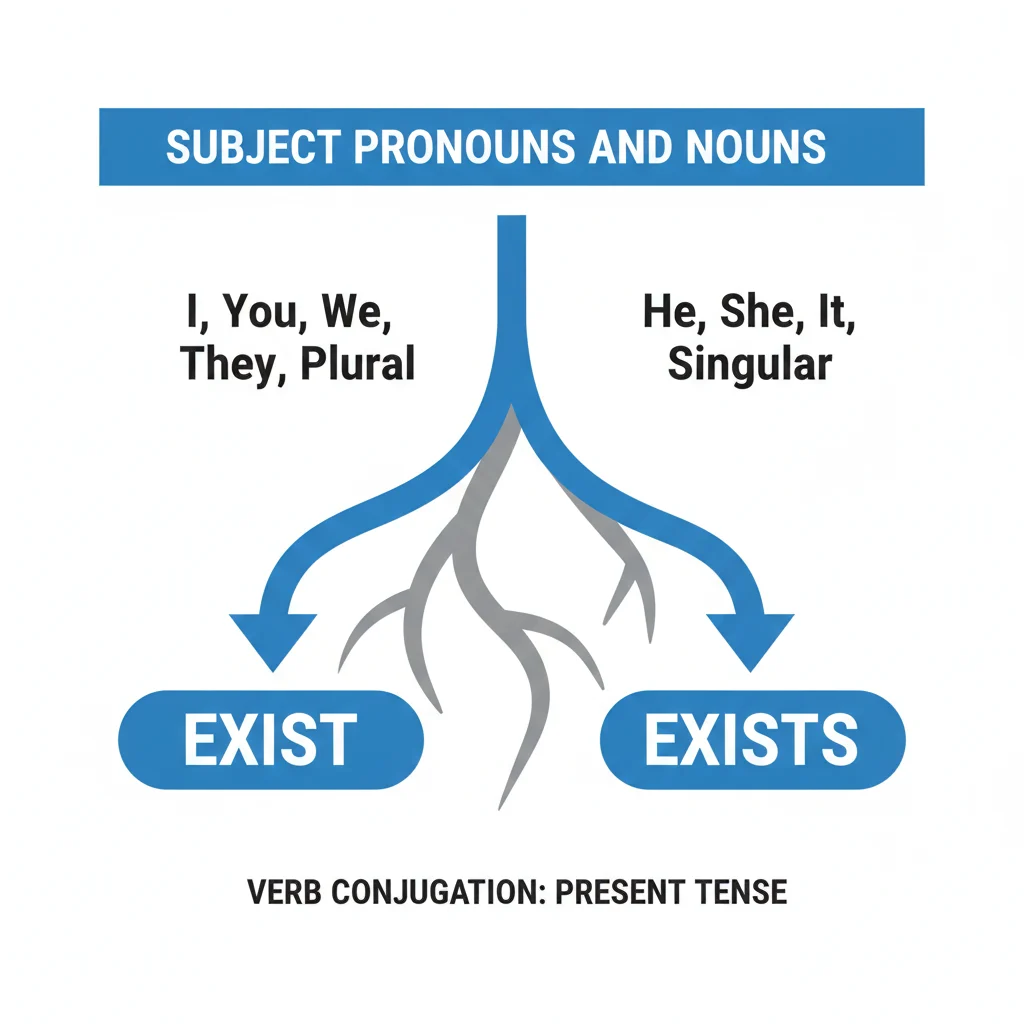
Exist or Exists: The difference between exist and exists is that exist is the base form of the verb used with plural subjects and pronouns like I, you, we, and they, while exists is the third-person singular form used with singular subjects such as he, she, it, or a singular noun. For example, you would say, “Many opportunities exist,” but “A solution exists.”
Choosing between exist and exists may seem confusing, but one simple grammar rule makes the correct choice easy. Both words have the same meaning—to be real, present, or have being—but they are used with different subjects. Using the correct form improves your English grammar, makes your sentences sound more natural, and helps you avoid one of the most common subject-verb agreement mistakes. Once you understand this rule, you’ll be able to choose the right word with confidence every time.
Many English learners search for exist or exists because they’re unsure which form is grammatically correct in different sentences. Whether you’re writing an essay, email, report, school assignment, professional document, or everyday message, knowing when to use exist and exists helps you communicate more clearly and accurately. This simple rule is easy to learn and even easier to remember with the right examples.
In this guide, you’ll learn the exact difference between exist and exists, their meanings, grammar rules, sentence structure, common mistakes, and plenty of easy examples to help you master the correct usage. By the end of this article, you’ll know exactly when to use each word and avoid this common English grammar mistake with confidence.
Exist or Exists meanings
The choice between exist and exists depends on the subject of your sentence. Use exists for singular, third-person subjects (he, she, it, the cat, the problem). Use exist for plural subjects (they, we, you, the cats, the problems) and with “I.”
This is the standard rule for most English verbs in the present tense.
Examples:
- “A solution exists.” (Singular subject: “a solution”)
- “Many solutions exist.” (Plural subject: “many solutions”)
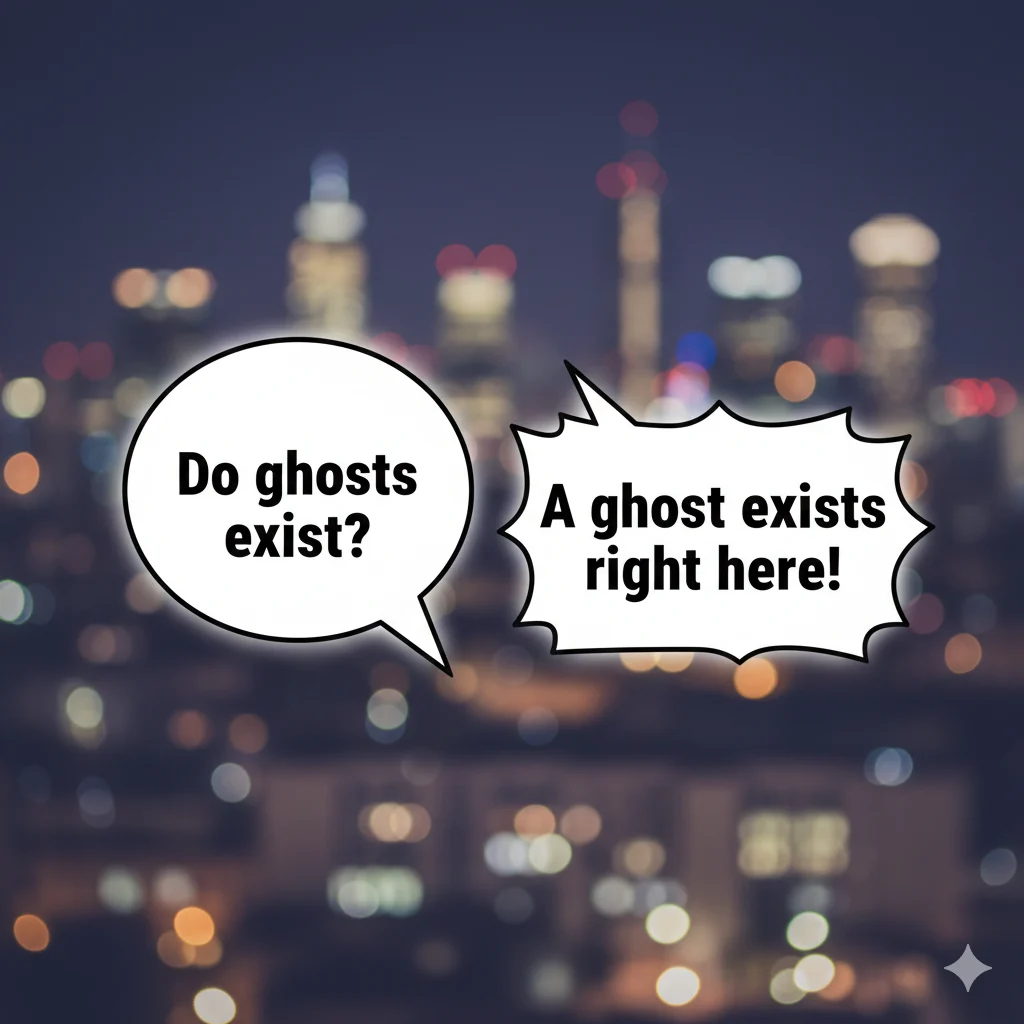
- “Does a ghost exist?” (Singular subject in a question: “a ghost”)
- “Do ghosts exist?” (Plural subject in a question: “ghosts”)
The core rule is simple: Singular subject = exists. Plural (or I/you) subject = exist.
The Origin of “Exist” and “Exists”
The verb “exist” comes from the Latin word existere, meaning “to stand forth, appear, exist.” It entered English in the late 16th century. Like most verbs inherited from Latin and other languages, it follows standard English conjugation patterns.
The “s” ending in “exists” is a remnant of Old English grammar. Hundreds of years ago, English verbs had many more endings to show person and number. Over time, most of these endings disappeared, leaving us with a simplified system. The “-s” ending is one of the last survivors, specifically marking the third-person singular present tense (he/she/it [verb]s).
This is why we say “I exist,” “you exist,” but “he exists,” “the idea exists.” The confusion happens because this “-s” rule feels unique compared to other languages and because in questions and negatives with “does/doesn’t,” the main verb reverts to its base form (“exist”), which can be tricky.
British English vs. American English Spelling
For the words exist and exists, there is no spelling difference between British and American English. The variation is purely grammatical, based on subject-verb agreement, not regional spelling.
Both dialects follow the exact same rule:
- Singular third-person subject → exists.
- All other subjects (I, you, we, they, plural nouns) → exist.
The consistency across English dialects makes this rule even more powerful to learn. Whether you’re writing for a London-based journal or an American website, the application is identical.
| Feature | American English | British English |
|---|---|---|
| Base Verb | exist | exist |
| 3rd Person Singular | exists | exists |
| Key Rule | Add “-s” for he/she/it singular subjects. | Add “-s” for he/she/it singular subjects. |
Which Spelling Should You Use?
Your choice depends entirely on your sentence’s subject, not your location.
For US Audiences: Use exists with singular, third-person subjects. This rule is strictly followed in all formal and informal writing.
For UK/Commonwealth Audiences: The rule is the same. Use exists for he/she/it singular subjects.
For Global/International English: This is a universal grammar rule. Mastering “exist” vs. “exists” is essential for clear communication in international business, academia, and online content. Always default to the subject-verb agreement rule.
Simple Check: Identify your subject. If it can be replaced with “he,” “she,” or “it,” use exists. If it can be replaced with “they,” “we,” or “you,” use exist.
Common Mistakes with “Exist” and “Exists”
The most frequent error is using “exist” with a singular subject.
- Incorrect: “A problem exist here.”
- Correct: “A problem exists here.”
Another common mistake happens in questions with “does.” Remember, “does” already carries the third-person “-s,” so the main verb should be in its base form.
- Incorrect: “Does it exists?”
- Correct: “Does it exist?”
- Why: “Does” is the conjugated verb agreeing with “it.” “Exist” remains in its base form.
The same logic applies to negative statements:
- Incorrect: “It doesn’t exists.”
- Correct: “It doesn’t exist.”
“Exist” and “Exists” in Everyday Examples
In an Email:
- “I want to confirm that an opportunity exists for collaboration.” (Formal, singular subject)
- “Do any time slots exist next week?” (Question with plural subject)
In News Headlines:
- “New Evidence Exists, Says Report.” (Singular subject)
- “Doubts Exist Over New Policy.” (Plural subject)
On Social Media:
- “Proof that good people still exist.” (Plural subject implied: “people”)
- “A glitch exists in the new update.” (Singular subject)
In Formal/ Academic Writing:
- “The data suggests a correlation exists.” (Singular)
- “Several theories exist to explain this phenomenon.” (Plural)

“Exist” and “Exists” – Google Trends & Usage Data
Search data shows that “exist or exists” is a consistently searched phrase globally, indicating ongoing confusion. Interest is fairly evenly spread between English-speaking countries like the US, UK, Canada, and Australia, as well as non-native English countries like India and the Philippines, where learners frequently seek grammar clarity.
The related search “does it exist” is significantly more common than “does it exists,” demonstrating that the correct grammatical form is ultimately more prevalent in actual usage. Searches often spike during academic cycles (back-to-school, exam periods), showing students actively seeking to correct their writing.
Keyword Comparison Table
| Keyword | Part of Speech | When to Use | Example Sentence |
|---|---|---|---|
| Exist | Verb (base form) | With I, you, we, they, and plural nouns. In questions with “do” or after “does/doesn’t.” | “I exist. You exist. Opportunities exist. Do they exist?” |
| Exists | Verb (3rd person singular) | With he, she, it, and singular nouns. | “She exists. It exists. A chance exists. He exists.” |
| Existed | Verb (past tense) | For all subjects when referring to the past. | “It existed. They existed. I existed.” |
| Existing | Verb (present participle) | Used for continuous tenses or as an adjective. | “The existing problem. They are existing on very little.” |
FAQs: Exist vs. Exists
Do you say exist or exists?
You say exists when the subject is one person or thing (he, she, it, the book). You say exist when the subject is plural (they, the books) or is “I” or “you.”
When to use exists?
Use exists only with singular, third-person subjects. For example: “The file exists on the server.” “Hope exists.”
Does something exist or exists?
The correct phrase is “Does something exist?” In questions with “does,” the main verb (“exist”) stays in its base form without an “s.”
Is it ever exist or exists?
Yes, it is “it exists” in a normal statement (“It exists in two versions.”). It becomes “does it exist” in a question (“Does it exist elsewhere?”).
What is a synonym for exist?
Common synonyms include: live, be, occur, be present, be found, prevail, and subsist.
Can you give an example of “exist” in a sentence?
“Many ancient traditions still exist today.” (Plural subject: “traditions”)
“Does life exist on other planets?” (Question with “does”: life = singular subject)
What does “it exists” mean?
“It exists” simply means that something is real, present, or can be found. It confirms the presence or reality of a singular thing. Example: “The document was lost, but a copy exists.”
Conclusion
Mastering the difference between exist and exists boils down to one fundamental grammar rule: subject-verb agreement. Remember, the “-s” attaches to the verb when your subject is a singular “he,” “she,” or “it.” For everything else—I, you, we, they, and all plural nouns—use the base form exist. This rule remains consistent across all forms of English, making it a reliable tool for any writer.
To avoid common pitfalls, be especially careful when forming questions. The helper verb “does” takes on the “-s,” freeing “exist” to remain in its simple form: “Does it exist?” By applying this straightforward check to your sentences, you can eliminate doubt and write with greater confidence and precision. Clear communication exists at the foundation of good writing, and getting these small details right makes a significant impact.

Noah Syntax is a linguistics lover who finds beauty in structure and rhythm. His writing combines precision with playfulness, decoding the secrets of language for everyday readers. At Simile Mind, Noah brings clarity, humor, and insight to every metaphor he explores.