“Gibberish and jibberish both refer to meaningless or nonsensical speech, but ‘gibberish’ is more commonly used and widely accepted.”
Gibberish or jibberish — which one is correct, and are they really the same? Both words describe speech or writing that is nonsensical, meaningless, or hard to understand. The main difference lies in usage and popularity:
gibberish is widely recognized and used in everyday English, while jibberish is less common and often considered a variant or misspelling.
For example: “He was speaking in complete gibberish” sounds natural and correct, while “I couldn’t understand a word — it was total jibberish!” might be understood but is less standard. Understanding this distinction ensures your writing and speech remain clear, professional, and grammatically accurate.
In this article, you’ll discover the exact differences, history, correct usage, and common mistakes between gibberish vs jibberish. You’ll also get real-life examples and tips to confidently use the right word in any context. By the end, you’ll never mix them up again, whether you’re writing, speaking, or teaching English.
Gibberish or Jibberish meanings
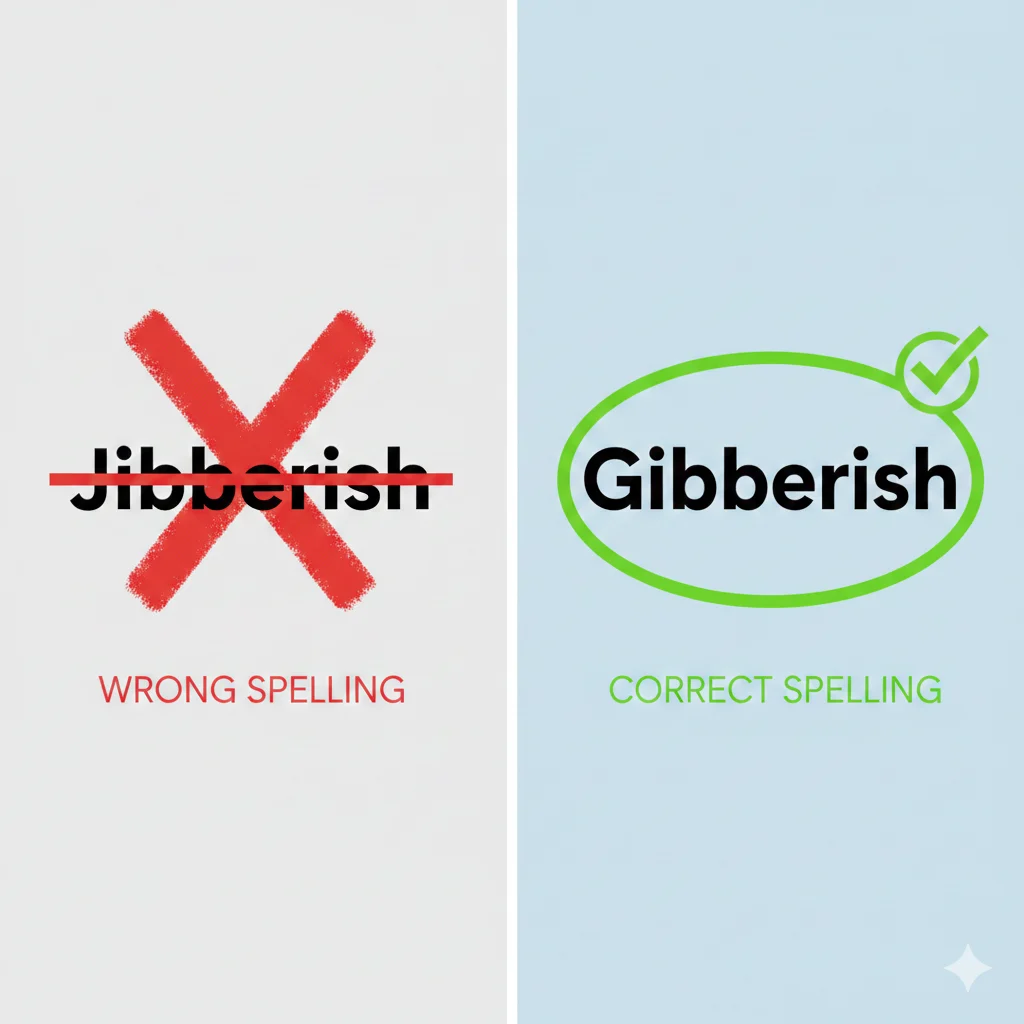
The correct spelling is GIBBERISH with a G.
How do you spell gibberish or jibberish? The only correct spelling is G-I-B-B-E-R-I-S-H. If you write “jibberish,” spell check will mark it wrong every time.
What does gibberish mean? It means speech or writing that is nonsense and has no meaning. When someone says things that do not make sense, they are speaking gibberish. When you read something confusing, you might say it is gibberish.
Gibberish or jibberish examples:
- “The technical manual was full of gibberish I could not understand.”
- “My grandfather started speaking gibberish after his fever got worse.”
- “The email looked important, but it was just random gibberish from a spammer.”
So why do so many people spell it jibberish? The answer is simple. When you check gibberish or jibberish pronunciation, both sound identical. The letter G in “gibberish” is soft, which means it sounds exactly like a J. Your ears hear a J sound, so your hand wants to write a J. This is called a phonetic spelling error, and it happens to almost everyone at some point.
Gibberish language is not a real language. It is a term we use to describe something that sounds like language but has no actual meaning. Babies often babble in what sounds like a gibberish language before they learn real words. Some comedians pretend to speak a gibberish language to sound like they are from another country.
The Origin of Gibberish
The word gibberish has been around for hundreds of years. It first appeared in English during the 1500s, and its origin connects directly to how people talk when they are nervous or excited.
The most widely accepted explanation is that gibberish comes from the verb “gibber.” To gibber means to speak rapidly and in a way that is hard to understand. Imagine someone who is scared or shocked. They might start making quick, meaningless sounds. That action is gibbering, and the result is gibberish. The word was created to imitate the sound itself, similar to how “buzz” sounds like a bee.
Another interesting theory connects gibberish to an alchemist named Geber. He lived hundreds of years ago and wrote about science using complex secret codes. People who tried to read his work found it completely impossible to understand. Some language experts believe his name became linked to confusing writing, eventually turning into the word gibberish we use today.
The word has also influenced how we describe confusing official language. When government workers or companies use fancy words that regular people cannot understand, we sometimes call that gobbledygook. This is different from gibberish or jibberish because gobbledygook uses real words in overly complex ways, while gibberish can be completely made up.
If you have ever wondered what does zibrish mean, you might be surprised. Zibrish is not a real word at all. It is a common mishearing of gibberish. Some people hear the soft G and think they hear a Z sound at the beginning. This mistake happens often with children or people learning English as a second language. The correct term remains gibberish, and zibrish does not appear in any dictionary.
British English vs American English Spelling
When it comes to gibberish or jibberish, the spelling stays the same everywhere. Both British and American English use GIBBERISH. The difference appears when you ask how do you say gibberish in British English.
Gibberish or jibberish pronunciation changes slightly depending on where you live. Americans pronounce the R sound more strongly. Brits soften the R or drop it completely. Here is how it breaks down:
- American pronunciation: JIB-err-ish
- British pronunciation: JIB-uh-rish
In both cases, the word starts with a clear J sound. This is why the spelling confusion exists. You pronounce it with J but write it with G. This is one of the many cases where English spelling does not match English sounds.
Gibberish or jibberish grammar rules treat this word as a noun. You cannot have “a gibberish” like you would have “a car.” It is an uncountable noun. You would say “much gibberish” or “a lot of gibberish,” not “many gibberishes.”
Here is a simple table showing the differences:
| Feature | American English | British English |
|---|---|---|
| Spelling | Gibberish | Gibberish |
| Pronunciation | JIB-err-ish | JIB-uh-rish |
| R sound | Strong and clear | Soft or silent |
| Common usage | “That sounds like gibberish to me” | “It’s all gibberish, mate” |
Which Spelling Should You Use?
The answer to is it gibberish or jibberish depends entirely on where you are writing. If you are writing for school, work, or any formal purpose, use GIBBERISH. This is the only spelling accepted in the gibberish or jibberish dictionary. Open any dictionary, and you will find gibberish. You will never find jibberish listed as an alternative spelling.
For different audiences, here is what works best:
- US audience: Use gibberish. Americans follow the standard dictionary spelling just like everyone else.
- UK and Commonwealth audience: Use gibberish. British English, Australian English, and Canadian English all prefer the G spelling.
- Global audience: Use gibberish. This is the safe choice that works everywhere.
- Informal writing: Even in texts or social media, use gibberish. It takes only one extra second to type the G correctly.
Gibberish translator tools have become popular online. People use them to turn normal sentences into nonsense for fun. If you search for a gibberish translator, you will find websites that scramble your words into meaningless text. These tools use the correct spelling of gibberish because they follow standard English rules.
Gibberish meaning stays the same in all contexts. Whether you are in New York or London, gibberish meaning is always nonsense or meaningless speech. There is no difference in definition between regions.
Common Mistakes with Gibberish
People make several mistakes with this word beyond just the spelling. Understanding these errors will help you use gibberish correctly every time.
Mistake 1: Spelling it jibberish
This is the most common error. Because of gibberish or jibberish pronunciation, the J spelling feels natural. Always remember the G.
Mistake 2: Spelling it gibberish or jibberish with one B
Some people write “giberish” or “jiberish.” The correct spelling has two Bs in the middle. G-I-B-B-E-R-I-S-H.
Mistake 3: Using zibrish
What does zibrish mean? Nothing. It is not a word. If you hear someone say zibrish, they are mispronouncing gibberish. This mistake happens when people think they hear a Z at the beginning instead of a soft G or J sound.
Mistake 4: Using it as a countable noun
You cannot say “I heard three gibberishes today.” Gibberish or jibberish grammar rules make this an uncountable noun. Say “three instances of gibberish” or “a lot of gibberish.”
Mistake 5: Confusing it with jargon
Jargon is specialized language that experts understand. Gibberish is meaningless to everyone. If a doctor uses medical terms you do not know, that is jargon. If a doctor says random nonsense words, that is gibberish.
Mistake 6: Mispronouncing the G sound
Some people try to pronounce gibberish with a hard G, like in “gift.” This sounds unnatural. The correct gibberish or jibberish pronunciation always uses the soft J sound, no matter how you spell it.
Gibberish in Everyday Examples
Seeing gibberish used in real situations helps lock in the correct usage. Here are examples from different types of writing and speaking.
In emails:
“Sorry for the confusion earlier. That attachment was complete gibberish. Let me send you the correct file.”
“The instructions in the user manual were gibberish. I had to watch a video instead.”
In news articles:
“The politician’s response was dismissed as gibberish by reporters who could not make sense of his words.”
“Experts reviewed the ransom note and determined it was gibberish, likely written by someone pretending to be a hacker.”
On social media:
“This app update is gibberish. Nothing works the way it used to.”
“My cat walked across my keyboard and typed pure gibberish. Deleting now.”
In formal writing:
“The witness testimony was deemed gibberish and was not entered into evidence.”
“The manuscript appeared to be written in a gibberish language, leading scholars to question its authenticity.”
Gibberish or jibberish examples in conversation:
Person A: “Did you understand what he said?”
Person B: “Not a word. It was all gibberish to me.”
Gibberish words are sometimes used intentionally. Nonsense words like “blarf” or “snazzle” are examples of gibberish words that sound real but have no meaning. Writers and comedians create gibberish words for humor or to fill space in fantasy stories.
Gibberish – Google Trends and Usage Data
Search data shows that is it gibberish or jibberish is one of the most frequently asked spelling questions online. People in English-speaking countries search for this word millions of times each year.
In the United States, searches for gibberish or jibberish spike during back-to-school season. Students writing papers want to make sure they use the correct spelling. In the United Kingdom, searches often include how do you say gibberish in British English as people become curious about pronunciation differences.
Gibberish meaning searches happen most often when a confusing news event occurs. When public figures say things that make no sense, people rush to look up the exact definition of gibberish to describe it accurately.
The word is also popular in entertainment searches. Gibberish language videos on social media platforms get millions of views. People create videos pretending to speak foreign languages, but they are actually speaking gibberish. These videos often include captions asking what does gibberish mean because viewers are curious about the concept.
Gibberish translator tools have seen steady growth in popularity. People use them to generate funny text messages or to create secret codes with friends. The search term gibberish translator often appears alongside questions about gibberish words and how to create them.
In professional settings, searches for gibberish or jibberish grammar increase when people need to use the word in business writing. The confusion about whether it is countable or uncountable leads many to check grammar guides before sending important emails.
Frequently Asked Questions
Is it spelled gibberish or jibberish?
The correct spelling is gibberish with a G. Jibberish is a common misspelling based on how the word sounds when spoken.
What does gibberish mean?
Gibberish means speech or writing that is nonsense and has no meaning. It can also refer to words that sound like language but are completely made up.
What does zibrish mean?
Zibrish is not a real word. It is a mispronunciation or mishearing of gibberish. Some people think they hear a Z sound at the beginning, but the correct word is gibberish.
How do you say gibberish in British English?
In British English, gibberish is pronounced JIB-uh-rish. The R at the end is soft or silent compared to the American pronunciation JIB-err-ish.
Can gibberish be a language?
No, gibberish is not a real language. A gibberish language is a term used to describe made-up speech that sounds like language but has no grammar, vocabulary, or meaning.
How do you use gibberish in a sentence?
You can say “The instructions were complete gibberish” or “Stop speaking gibberish and tell me what happened.” It is an uncountable noun, so do not say “gibberishes.”
Is there a gibberish translator?
Yes, many websites offer gibberish translator tools. These take your normal text and convert it into random nonsense words for fun or creative projects.
Why do people say jibberish instead of gibberish?
People say and write jibberish because of pronunciation. The word starts with a soft G that sounds exactly like a J. Your ears hear J, so your brain sometimes wants to write J.
What are some gibberish words?
Gibberish words are made-up terms that have no real meaning. Examples include “flibbertigibbet,” “thingamajig,” or random sounds like “blah blah blah.” These are considered gibberish words because they do not mean anything specific.
Conclusion
Understanding the difference between gibberish or jibberish comes down to one simple rule. The correct spelling is always GIBBERISH with a G. The confusion exists because of gibberish or jibberish pronunciation, which makes the G sound exactly like a J. This phonetic trick trips up even experienced writers.
The gibberish meaning has remained consistent for centuries. It describes nonsense, meaningless speech, or words that sound real but have no actual definition. Whether you are dealing with a confusing email, a baby’s babbling, or someone pretending to speak a foreign language, gibberish is the perfect word to describe it.
When writing for any audience, remember that gibberish is the only correct form. The gibberish or jibberish dictionary entries all show the G spelling. The gibberish or jibberish grammar rules treat it as an uncountable noun. The gibberish language concept refers to made-up speech, not a real way of communicating.
If you ever hear someone ask what does zibrish mean, you can confidently explain that the correct word is gibberish. If you need to know how do you say gibberish in British English, remember the softer R sound. For gibberish or jibberish pronunciation in America, pronounce the R clearly. The spelling never changes.

Lena Wordsworth is a literary enthusiast with a gift for bringing language to life. Her passion lies in helping readers fall in love with words through vivid imagery and emotional storytelling. At Simile Mind, Lena’s articles inspire creativity and curiosity in every reader.