“Everyone’s” is correct because it is the possessive form of “everyone,” while “everyones” without an apostrophe is incorrect in standard English.
Still unsure where to place the apostrophe in everyone’s? You’re not alone—this is one of the most common apostrophe mistakes in English. The rule is simple: “everyone’s” (with an apostrophe) shows possession, meaning something belongs to everyone. The word “everyones” (without an apostrophe) is not grammatically correct in standard English.
For example:
✔ Everyone’s opinion matters.
Here, “everyone’s” means the opinion belongs to everyone.
If you’ve ever searched for the difference between everyone’s vs everyones, wondered about apostrophe rules, or felt confused about possessive forms, this guide will make it clear in minutes. In this article, you’ll learn the quick grammar rule, easy examples, common mistakes to avoid, and a simple memory trick so you never make this error again.
Everyone’s meanings
The quick answer is that “everyone’s” is the only correct form in standard English. The word “everyones” (without an apostrophe) is always a grammar mistake.
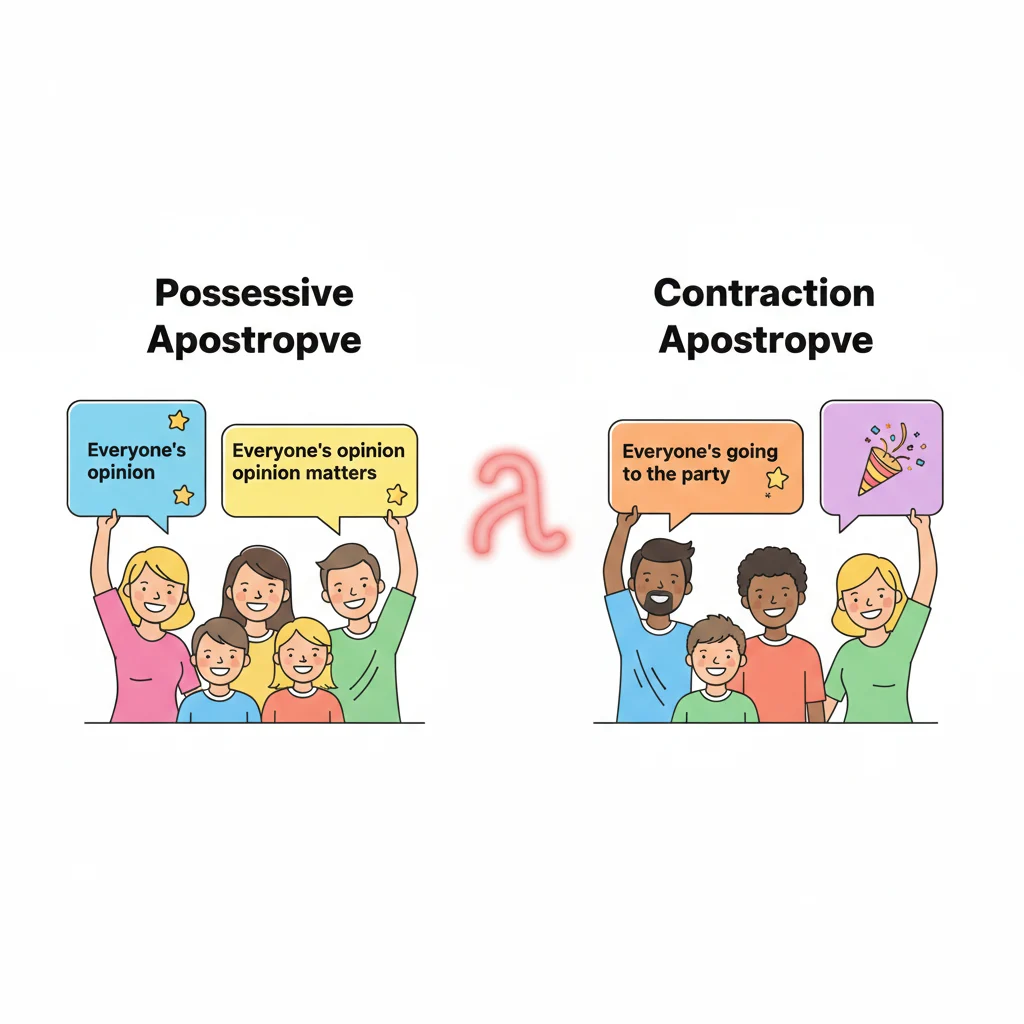
Here is the simple breakdown of why “everyone’s” has two very different jobs:
- Possessive Form: It shows that something belongs to every person in a group.
- Example: “Everyone’s opinion matters in this meeting.”
- Example: “The teacher checked everyone’s homework.”
- Contraction (Short Form): It is a short way of saying “everyone is.”
- Example: “Don’t worry, everyone’s going to the party.” (Here, “everyone’s” means “everyone is.”)
- Example: “I think everyone’s ready to leave now.” (Here, “everyone’s” means “everyone is.”)
Remember: If you can replace it with “everyone is,” use the apostrophe. If you are showing ownership, use the apostrophe. You cannot use “everyones” for either of these jobs.
The Origin of Everyone’s
To understand why we write “everyone’s,” it helps to look at the history of the word. Everyone” is a compound word formed from “every” and “one.” It has been used in English for centuries to mean “each person” or “all people.”
The spelling confusion comes from the word’s meaning. Because “everyone” refers to a group of people, writers often mistakenly think it is a plural noun, like “dogs” or “cars.” When we make plural nouns possessive in English, we usually add an apostrophe after the existing -s (for example: “the dogs’ bowls”).
However, “everyone” is an indefinite pronoun. It is grammatically singular. It treats the whole group as one single unit. Because it is singular, its possessive form follows the simple rule for singular nouns: add an apostrophe and an -s (‘s). This is why “everyone’s” is the standard form, regardless of whether it is acting as a possessive or a contraction. The spelling has remained consistent because the grammatical rule has been stable for centuries.
British English vs American English Spelling
When it comes to the core word “everyone” and its possessive form “everyone’s,” there is no difference between British and American English spelling. The rules are exactly the same in both major dialects. This is a rare case where the Atlantic Ocean does not cause a spelling divide.
The confusion between “everyone’s” and “everyones” is not a regional difference; it is simply a difference between correct and incorrect grammar. Whether you are writing for a London newspaper or a New York blog, you must use the apostrophe.
Here is a comparison table to clarify the usage rules, which are universal:
| Form | Grammar Rule | Example Sentence |
|---|---|---|
| everyone’s | Correct possessive form of “everyone.” | The surprise was everyone’s favorite part of the day. |
| everyone’s | Correct contraction of “everyone is.” | I’m so happy that everyone’s feeling better today. |
| everyones | Incorrect spelling. Do not use this. | (Incorrect) The dog was licking everyones hands. |
Which Spelling Should You Use?
This is simple: You should always use “everyone’s” in your writing.
- For a US Audience: Use “everyone’s.” American English strictly follows the rule that indefinite pronouns require an apostrophe for possession and contraction.
- For a UK / Commonwealth Audience: Use “everyone’s.” The rule is identical in British English, Canadian English, Australian English, and other Commonwealth varieties.
- For a Global Audience: Definitely use “everyone’s.” Since this is the only grammatically correct form, it is the safest and most professional choice for international communication, whether in business, academia, or social media.
Never use “everyones.” It is not a recognized word in any standard English dictionary.
Common Mistakes with Everyone’s
Even native speakers make mistakes with this word. Here are the most frequent errors and how to fix them.
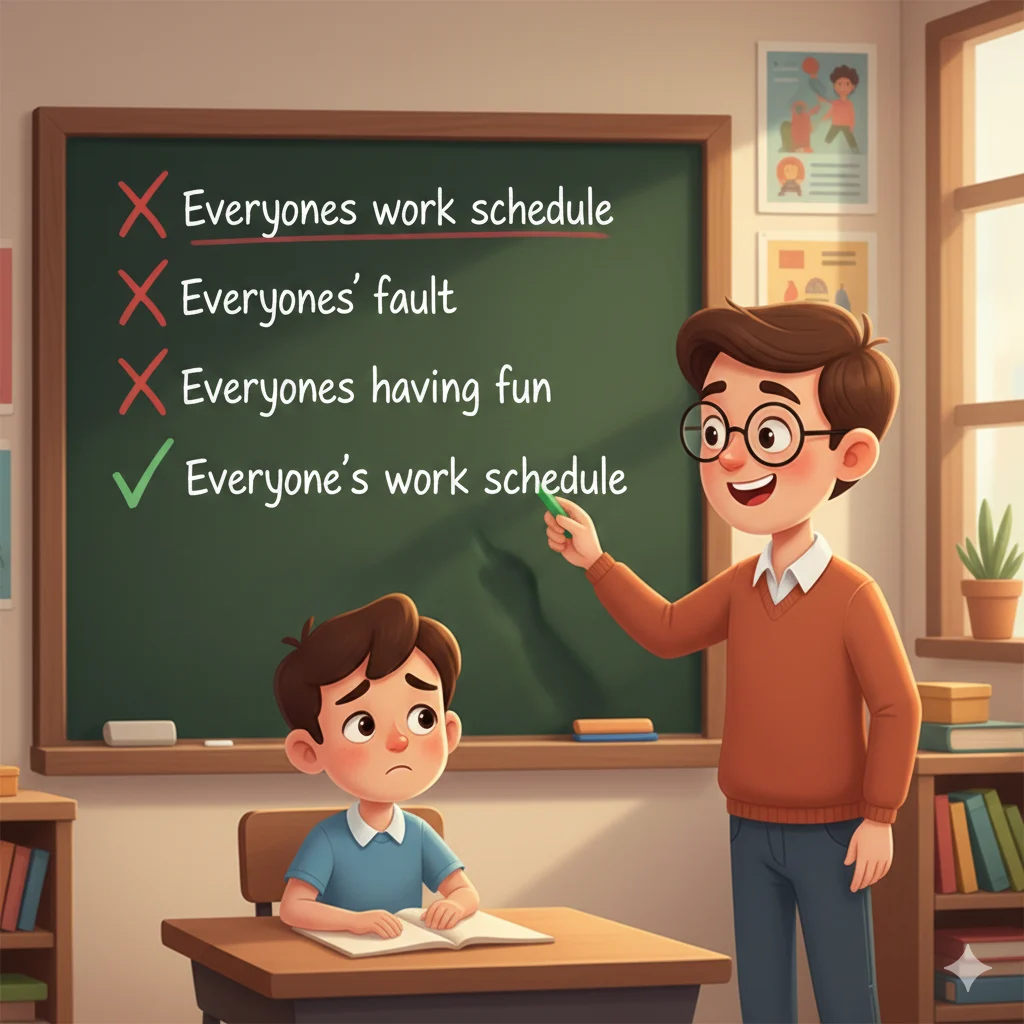
Mistake 1: Using “everyones” as a plural possessive.
- Incorrect: “The new policy affects everyones work schedule.”
- Why it’s wrong: “Everyones” is not a word. It incorrectly treats “everyone” as a plural noun that just needs an -s.
- Correct: “The new policy affects everyone’s work schedule.”
Mistake 2: Using “everyones'” with the apostrophe after the -s.
- Incorrect: “Is this everyones’ fault?”
- Why it’s wrong: This follows the rule for plural nouns (like “the students’ lounge”), but “everyone” is singular. It does not end in -s in its base form.
- Correct: “Is this everyone’s fault?”
Mistake 3: Forgetting the apostrophe in a contraction.
- Incorrect: “I hope everyones having a good time.”
- Why it’s wrong: It misses the apostrophe that signals the missing letter “i” in “is.”
- Correct: “I hope everyone’s having a good time.”
Mistake 4: Confusing “everyone’s” with “everyone.”
- Question: “Is everyone’s lives grammatically correct?”
- Answer: Yes, it can be. Here, “everyone’s” is the possessive form. The phrase means “the lives of everyone.” So, the sentence “Everyone’s lives will change” is grammatically fine. The tricky part is the verb. Because “everyone” is singular, you say “Everyone’s (everyone is) ready,” but for the possessive, “Everyone’s lives are…” is correct because “lives” is plural.
Everyone’s in Everyday Examples
Seeing “everyone’s” in different contexts helps solidify the rule. Here is how it looks in real-world writing.
In Formal Writing (Business/Reports)
- “The committee respects everyone’s right to a private opinion.”
- “It is in everyone’s best interest to complete the project on time.”
In Email Communication
- Subject: “Thank you for everyone’s hard work this quarter.
- “Hi team, just a reminder that everyone’s feedback is needed by Friday.”
On Social Media
- “This new coffee shop is everyone’s new favorite spot! ☕”
- “I love how everyone’s style is so unique in this group.”
In News Headlines & Journalism
- “Affordable Housing is Everyone’s Problem, Says New Report”
- “The singer thanked her fans, saying, ‘Everyone’s support means the world.'”
In Everyday Conversation
- “Don’t eat all the pizza; it’s everyone’s dinner!”
- “Look at the sky—everyone’s going to stop and stare.”

Everyone’s – Google Trends & Usage Data
An analysis of search data and language trends confirms that the confusion between “everyone’s” and “everyones” is widespread. The primary search intent is navigational and informational: people are looking for a quick spelling and grammar confirmation.
- High-Volume Keywords: Search terms like “is it everyone’s or everyones,” “everyone’s grammar,” and “everyone’s meaning” have consistently high search volume. This indicates a persistent confusion point for writers of all levels.
- Country Popularity: While the correct spelling is universal, the search for clarification is highest in English-speaking countries, particularly the United States, the United Kingdom, Canada, and Australia. This shows that even in regions where English is the first language, the possessive rules for pronouns are a common stumbling block.
- Context of Searches: People often pair these searches with other tricky possessives, such as “its or it’s” or “theirs or their’s,” showing a broader need for clarity on apostrophe usage.
- The Verdict: The data confirms that “everyones” (without an apostrophe) is almost never searched for as a correct word; instead, it is searched for in comparison to the correct form. This proves that most people instinctively know “everyone’s” is correct but need confirmation.
(FAQs)
1. Is it correct to say everyone’s?
Yes, it is always correct to say “everyone’s” when you need a possessive form or a contraction for “everyone is.
2. Is “everyone’s” plural or singular?
“Everyone” is grammatically singular. Therefore, “everyone’s” (the possessive form) is also treated as singular when determining subject-verb agreement. For example, “Everyone’s here” is correct, not “Everyone’re here.”
3. Is “everyones” ever correct grammar?
No. “Everyones” (without an apostrophe) is never correct in standard English. It is a common misspelling and should always be avoided.
4. What is the difference between “everyone’s” and “everyones'”?
“Everyone’s” is the correct form. “Everyones'” is incorrect. The apostrophe goes after the -s only for plural nouns that end in -s (like “the students'”). Since “everyone” is singular and does not end in -s, the apostrophe always comes before the -s.
5. What does “everyone’s” mean?
It has two meanings based on context:
- Possession: Belonging to everyone (e.g., “Everyone’s guess is as good as mine”).
- Contraction: Everyone is (e.g., “Everyone’s excited for the trip”).
6. How do you use “everyone’s” in a sentence?
You use it as you would any possessive noun or contraction. For example: “Taking care of everyone’s needs is a big job.” Or, “I think everyone’s finished with their lunch.”
7. Is it “everyone’s favorite” or “everybody’s favorite”?
Both are correct and interchangeable. “Everyone” and “everybody” are synonyms. You can say “That song is everyone’s favorite” or “That song is everybody’s favorite.” The grammar rule for the apostrophe applies to both.
8. Why do people add an apostrophe after the S in “everyones”?
They make this mistake because they confuse “everyone” with plural nouns. Since “everyone” refers to many people, they incorrectly assume it should follow the plural possessive rule (like “parents’ meeting”). However, because it is a singular pronoun, it follows the singular possessive rule.
Conclusion
Mastering the difference between “everyone’s or everyones” is a small but powerful step toward clear and professional writing. The rule is definitive: “everyones” is not a word and should never be used. The correct form is always “everyone’s.” This simple apostrophe + s does double duty. It shows possession, as in “taking everyone’s order,” and it acts as a contraction for “everyone is,” as in “everyone’s welcome here.”
By remembering that “everyone” is a singular indefinite pronoun, you can avoid the common trap of treating it like a plural noun. Whether you are writing a formal business report, a quick text to a friend, or a post on social media, using “everyone’s” correctly builds trust with your reader. It shows attention to detail and a solid grasp of English grammar. The next time you write about a group of people, you can do so with confidence, knowing you have mastered this tricky punctuation rule. Keep it simple: when in doubt, put the apostrophe in.

Noah Syntax is a linguistics lover who finds beauty in structure and rhythm. His writing combines precision with playfulness, decoding the secrets of language for everyday readers. At Simile Mind, Noah brings clarity, humor, and insight to every metaphor he explores.