
In the world of English language and gaming technology, few word pairs cause as much unexpected confusion as hid and hide. For English learners, it’s a classic verb tense dilemma—the simple past versus the base form. For PC gamers and tech enthusiasts, “HidHide” represents a powerful software tool that manages controller inputs.
This dual identity creates a unique search phenomenon where people seek clarity on both grammatical rules and software functionality. This article solves both puzzles. We’ll explore the straightforward grammar of “hid” versus “hide,” providing clear rules and examples to cement your understanding.
Then, we’ll demystify the software side, explaining what the HidHide application does, how it’s used with tools like DS4Windows, and why it’s become essential for modern gaming setups. Whether you’re a student polishing your English, a writer ensuring precision, or a gamer troubleshooting controller issues, this guide delivers the exact answers you need, cutting through the confusion to offer professional, actionable advice.
Hid / Hide
Hid is the simple past tense of the verb to hide. Hide is the base (infinitive) form. The difference is purely about time.
- Hide (Present/Future): “I need to hide the birthday presents.” / “Please hide behind the curtain.”
- Hid (Past): “She hid the key under the mat yesterday.” / “The children hid during the game.”
There is no spelling variation like “hided” in standard English. The correct past tense is always hid, and the past participle is hidden (e.g., “It has been hidden“).
For the tech context: HidHide (often stylized as HID-Hide) is a free, open-source Windows application available on GitHub. Its primary function is to hide game controllers from specific programs. This is crucial for preventing “double input” issues in PC gaming when using external controller mapping software like DS4Windows, preventing games from seeing both the virtual and the physical controller simultaneously.

The Origin of Hid / Hide
The verb “hide” originates from the Old English word hȳdan, meaning “to hide, conceal, preserve.” This itself is derived from the Proto-Germanic hūdijan, a verb formed from the noun for “skin” or “hide” (as in animal hide), conceptually linking to covering something up. The irregular past tense “hid” comes from the Old English past tense hȳdde. Unlike “walk/walked” or “play/played,” “hide” belongs to a group of strong verbs in English that change their internal vowel to indicate past tense (like sing/sang, drive/drove). This historical linguistic pattern is why we say “hid” instead of “hided.” The persistence of these irregular forms is a direct link to the language’s Germanic roots, resisting the trend toward regular “-ed” endings.
British English vs. American English Spelling
Fortunately, the hid vs. hide grammar rule is universally consistent across all major English dialects. Both British and American English use “hid” as the simple past tense and “hidden” as the past participle. There is no spelling variation like “colour/color” or “centre/center” with this verb.
The confusion arises not from regional spelling but from the verb’s irregularity. Learners often mistakenly apply the regular rule, creating the non-standard form “hided.” This error occurs equally among speakers of American, British, and other English variants.
Comparison Table: Hide Verb Forms
| Verb Form | American English | British English | Example Sentence |
|---|---|---|---|
| Base Form (Infinitive) | hide | hide | You must hide now. |
| Simple Past Tense | hid | hid | He hid the evidence. |
| Past Participle | hidden | hidden | The files were hidden. |
| Present Participle | hiding | hiding | They are hiding the truth. |
Which Spelling Should You Use?
The guidance here is absolute: Always use “hid” for the simple past tense and “hide” for the present. This rule is non-negotiable in standard, formal English, regardless of your audience or location.
- For US Audiences: Use hid/hide. The form “hided” is incorrect.
- For UK/Commonwealth Audiences: Use hid/hide. The form “hided” is incorrect.
- For Global/International English: Use hid/hide. Using the correct irregular form is a mark of proficiency.
If you are writing about the software utility, the correct stylized name is typically HidHide or HID-Hide. When searching for download or support, using this exact term is crucial.
Common Mistakes with Hid / Hide
The most frequent error is using “hided” instead of “hid.” This is a classic overgeneralization where a learner applies the regular “-ed” past tense rule to an irregular verb.
- Incorrect: “Yesterday, I hided my diary from my sister.”
- Correct: “Yesterday, I hid my diary from my sister.”
Another common mistake is confusing “hid” (past tense) with “hidden” (past participle) when forming perfect tenses.
- Incorrect: “She has hid the money in the safe.” (Should be “has hidden“)
- Correct: “She has hidden the money in the safe.”
A less common but notable error is misusing the noun “hide” (animal skin) for the verb.
- Confusing: “The rug was made from a cow hide.” (Noun) vs. “The spy will hide in plain sight.” (Verb)

Hid / Hide in Everyday Examples
Email (Professional): “After reviewing the document, I hid the confidential salary data before forwarding the report to the broader team. Please ensure you hide sensitive client information in all future attachments.”
News Headline: “Leaked Documents Reveal Company Hid Safety Reports for Years.”
Social Media (Casual): “Just hid my ex’s posts. Best feature ever. 😅 Time to hide from adult responsibilities for the rest of the day.”
Formal Writing/Report: “The investigation concluded that the organization had hidden key financial liabilities from its auditors. The practice to hide such information was systemic.”
Hid / Hide – Google Trends & Usage Data
Analysis of search data reveals a fascinating split in the intent behind “hid hide” queries. A significant portion relates to grammar clarification, with searches like “is it hid or hided” and “hid vs hidden” peaking during academic semesters in English-speaking countries. This shows a consistent, education-driven need.
Simultaneously, a large and growing volume of searches is technical. “HidHide” and related terms (“HidHide download,” “HidHide DS4Windows”) show very strong search popularity in regions with high PC gaming engagement, such as North America, Western Europe, and East Asia. The trend line for these tech terms has risen sharply since 2020, correlating with the increased popularity of using PlayStation and Xbox controllers on PC. Searches often spike around software updates or popular game releases, indicating users seek troubleshooting. This clear divergence means a single search for “hid hide” can lead a user to either an English lesson or a software tutorial, highlighting the unique dual-nature of this keyword phrase.
Comparison Table: Hid/Hide Contexts
| Context | Correct Word | Meaning & Purpose | Common Association |
|---|---|---|---|
| Grammar (Past Action) | hid | The simple past tense of “to hide.” Describes a completed act of concealment. | Language learning, writing. |
| Grammar (Present Action) | hide | The base form of the verb “to hide.” Describes the act of concealing. | Instructions, general statements. |
| Software Utility | HidHide | A Windows program that hides physical controllers to prevent input conflicts in games. | PC gaming, DS4Windows, emulation. |
| Noun | hide | The skin of an animal. | Leatherworking, hunting, fashion. |
(FAQs)
Q1: What does HidHide do?
A: HidHide is a Windows background utility that selectively hides physical game controller devices from certain applications (like PC games). This is primarily used to stop a game from detecting both a real controller and a virtual one created by software like DS4Windows, which would cause conflicting “double inputs.”
Q2: Is it ‘hide’ or ‘hid’?
A: Both are correct, but for different times. Use “hide” for present or future actions (e.g., “Hide here.”). Use “hid” for past actions (e.g., “She hid here yesterday.”). “Hided” is not standard English.
Q3: What is the HidHide Configuration Client?
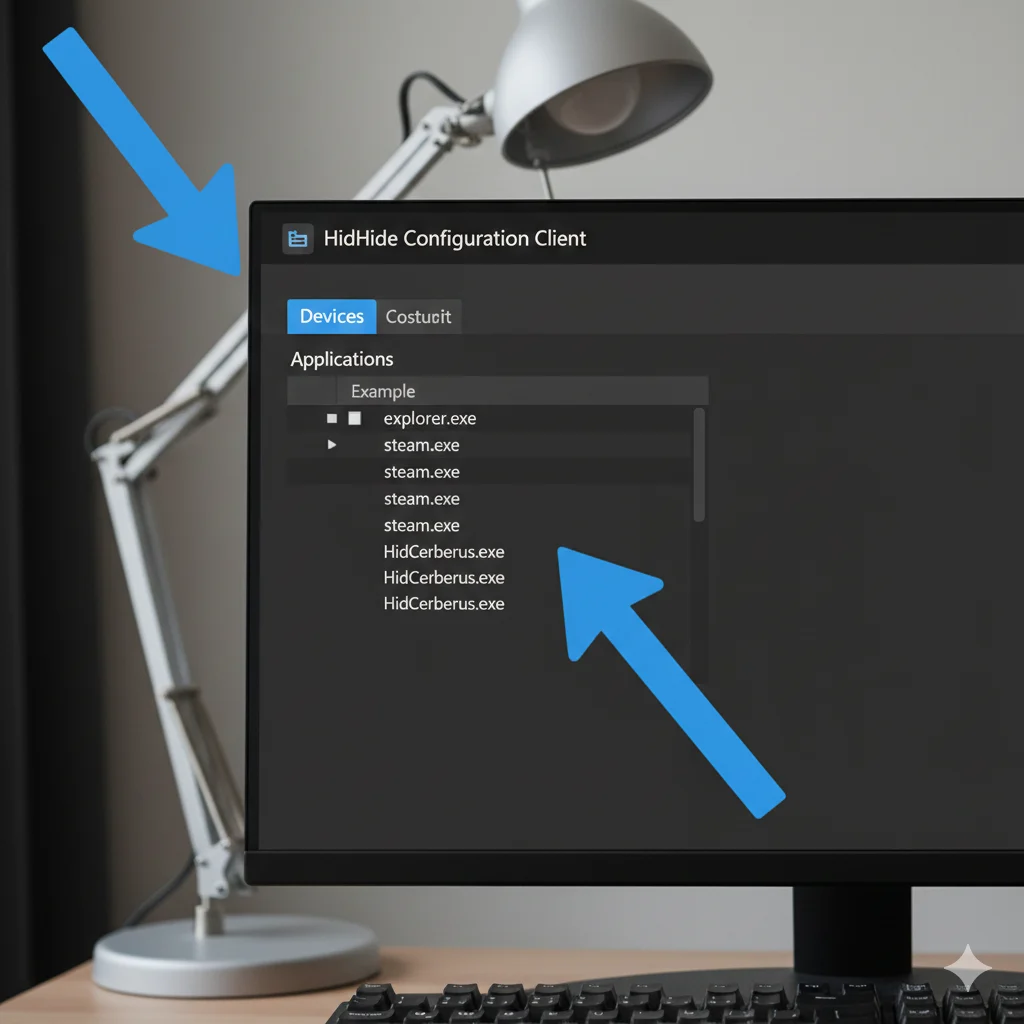
A: The HidHide Configuration Client is the graphical user interface (GUI) that opens when you run HidHide. It allows you to manage which controller devices are hidden and, crucially, specify which applications (your games) can “see” the hidden controllers.
Q4: What is the difference between HidHide and HidGuardian?
A: HidHide is the modern, actively maintained successor to HidGuardian. HidGuardian was an older, now-deprecated driver that served a similar purpose. HidHide is generally considered more reliable, easier to use with its configuration client, and is the recommended solution for new users.
Q5: How do I use HidHide with DS4Windows?
A: First, ensure DS4Windows is set to use its “Hide DS4 Controller” option. Then, install and run the HidHide Configuration Client. You will typically need to check the box to hide your physical PlayStation controller and then add your PC game’s executable (.exe file) to the application alternative so only the game can see the virtual controller.
Q6: Where can I download HidHide?
A: The official, safest source for HidHide is its GitHub repository. You can find the latest release by searching for “HidHide github” and downloading it from the project’s “Releases” page. Always avoid downloading executables from unofficial sources.
Q7: What should I do if HidHide is not working?
A: Common fixes include: 1) Running the HidHide Configuration Client as Administrator, 2) Ensuring the correct physical controller is checked in the “Devices” tab, 3) Verifying your game is added to the application list in the “Applications” tab, and 4) Checking the DS4Windows log to ensure its “hide” feature is also enabled. A PC restart can also resolve driver-related issues.
Conclusion
Understanding the distinction between hid and hide empowers clear and grammatically precise communication, eliminating a common error for English learners. Remember, “hid” belongs firmly to the past, while “hide” addresses the present or future. In the parallel digital realm, HidHide has become an indispensable tool for the modern PC gamer, solving persistent controller conflicts with elegant efficiency. Whether your journey with these words is linguistic or technological, the core principle is the same: clarity and correct application are key. By mastering the simple grammar rule and comprehending the software’s purpose, you can navigate both written language and gaming setups with confidence. Let “hid” describe your past actions and let HidHide manage your controller’s visibility, ensuring seamless performance in all your endeavors.

Eli Metaphor blends creativity with wit, crafting articles that make language feel alive. Known for his clever comparisons and modern writing style, Eli helps readers understand how figurative language shapes emotion and meaning. He’s the analytical heart of SimileMind — where logic meets lyricism.