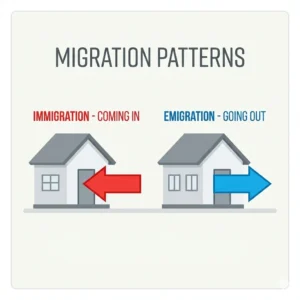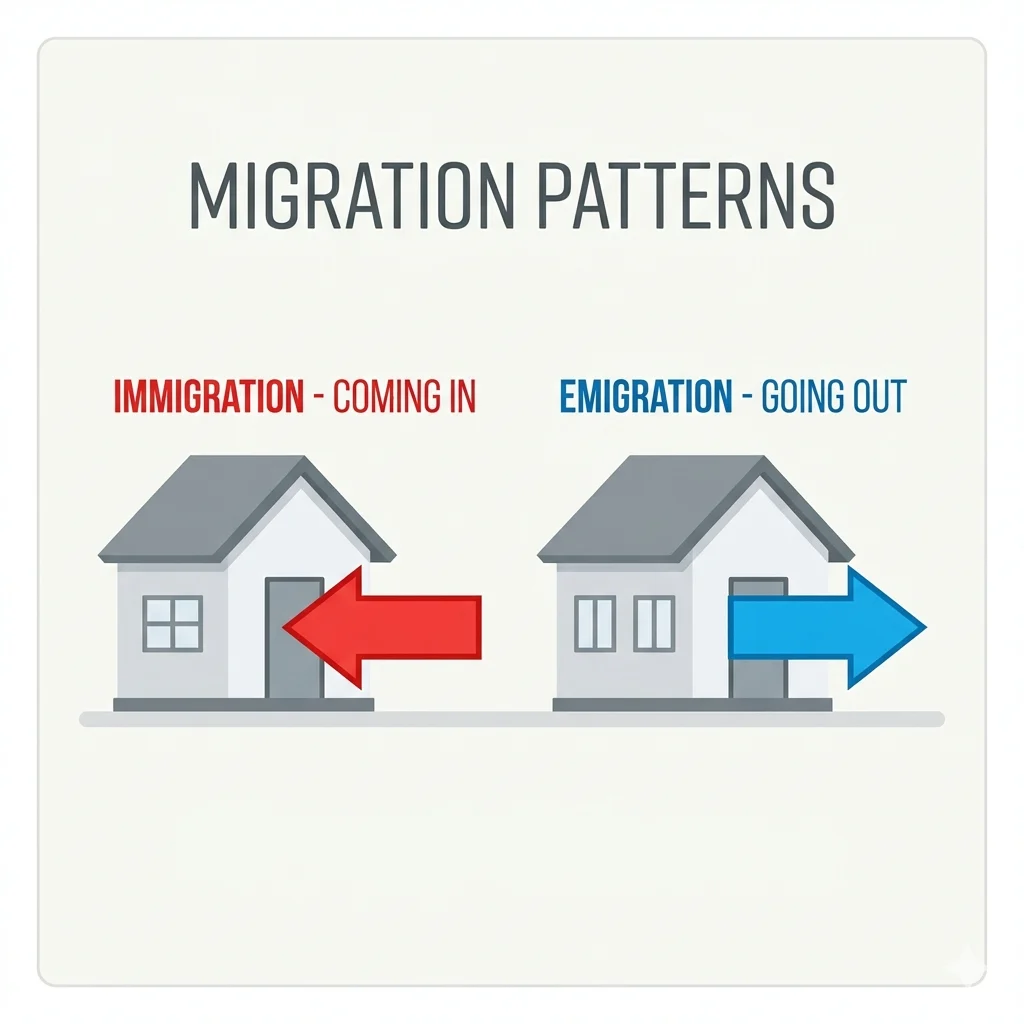
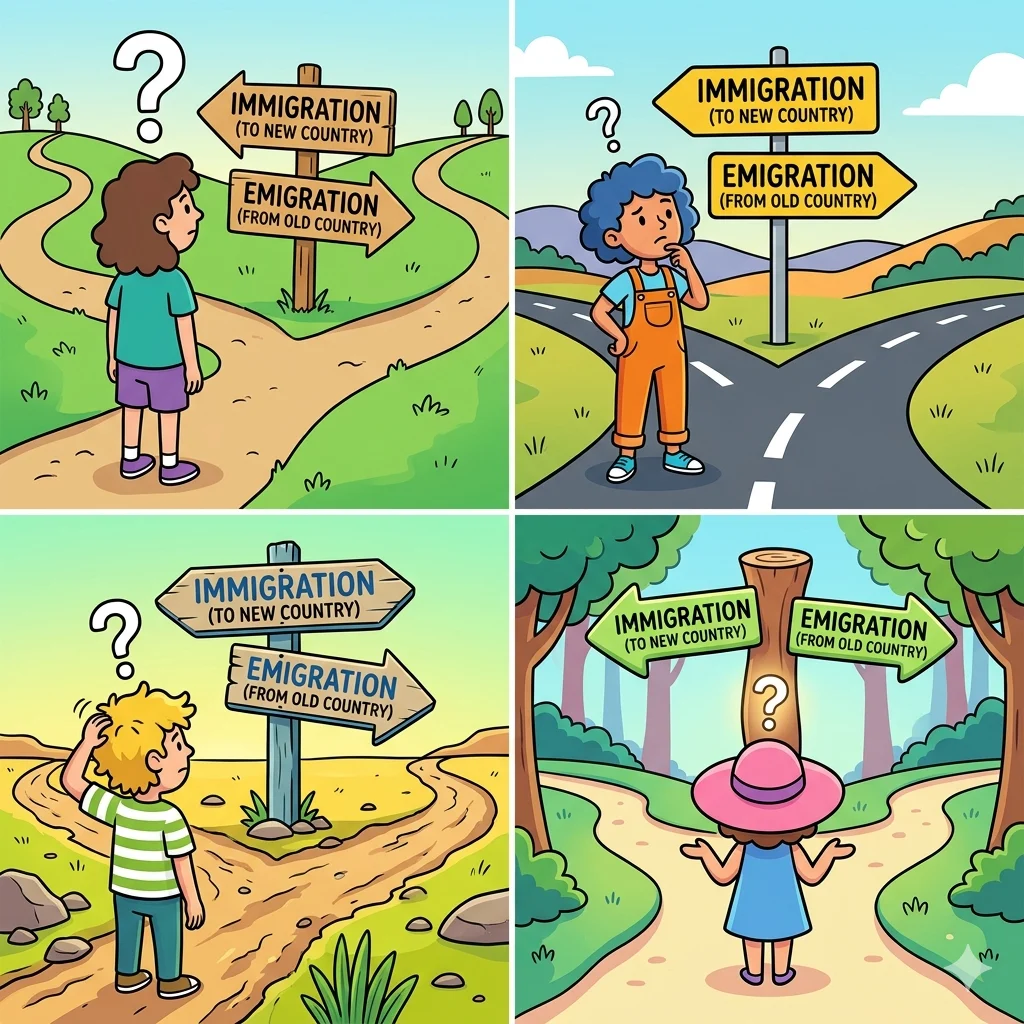
“Immigration means entering a country, while emigration means leaving it; both describe the direction of movement.”
Confused between immigration and emigration? Learn the simple trick to never mix them up again! Both terms describe moving from one country to another, but the key difference is direction.
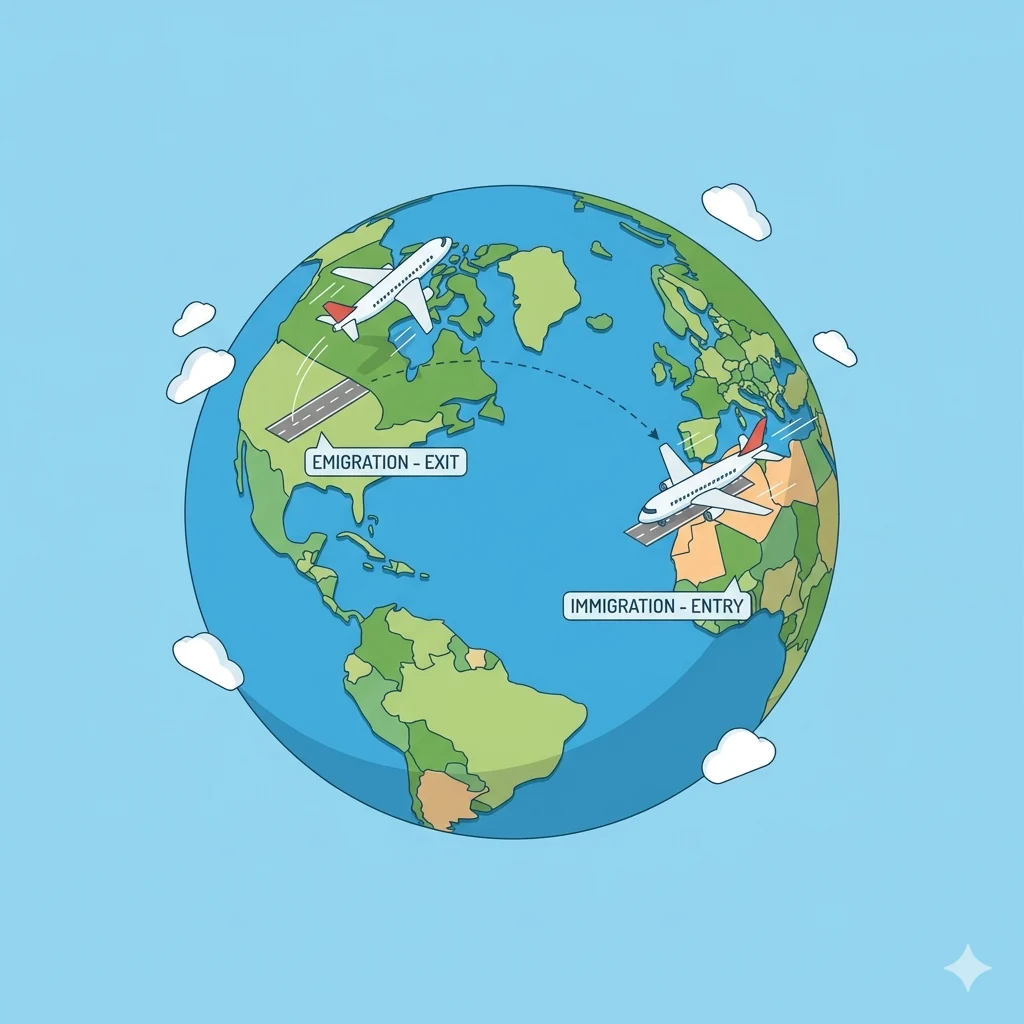
Immigration means entering a new country to live or work, while emigration means leaving your home country to settle somewhere else. For example, if someone moves from Pakistan to Canada, they are emigrating from Pakistan and immigrating to Canada. Similarly, a person leaving India is emigrating, while entering the UK is immigrating.
A simple way to remember this: “I” in Immigration = “In” (coming into a country), and “E” in Emigration = “Exit” (leaving a country). This quick trick makes it easy to recall the difference anytime.
Understanding immigration vs emigration is essential for writing, exams, news, and everyday conversations. In this guide, you’ll learn clear explanations, examples, and memory tips so you never confuse these terms again.
Immigration or Emigration meanings
Immigration means entering a new country to live. Emigration means leaving your old country to live elsewhere.
Think of a door. Immigration is “coming in.” Emigration is “going out.”
Examples:
- If you move from Mexico to Canada, you emigrate from Mexico. You immigrate to Canada.
- At the airport, you go through immigration when you land. You do not see an “emigration” desk. You see “Departures” or “Exit.”
So, what is the difference between emigrating and immigrating? The point of view. Immigration looks at the new home. Emigration looks at the old home.

The Origin of Immigration and Emigration
The words come from Latin.
- “Migrate” means to move from one place to another.
- “Im-“ means into. (Like “import” means bring in.)
- “E-“ means out of. (Like “exit” means go out.)
So, immigration = moving into. Emigration = moving out of.
Why do spelling differences exist? English took these words from Latin through French. Over 400 years, spelling became fixed. British writers kept the French-style spellings (like “emigration” with one ‘m’). American writers later simplified some words, but not these. Both sides kept the same spelling. The confusion is not spelling. It is meaning.
British English vs American English Spelling
Good news: Immigration and emigration are spelled the same in both British and American English. No difference!
However, the use of these words in sentences can change slightly. British people often say “migration” for animals. Americans do too. But for people, both use “immigration” for entry and “emigration” for exit.
Here is a table to compare:
| Term | British Spelling | American Spelling | Meaning |
|---|---|---|---|
| Immigration | immigration | immigration | Entering a new country |
| Emigration | emigration | emigration | Leaving your country |
| Immigrant | immigrant | immigrant | Person who enters |
| Emigrant | emigrant | emigrant | Person who leaves |
No spelling changes. But always check the context. Is it immigration or emigration? Look at the direction of travel.
Which Spelling Should You Use?
You do not choose a spelling. You choose the correct word based on your audience and meaning.
- Use “immigration” when you talk about a person arriving. This is for US, Canada, Australia, and most global news. Example: “US immigration laws are strict.”
- Use “emigration” when you talk about a person leaving. This is common in the UK, India, and Europe when discussing brain drain. Example: “Emigration from Poland increased after 2004.”
Global audience: If you write for everyone, use both words to show direction. Say: “Emigration from Syria led to immigration to Germany.”
When to use immigration and emigration?
- Airport form? Use immigration (arrival card).
- University paper on population? Use emigration (people leaving a country).
- Talking to a friend? Say “I moved.” It is easier.
Am I immigrating or emigrating? You are doing both. You emigrate from one place. You immigrate to another.
Common Mistakes with Immigration and Emigration
Here are frequent errors and how to fix them.
Mistake 1: Saying “I immigrated from France.”
- Wrong. “From” needs “emigrated.”
- Correct: “I emigrated from France.”
Mistake 2: Saying “I emigrated to Japan.”
- Wrong. “To” needs “immigrated.”
- Correct: “I immigrated to Japan.”
Mistake 3: Using “migration” for all moves.
- Problem: Migration includes animals and seasonal moves. It is not specific.
- Fix: Use immigration (entry) or emigration (exit) for permanent human moves.
Mistake 4: Confusing immigration or emigration in airport signs.
- Fact: Airports have “Immigration” for arrivals. They have “Departure” for leaving. They rarely write “Emigration.”
Mistake 5: Thinking immigration meaning is the same as emigration meaning.
- No. Immigration = coming in. Emigration = going out.
Immigration or Emigration in Everyday Examples
Let us see these words in real life.
Email (formal):
“Dear HR, My visa is approved. My immigration lawyer will send the documents. I will emigrate from India on June 1st.”
News headline:
“UK immigration hits record high as emigration to Australia slows.”
Social media (Twitter/X):
“Just cleared immigration at JFK. Tired but happy. #movingtousa”
Social media (Facebook post):
“Saying goodbye to my family. Hard to emigrate from Brazil, but excited for Canada.”
Formal writing (government report):
“The difference between immigration and emigration determines net population change. If immigration > emigration, population grows.”
Airport conversation:
Traveler: “Where is immigration or emigration?”
Officer: “This is immigration for arrivals. For leaving, go to Departures.”
What is emigration in simple words? Emigration is leaving your home country to live somewhere else.
Immigration vs Migration – Google Trends & Usage Data
Google data shows that people search “immigration” five times more than “emigration.” Why? Because countries focus on who enters.
- Top countries searching “immigration”: USA, Canada, Australia, UK.
- Top countries searching “emigration”: India, Pakistan, Nigeria, Philippines. (These are countries with many people leaving.)
Context matters:
- Immigration vs migration: Migration is broader. It includes birds, seasons, and internal moves. Immigration is only human entry to a new country.
- Immigration emigration migration difference: Migration is the general move. Immigration is the “in” part. Emigration is the “out” part.
Example of science use: In biology, what is the difference between immigration and emigration in science? Animals immigrate into a habitat. They emigrate out of a habitat. Scientists count both to study population.
5 differences between immigration and emigration (table):
| Feature | Immigration | Emigration |
|---|---|---|
| Direction | Entering | Leaving |
| Focus | Destination country | Origin country |
| Airport sign | Yes (Arrivals) | No (Departures) |
| Common in news | Very common | Less common |
| Example sentence | “She immigrated to the US.” | “She emigrated from Vietnam.” |
Comparison Table: Keyword Variations Side by Side
| Term | Definition | Example |
|---|---|---|
| Immigration | Entering a new country | “Immigration to Canada is rising.” |
| Emigration | Leaving your country | “Emigration from Cuba increased.” |
| Migration | Moving (any reason, any species) | “Bird migration happens in fall.” |
| Immigrant | Person who enters | “He is an immigrant from Ghana.” |
| Emigrant | Person who leaves | “She is an emigrant leaving Ireland.” |
| Immigration or emigration definition | Entry vs exit | Entry = immigration; Exit = emigration |
| Is migration immigration or emigration? | Neither. Migration is the general term. | Migration includes both. |
| Immigration or emigration is also known as | Immigration = inbound; Emigration = outbound | Also called “in-migration” and “out-migration.” |
(FAQs)
1. What is the difference between emigrating and immigrating?
Emigrating means leaving your old country. Immigrating means entering a new country. One is exit. One is entry.
2. When to use immigration and emigration?
Use immigration when talking about arriving. Use emigration when talking about departing. Example: “Emigration from Italy slowed. Immigration to the US grew.”
3. Am I immigrating or emigrating?
You are both. You emigrate from your home. You immigrate to your new home. It depends on where you stand.
4. What are 5 differences between immigration and emigration?
- Immigration = in; Emigration = out.
- Immigration uses “to”; Emigration uses “from.”
- Airports have immigration desks.
- Immigration is more common in news.
- Emigration reduces population of old country.
5. Is it immigration or emigration in airport?
At the airport, you see “Immigration” when you land. You do not see “Emigration.” You see “Departures” or “Exit” for leaving.
6. What is the difference between immigration and emigration with examples?
Immigration: “Maria immigrated to Portugal.”
Emigration: “Maria emigrated from Angola.”
7. What is emigration in simple words?
Emigration is leaving your country to live in another one. You become an emigrant.
8. What is the difference between immigration and emigration in science?
In science (ecology), immigration is new animals entering a habitat. Emigration is animals leaving. Scientists measure both to see if a population grows or shrinks.
9. Is it immigration or emigration meaning the same?
No. They are opposites. Immigration is coming in. Emigration is going out.
10. What is the difference between migration immigration emigration?
Migration is the big category (any move). Immigration is moving into a new place. Emigration is moving out of an old place.
Conclusion
You now know the difference. Immigration is entering. Emigration is leaving. Use “immigrate to” and “emigrate from.” Never mix them again.
Remember the door: In or out. For most daily talk, just say “move.” But for formal writing, exams, or airport forms, use the correct word. If you are writing for a US audience, focus on immigration. If you are writing about population loss, use emigration.
Check your sentence. Ask: Is the person coming or going? That gives you the answer. Now you can write with confidence. You can also explain to friends what is the difference between emigrating and immigrating. You have the knowledge. Use it well.

Eli Metaphor blends creativity with wit, crafting articles that make language feel alive. Known for his clever comparisons and modern writing style, Eli helps readers understand how figurative language shapes emotion and meaning. He’s the analytical heart of SimileMind — where logic meets lyricism.