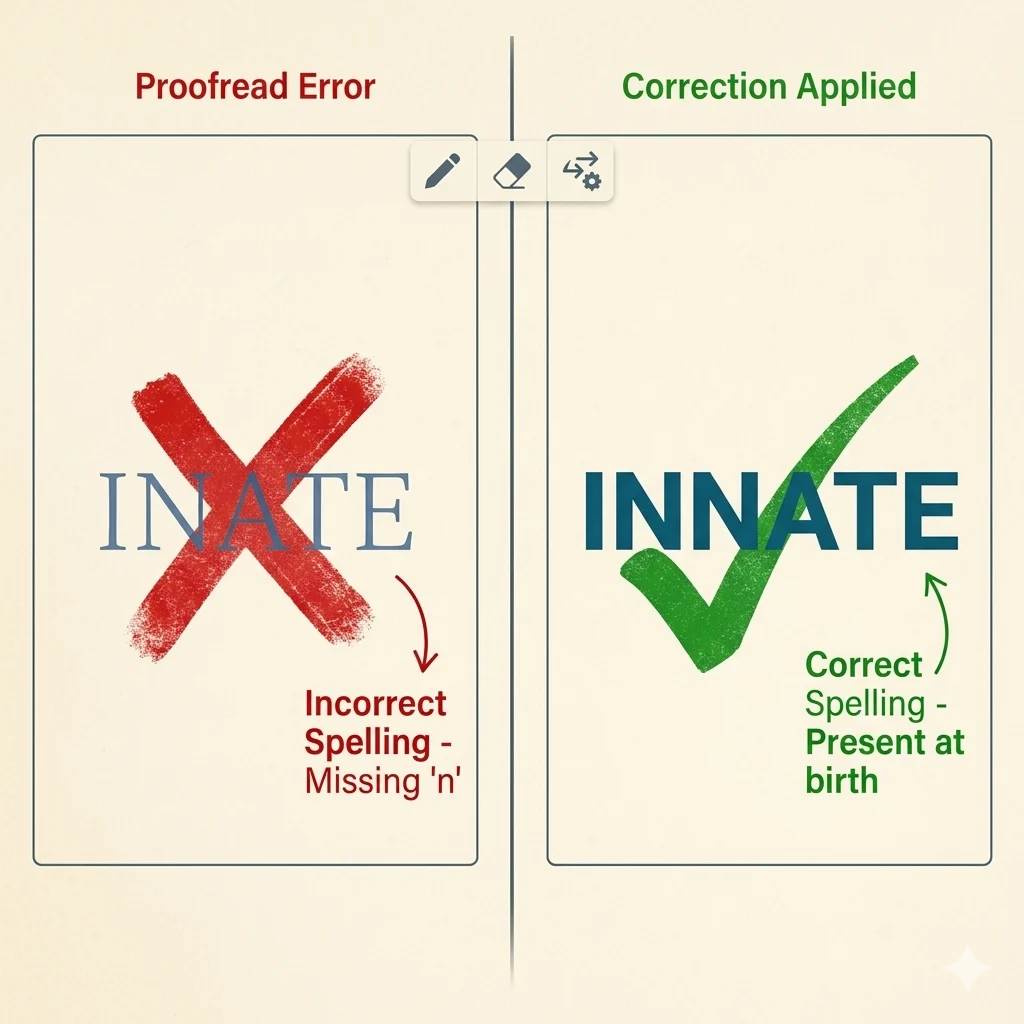
“Innate (not inate) means a natural talent or quality someone is born with; use it correctly to write confidently.”
Tired of seeing “inate” everywhere? Learn why “innate” is the correct spelling and never get it wrong again! The correct word is “innate”, which refers to qualities, abilities, or characteristics someone is born with, rather than learned. Inate is a common misspelling and is incorrect.
For example:
- “She has an innate talent for music”
- “His innate curiosity drives him to explore new ideas”
- “Animals have innate instincts for survival”
- “Her innate sense of humor always lights up the room”
Using innate correctly ensures your writing is professional, accurate, and natural. In this guide, you’ll learn the correct spelling, meaning, usage in sentences, and common mistakes to avoid, so you can confidently master Inate vs Innate once and for all.
Innate or Innate meanings
The correct spelling is “innate.” The spelling “inate” is always a misspelling and is not a recognized word in the English language.
Innate is an adjective that describes a quality or characteristic that you are born with. It is natural, inborn, and not something you learn.
Examples:
- Correct: She has an innate ability to play the piano. (She was born with this talent).
- Incorrect: He has an inate sense of rhythm. (This is wrong).
- Correct: Birds have an innate instinct to build nests.
The Origin of Innate
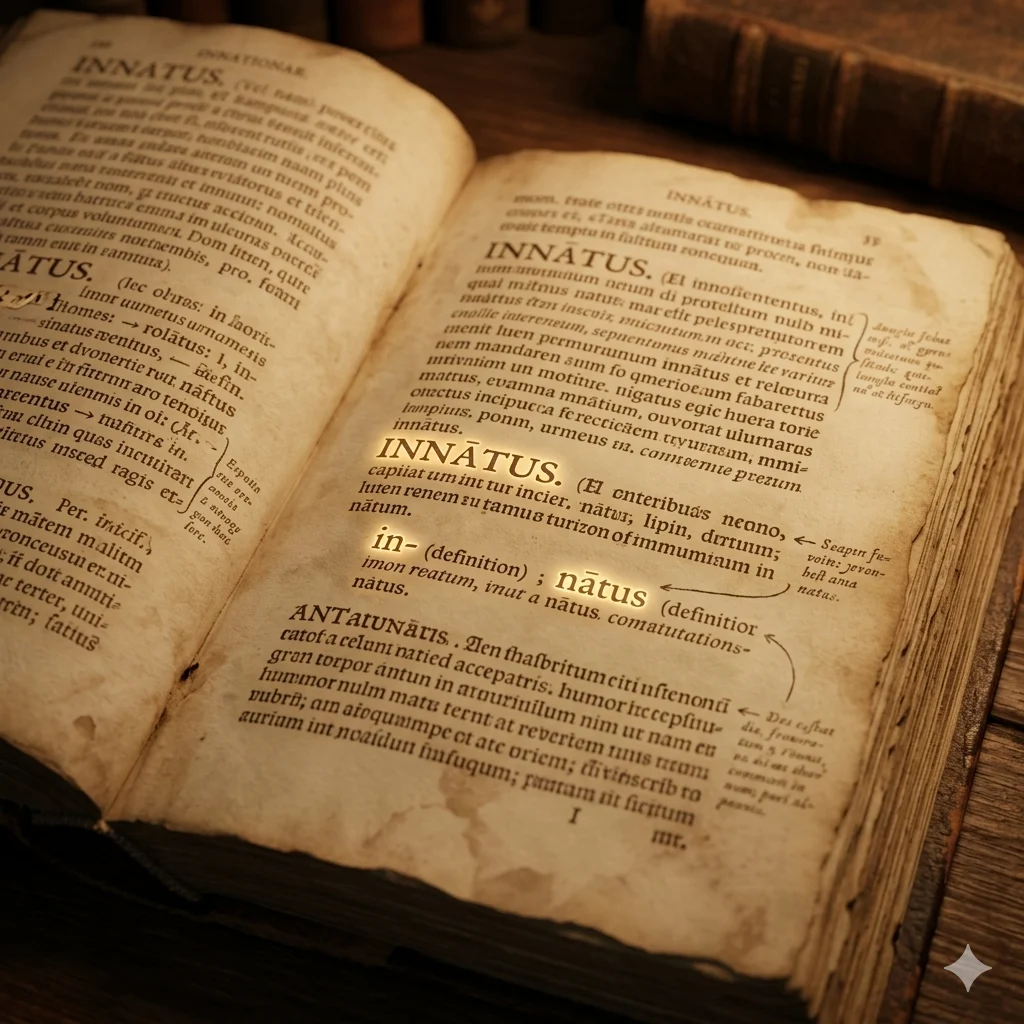
Understanding the origin of a word can help you remember its spelling. The word innate comes from the Latin word innatus. This word is a combination of two parts:
- *in-* : A prefix meaning “in” or “into.”
- natus : The past participle of nasci, which means “to be born.”
So, the literal meaning of innatus is “to be born in.” This origin story is the key to the spelling. Because it comes from natus (meaning born), it keeps the double ‘n’—one from the prefix *in-* and the first letter of the root word natus. Over centuries, the word was adopted into English, but its spelling remained true to its Latin roots, solidifying “innate” as the standard form.
British English vs American English Spelling
When it comes to the word innate, there is no difference between British and American English. It is one of the many words that are spelled identically on both sides of the Atlantic. The confusion between “inate” and “innate” is purely a grammatical error, not a regional spelling variation.
Here is a simple table to make this crystal clear:
| Variation | Correct Spelling? | British English Usage | American English Usage |
|---|---|---|---|
| inate | No | Never correct | Never correct |
| innate | Yes | Standard and correct | Standard and correct |
Which Spelling Should You Use?
Since “inate” is not a word, the advice is simple: you should always use “innate.”
- For a US Audience: Use “innate.”
- For a UK or Commonwealth Audience: Use “innate.”
- For a Global Audience: Use “innate.”
There are no special cases where “inate” is acceptable. If you are writing in English, regardless of the dialect, innate is the only correct choice. Think of it like this: if you wouldn’t write “nite” for “night” in a formal document, you shouldn’t write “inate” for “innate.”
Common Mistakes with Innate
The most frequent error is simply dropping one of the ‘n’s. Here are the most common mistakes people make with this word and how to fix them.
- Mistake: Using “inate” in any context.
- Correction: Replace it with “innate.”
- Example of Mistake: “His inate charm won everyone over.”
- Corrected: “His innate charm won everyone over.”
- Mistake: Confusing “innate” with “innit.”
- Explanation: “Innit” is a slang contraction of “isn’t it,” used informally in British English. It has no relation to the meaning of “innate.”
- Example: “The weather’s great, innit?” (slang) vs. “She has an innate grace.” (formal adjective).
- Mistake: Confusing “innate” with “inmate.”
- Explanation: An “inmate” is a person confined to an institution like a prison. The single ‘n’ change completely alters the meaning.
- Example: “The inmate read a book.” vs. “She had an innate love of reading.”

Innate in Everyday Examples
Seeing a word used in different contexts helps lock in its meaning and spelling. Here is how innate appears in various forms of writing.
- In a Formal Email:“Dear Hiring Manager, I believe I have the innate leadership qualities necessary to guide your team through this transition.”
- In a News Article:“The documentary explores the innate drive of sea turtles to return to the beach where they were hatched.”
- On Social Media (Instagram Caption):“Capturing my little one’s innate curiosity today. Everything is an adventure! #parenting #innate”
- In an Academic Essay:“Philosophers have long debated whether morality is an innate human trait or a construct of society.”
- In a Casual Conversation:“Don’t try so hard to be funny. You have an innate wit that works better when you’re relaxed.”

Innate – Google Trends & Usage Data
An analysis of search data for the keyword “inate or innate” reveals why this article is so necessary. A significant volume of searches comes from people who are actively writing and are unsure of the correct spelling. This indicates that while the correct word “innate” is universally used in published text, a large number of English speakers and writers are momentarily confused by the phonetic spelling.
Popularity by Country and Context:
- Correct Usage: The word “innate” is consistently used in professional, academic, and published writing across all English-speaking countries, including the United States, the United Kingdom, Canada, Australia, and New Zealand.
- Search Volume: The misspelling “inate” is searched for most often in regions where English is a second language, as well as by native speakers who are typing quickly and second-guessing themselves. The search for “inate or innate” spikes during back-to-school seasons and in January, when people are writing more resumes and cover letters.
- Contextual Data: In scientific and psychological contexts, “innate” is used with high precision. In contrast, the search for the correct spelling is most common in general writing contexts, such as crafting emails, essays, and creative pieces.
Inate vs. Innate
For a final, quick-glance reference, use this table to see the two options side-by-side.
| Feature | inate | innate |
|---|---|---|
| Spelling | One ‘n’ | Double ‘nn’ |
| Is it a word? | No | Yes |
| Part of Speech | None | Adjective |
| Meaning | None | Inborn; natural; originating in the mind |
| Pronunciation | /ɪˈneɪt/ (would be guessed) | /ɪˈneɪt/ or /ˈɪn.eɪt/ |
| Common Usage | Always an error | Correct in all contexts |
| Latin Root | N/A | Innatus (in-born) |
(FAQs)
Here are answers to the most common questions people have about this word.
Is “inate” a word?
No, “inate” is not a recognized word in the English language. It is a common misspelling of the word innate.
What does innate mean?
Innate means existing in one from birth; inborn; native. It refers to qualities, abilities, or characteristics that are natural and not learned. For example, an innate sense of direction.
What does innate goodness mean?
Innate goodness refers to the philosophical and ethical idea that humans are born with a natural tendency towards being good, kind, and moral. It suggests that virtue is an internal, natural quality rather than something taught by society.
What is another word for innate?
There are several synonyms for innate, including:
- Inborn
- Natural
- Inherent
- Intrinsic
- Instinctive
- Native
Is it innate to or innate in?
The correct preposition to use with innate is almost always “in.”
- Correct: The ability to sing is innate in her.
- Incorrect: The ability to sing is innate to her.
While you might see “to” used informally, “innate in” is the grammatically preferred and more common construction in formal writing.
How do you use innate in a sentence?
Here are a few examples:
- “Puppies have an innate desire to please their owners.”
- “Her innate optimism helped her through difficult times.”
- “Critics argue that patriarchy is not innate but a social construct.”
What is the opposite of innate?
The opposite of innate is acquired or learned. While innate traits are present from birth, acquired traits are developed through experience. Other opposites include extrinsic or external.
What is the correct innate pronunciation?
Innate is pronounced: ih-NEYT.
- The first syllable “ih” is soft (like the ‘i’ in “it”).
- The second syllable “NEYT” rhymes with “gate” or “eight.”
You can hear the pronunciation on any online dictionary by clicking the speaker icon.
Conclusion
To summarize the great debate of inate or innate, the answer is definitive: innate is the only correct spelling. The single ‘n’ version, “inate,” is a common error but has no place in proper English. Remembering the word’s origin—from the Latin innatus, meaning “to be born in”—can help you visualize and remember the double ‘n’.
Whether you are writing for a British, American, or global audience, the rule is the same. This word describes qualities that are natural, inborn, and intrinsic, and its spelling should be just as natural to you after reading this guide. Next time you describe someone’s natural talent or instinct, you can do so with the complete confidence that your spelling is perfect.

Eli Metaphor blends creativity with wit, crafting articles that make language feel alive. Known for his clever comparisons and modern writing style, Eli helps readers understand how figurative language shapes emotion and meaning. He’s the analytical heart of SimileMind — where logic meets lyricism.