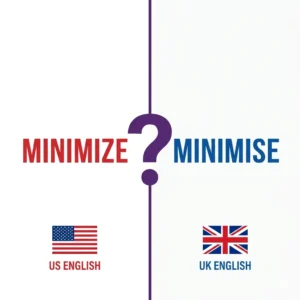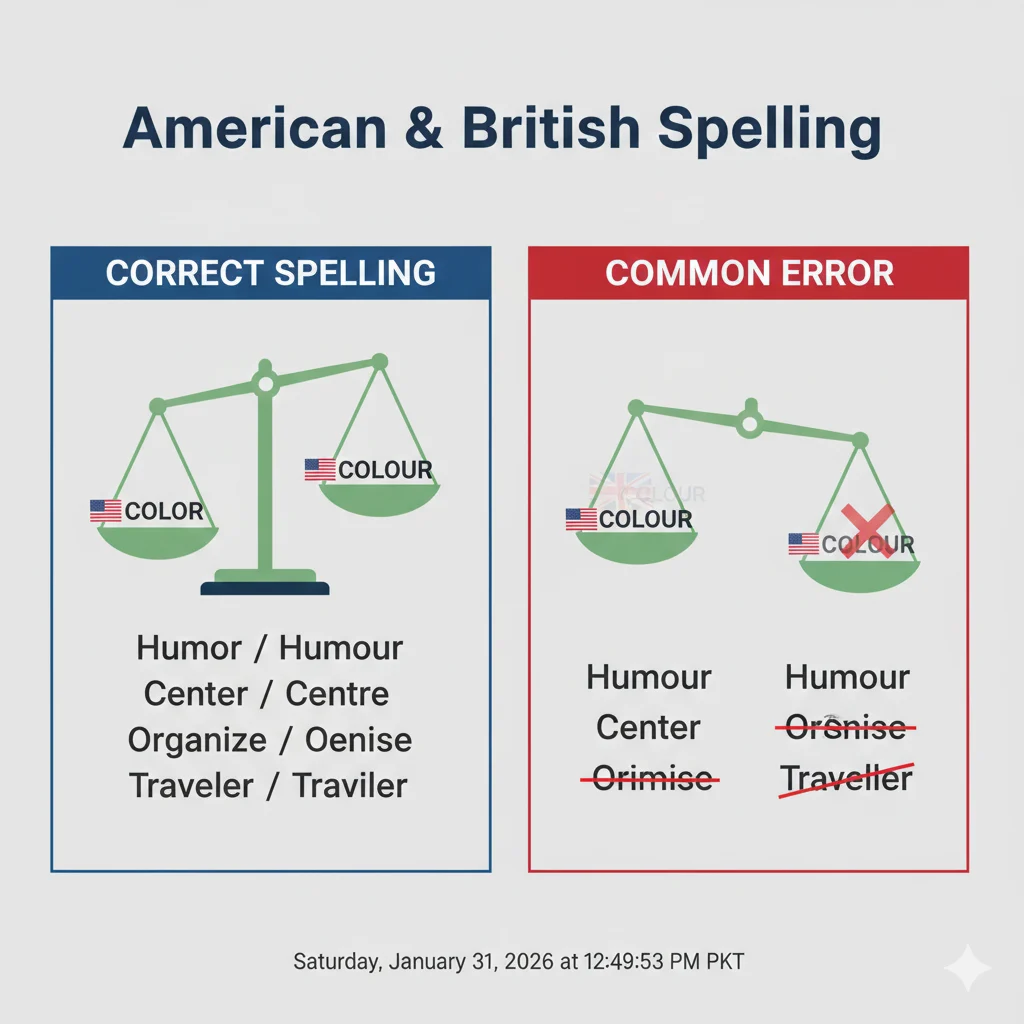
Unbalanced and imbalanced both describe a lack of balance, but they are used in slightly different contexts. Many learners confuse them or use them interchangeably, which can make writing seem less precise or informal.
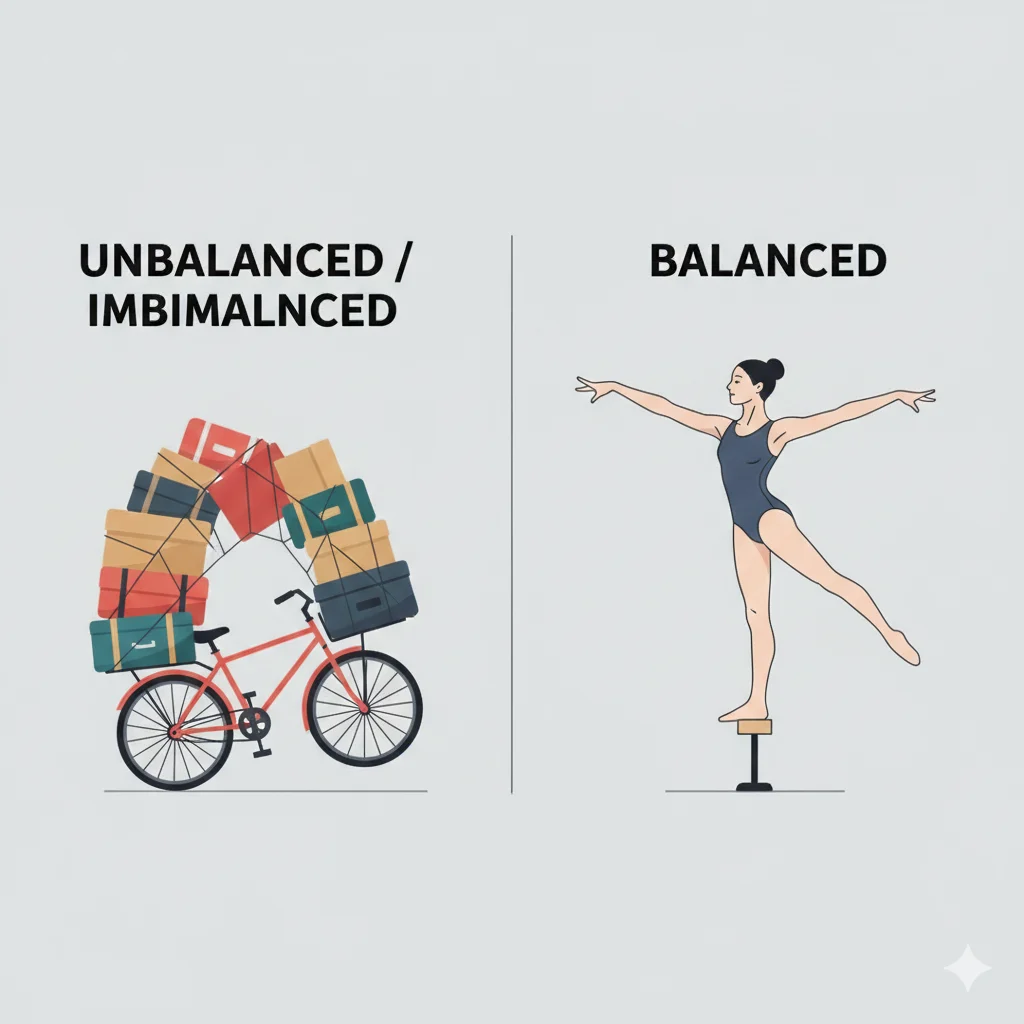
- Unbalanced is more common in everyday language and refers to something physically, emotionally, or figuratively uneven or unstable.
Example: “The chair felt unbalanced and wobbled when I sat on it.”
Example (figurative): “His argument was unbalanced, ignoring important points.” - Imbalanced is often preferred in formal, technical, or scientific contexts, referring to unequal distribution, disproportion, or improper proportions.
Example: “The experiment showed an imbalanced sample population.”
Example (health/medicine): “Her diet was imbalanced, lacking essential nutrients.”
Using the wrong term can confuse readers or make your writing appear careless, especially in academic work, professional documents, or online content. Understanding the difference helps you choose the right word confidently and write accurate, polished, and context-appropriate English.
Unbalanced or Imbalanced
Here is the quick, direct answer. Both “unbalanced” and “imbalanced” are correct English words. They are synonyms and mean the same thing: not balanced, uneven, or unstable. The difference is not in meaning, but in usage and regional preference.
Imbalanced is the newer, more modern term. It is often used when describing a state or condition that is systemically unequal. Think of it as the noun “imbalance” turned into an adjective.
- Example: “The imbalanced distribution of resources caused problems.” (Focuses on the state of inequality)
Unbalanced is the traditional, more common term. It is broader and can describe both physical instability and metaphorical lack of equilibrium.
- Example (Physical): “The washing machine was unbalanced and shook violently.”
- Example (Metaphorical): “He gave an unbalanced view of the situation.”
Simple Rule for Now: If you are in the United States, “imbalanced” is often preferred for technical or formal writing about systems and conditions. In most other cases, and especially in the UK, “unbalanced” is the safer, more common choice. For a global audience, “unbalanced” is widely understood.
The Origin of Unbalanced and Imbalanced
To understand why we have two words for the same idea, we must look at word origins. The root is the Latin word “bilancia,” meaning “balance.” The prefix is where the story unfolds.
“Un-” is a native English prefix from Old English. It means “not.” When attached to “balanced,” it simply means “not balanced.” This is a straightforward, centuries-old method of creating opposites, like “happy” to “unhappy.” “Unbalanced” has been in use since the 1600s, describing everything from literal wobbly objects to unstable minds.
“Im-” is a prefix of Latin origin, a variation of “in-” meaning “not.” It attaches to words beginning with ‘m,’ ‘p,’ or ‘b’ (like immature, impossible, imbalance). “Imbalance” entered English much later, in the early 1900s, as a specialized term often used in scientific, economic, or medical contexts to describe a lack of proportion within a system. “Imbalanced” naturally followed as its adjective form.
The spelling difference exists because English is a living language that absorbs and adapts. “Unbalanced” came from the traditional English path, while “imbalanced” entered through a more scholarly, Latin-influenced route to describe complex, systemic lacks of balance. This is why “imbalanced” can sound more technical or formal to many ears.
British English vs. American English Spelling
This is the core of the confusion. American and British English often treat these prefixes differently, influenced by historical preference and modern usage trends.
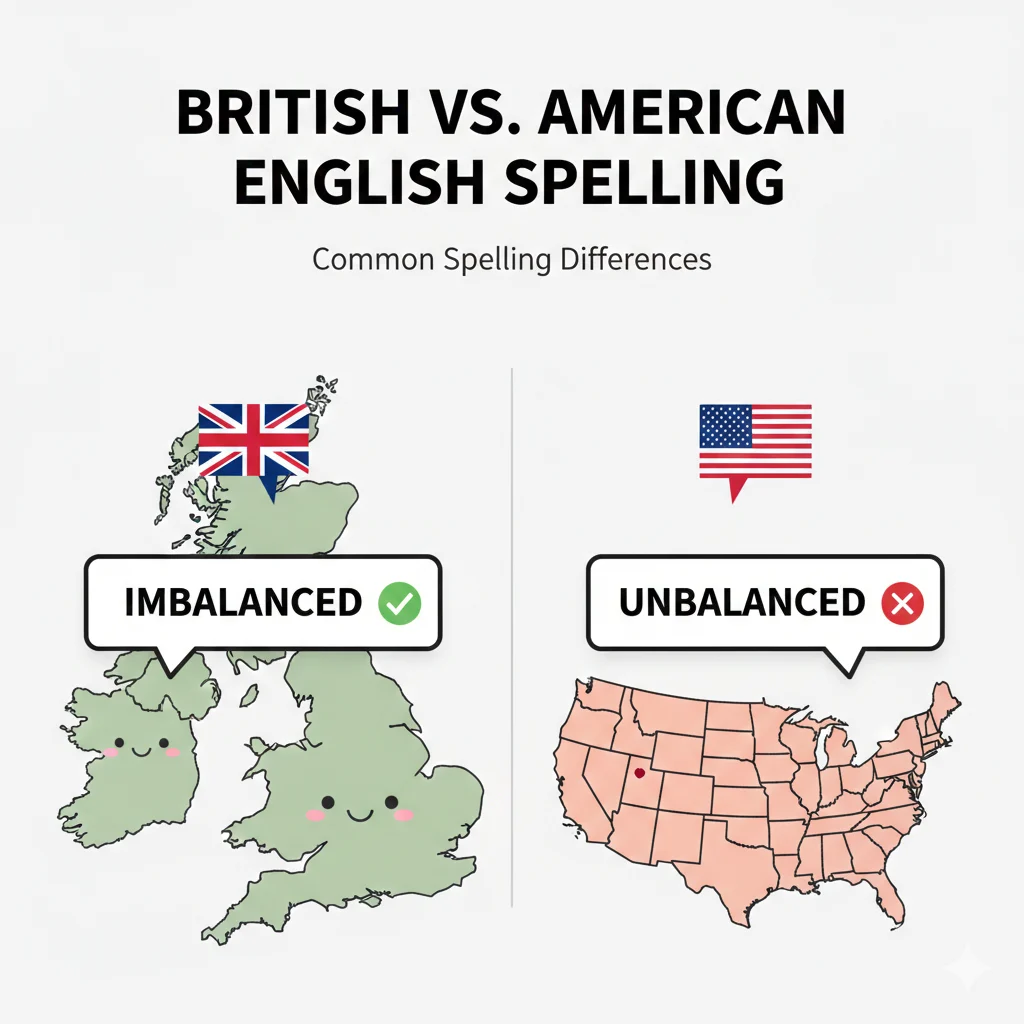
American English has warmly embraced the Latin-derived “im-” prefix. In the US, “imbalance” and “imbalanced” are strongly preferred, especially in formal, academic, medical, and technical writing. You will frequently see “imbalanced diet,” “imbalanced data,” and “hormonally imbalanced” in American publications. “Unbalanced” is still used, particularly for physical instability or informal contexts, but “imbalanced” dominates for describing conditions.
British English (and much of the Commonwealth) tends to stick closer to the traditional “un-” prefix. In the UK, “unbalanced” is the standard, default choice for almost all contexts. Using “imbalanced” in the UK can sometimes be seen as an unnecessary Americanism, though it is understood. The British preference is for the simpler, older form.
Comparison Table:
| Feature | Unbalanced | Imbalanced |
|---|---|---|
| Primary Prefix | Old English “un-” (not) | Latin “im-” (not) |
| Core Meaning | Not balanced; unstable; uneven. | Not balanced; lacking proportion. |
| Regional Preference | Preferred in British English. Common globally. | Preferred in American English. |
| Common Contexts | Physical objects (“unbalanced load”), mental state (“unbalanced mind”), general descriptions. | Systemic conditions (“imbalanced diet,” “imbalanced dataset,” “imbalanced hormones”). |
| Formality | Standard, broadly usable. | Often perceived as more formal or technical. |
| Example Sentence | “The unbalanced bookcase fell over.” | “The study corrected for an imbalanced sample size.” |
Recognisable / Recognizable: The Truth Most Writers Get Wrong
Which Spelling Should You Use?
Your choice should depend on your audience and context. Follow this simple, professional advice.
- For a US Audience: Use “imbalanced.” It is the expected, standard spelling in professional and academic writing. If you are writing for an American healthcare site, tech company, or news outlet, “imbalanced diet” or “imbalanced algorithm” is correct.
- For a UK/Commonwealth Audience (UK, Australia, Canada): Use “unbalanced.” This is the safe and traditional choice. You will rarely be wrong using “unbalanced” in these regions.
- For a Global or International Audience (e.g., website, international report): Use “unbalanced.” It is the more universally recognized and older term. It ensures clarity and understanding for all English readers, regardless of dialect.
- Context-Specific Advice:
- Technical/Scientific Writing: If your field commonly uses “imbalance” as a noun (e.g., chemical imbalance, gender imbalance), the adjective “imbalanced” often follows naturally, even outside the US.
- General/Marketing Writing: “Unbalanced” is simpler and has a wider, more immediate understanding.
- Describing Mental State: Traditionally, “mentally unbalanced” is the established phrase. “Mentally imbalanced” is understood but less common.
Common Mistakes with Unbalanced and Imbalanced
Avoid these frequent errors to polish your writing.
- Mistake: Thinking one is correct and the other is a spelling error.
- Correction: Both are correct. It’s a matter of regional and contextual preference.
- Mistake: Using “imbalanced” consistently in UK-targeted content.
- Correction: For UK readers, default to “unbalanced” unless following a specific style guide.
- Mistake: Using “unbalanced” in American technical writing where “imbalanced” is the norm.
- Correction: In US academic or scientific papers, use “imbalanced” for systemic issues (e.g., “imbalanced datasets in machine learning”).
- Mistake: Inconsistent use within a single document.
- Correction: Pick one term (unbalanced or imbalanced) based on your primary audience and use it consistently throughout your article, report, or website. Do not switch back and forth.
- Mistake: Incorrectly pairing the noun and adjective. “An imbalance system” is wrong.
- Correction: It’s “an imbalance” (noun) or “an imbalanced system” (adjective). Similarly, “a lack of balance” or “an unbalanced system.”
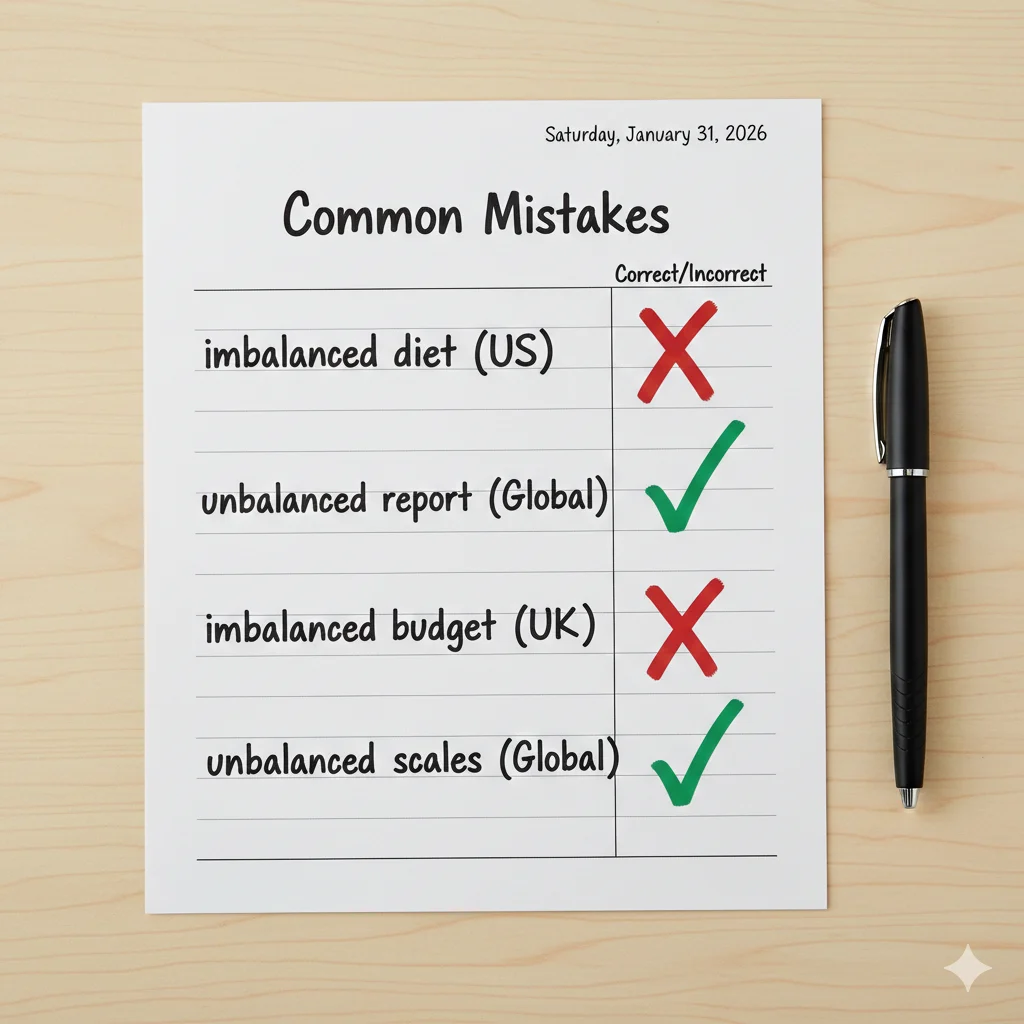
Unbalanced and Imbalanced in Everyday Examples
Let’s see how these words function in real-world writing.
- Professional Email (US): “The imbalanced workload across the team is affecting morale. I suggest a reallocation of tasks.”
- News Headline (UK): “Critics Call Government Report ‘Unbalanced and Misleading'”
- Social Media Post (Global Brand): “Feeling unbalanced? Our top 5 tips for recentering your day. #Wellness #Mindfulness”
- Formal Medical Abstract (US/International): “The study examined the effects of an imbalanced gut microbiome on long-term health outcomes.”
- Product Warning Label (Global): “Do not operate with an unbalanced load. Risk of injury or damage.”
Google Trends & Usage Data
Analysing search data reveals clear patterns. According to Google Trends data, search interest for “imbalanced” is significantly higher in the United States than in other parts of the English-speaking world. Interest in the term “unbalanced” is more evenly distributed globally.
In the US, searches for “imbalanced diet” and “imbalanced hormones” are particularly common, reflecting the term’s adoption in nutritional and wellness contexts. Worldwide, searches for “mentally unbalanced” still outnumber “mentally imbalanced,” showing the staying power of the traditional phrase. The data confirms the core advice: “imbalanced” is an American-led trend for specific contexts, while “unbalanced” remains the global standard.
(FAQs)
1. What’s the difference between unbalanced and imbalanced?
There is no difference in meaning. Both mean “not balanced.” The difference is in usage. “Imbalanced” is newer and preferred in American English for describing systemic conditions. “Unbalanced” is the traditional, globally common term.
2. Which is correct, imbalance or imbalance?
“Imbalance” (with an ‘a’) is the correct noun form. The question might be a typo, but it highlights the confusion. Remember: Imbalance (noun) -> Imbalanced (adjective). Unbalance (less common noun) -> Unbalanced (adjective).
3. Is it mentally unbalanced or imbalanced?
The traditional and still most common phrase is “mentally unbalanced.” While “mentally imbalanced” is understood, it is used less frequently.
4. What does “imbalanced” mean?
It means lacking balance or proportion. It often describes a system, condition, or state that is unequal or unstable, like an “imbalanced diet” (lacking nutritional proportion) or “imbalanced data” (uneven sample sizes).
5. What is an unbalanced or imbalanced diet?
It is a diet that does not provide the proper proportions of nutrients (carbohydrates, proteins, fats, vitamins). In the US, “imbalanced diet” is standard. Elsewhere, “unbalanced diet” is common.
6. What is an example of unbalanced and imbalanced?
- Unbalanced: “The unbalanced washing machine is making a loud noise.” (Physical)
- Imbalanced: “The imbalanced political coverage favored one candidate.” (Systemic/conditional)
7. What is an imbalanced synonym?
Common synonyms for both imbalanced and unbalanced include: uneven, unequal, unstable, lopsided, disproportionate, asymmetrical, and skewed.
Conclusion
The journey through unbalanced vs. imbalanced shows that English is a flexible, living language shaped by history and region. The key takeaway is simple: neither word is wrong. Your choice is a strategic one based on who you are writing for and the context of your writing. For American audiences, particularly in formal or technical fields, lean towards “imbalanced.”
For British, Commonwealth, and global audiences, the wider and safer choice is “unbalanced.” In all cases, consistency is crucial for professional clarity. Understanding this subtle distinction empowers you to write with confidence, knowing your word choice aligns with your reader’s expectations. It moves you from uncertainty to authoritative precision. So next time you hesitate, remember the simple rule—check your audience, consider the context, and choose consistently. This knowledge not only solves a common spelling puzzle but also subtly enhances the credibility and polish of everything you write.

Eli Metaphor blends creativity with wit, crafting articles that make language feel alive. Known for his clever comparisons and modern writing style, Eli helps readers understand how figurative language shapes emotion and meaning. He’s the analytical heart of SimileMind — where logic meets lyricism.