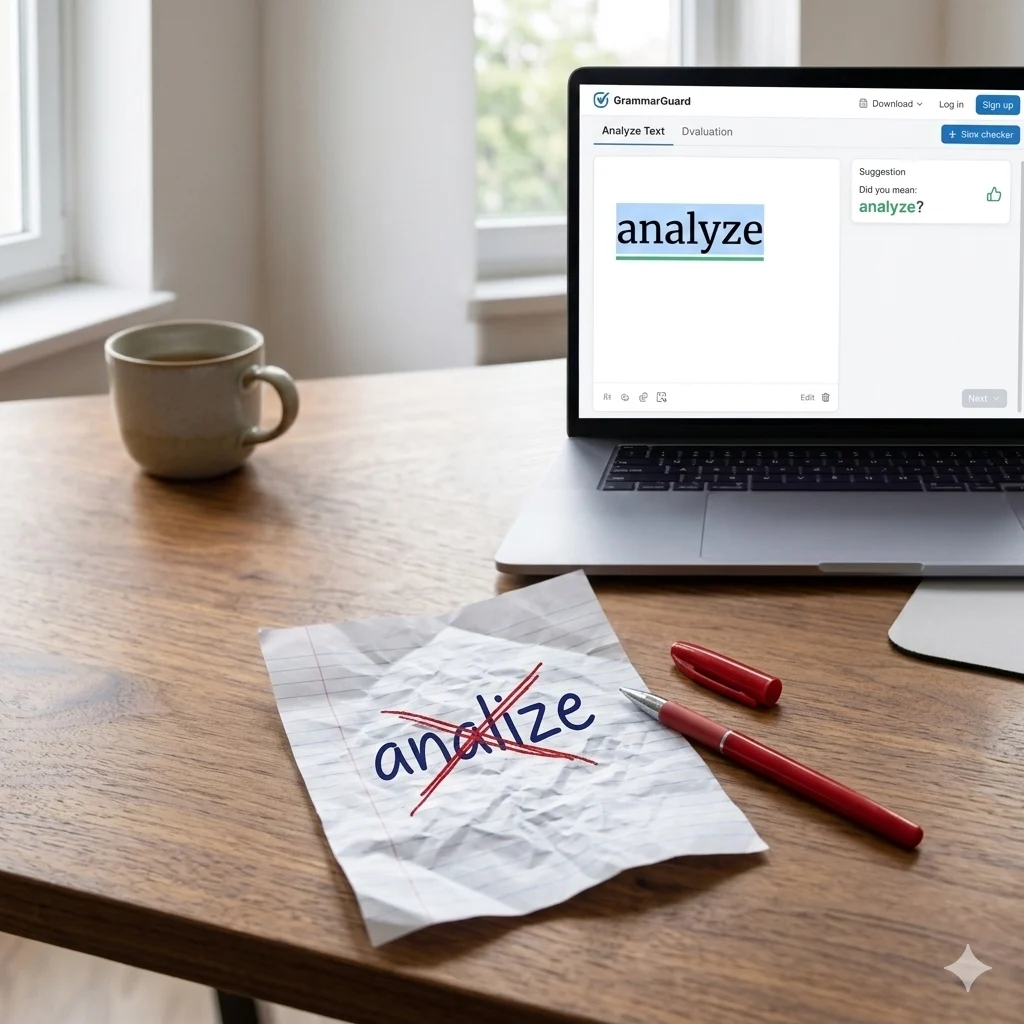
“Analyze is the correct spelling; ‘analize’ is a common misspelling meaning to examine something carefully.”
Confused between ‘analize’ and ‘analyze’? Avoid this tiny mistake that can make your writing look unprofessional! Many writers and students are unsure which spelling to use.
Analyze is the standard and widely accepted form in both American and British English, meaning to examine or study something methodically and in detail. On the other hand, analize is a frequent misspelling that can appear in informal writing.
Here are some quick examples to see it in action:
- ✅ Correct: “I need to analyze the data before the meeting.”
- ✅ Correct (daily life): “She analyzed her expenses to save money.”
- ❌ Incorrect: “I need to analize the data before the meeting.”
In this guide, you’ll learn why ‘analyze’ is correct, see examples of proper usage, and get tips to avoid the common ‘analize’ mistake. By the end, you’ll never confuse ‘analyze’ with ‘analize’ again, ensuring your writing stays polished, professional, and clear.
What is the meaning of analize?
First, let’s address the elephant in the room: “analize” is not a correct spelling in standard English. It is a common misspelling of the word “analyze” (or “analyse”). You will not find “analize” in the Oxford English Dictionary or any reputable dictionary. The correct spelling always includes a ‘y’ or an ‘s’, depending on which variant of English you are using.
The word means to examine something in detail, to break it down into its components to understand its structure or meaning. For example, a scientist might analyze data from an experiment. A critic might analyze a movie. So, if you are asking “What is the meaning of analise?”, you are likely asking about the meaning of “analyze” or “analyse,” which is the act of conducting a thorough investigation.
The Origin of Analyze
To understand why the spelling is so confusing, we have to look at the word’s history. The word comes from Greek roots. It is derived from the Greek word “analusis,” which is a combination of “ana” (meaning “up” or “back”) and “lysis” (meaning “a loosening”). So, the original sense was “to loosen up” or “to break up” a complex whole.
The word traveled from Greek to Latin, and then into French as “analyser.” It was the French version of the word that heavily influenced English. When the word first entered the English language, the spelling “analyse” was the standard, and it remains the standard in British English today. The shift in American English to “analyze” is largely credited to Noah Webster, the creator of Webster’s Dictionary. In the early 19th century, Webster pushed for spelling reforms to make American English distinct from British English and to make spellings more phonetic. He preferred the ‘z’ over the ‘s’ in many words (like “organize” and “civilize”), and “analyze” followed this pattern.

British English vs American English Spelling
This is the core of the confusion. The difference between “analyse” and “analyze” is purely a matter of geography, not grammar. Both spellings are correct, depending on your audience.
- Analyze (with a Z): This is the standard spelling in American English and Canadian English. It follows the common American pattern of using ‘z’ where British English uses ‘s’ (e.g., realize/realise, apologize/apologise).
- Analyse (with an S): This is the standard spelling in British English, as well as in Australia, New Zealand, and most other Commonwealth nations. It retains the ‘s’ from the original French spelling.
To make it crystal clear, here is a comparison table:
| Spelling | Variant of English | Example Sentence |
|---|---|---|
| Analyze | American English | The marketing team will analyze the campaign results tomorrow. |
| Analyse | British English | The chemist needs to analyse the compound before drawing a conclusion. |
| Analize | Incorrect | (Incorrect in all variants) The software helps you analize the data. |

Eighth or Eigth: The Tiny Detail You’re Always Getting Wrong 😱
Which Spelling Should You Use?
So, how do you decide whether to write “analyse” or “analyze”? The answer is simple: know your audience.
- Writing for an American Audience: If you are writing for a company in New York, submitting a paper to a US university, or publishing a blog targeting US readers, always use analyze. Using “analyse” here will look like a typo or an affectation.
- Writing for a UK or Commonwealth Audience: If you are writing for a client in London, a journal in Australia, or a school in India, use analyse. Using “analyze” might mark you as using “incorrect” English or as being overly Americanized.
- Writing for a Global Audience: This is the trickiest situation. There is no single rule. The best advice is to pick one standard and be consistent throughout your entire document. If you are writing for an international company, check their style guide. If they don’t have one, choose the spelling you are most comfortable with. In the world of science and technology, American spelling (analyze) is becoming increasingly common globally, but British spelling (analyse) is still very prevalent and respected. Using the plural noun analyzes (pronounced an-NAL-uh-seez) is also a point of confusion, but it follows the same rule: it is the third-person singular form of the verb, as in “He analyzes the data.”
Common Mistakes with Analyze
Beyond the core “analize or analyze” question, there are other frequent errors people make with this word family.
- Mistake 1: Adding an ‘s’ to the American spelling. You might see someone write “analyses” when they mean the verb form in American English. Remember, the verb forms are:
- I/You/We/They analyze (US)
- He/She/It analyzes (US)
- He/She/It analyses (UK)
- Mistake 2: Confusing the verb and the noun. The noun form is analysis (pronounced a-NAL-uh-sis). A common mistake is to spell the noun as “analyzis” or “analisis.” This is incorrect. The noun is always “analysis” regardless of whether you use UK or US spelling.
- Correct: We will conduct an analysis. (Noun)
- Correct: We will analyze the results. (Verb)
- Incorrect: We will do an analyzis.
- Mistake 3: Misspelling the plural of the noun. The plural of “analysis” is analyses (pronounced a-NAL-uh-seez). Notice it looks exactly like the UK verb form, but the pronunciation and context are different.
- We performed several analyses to confirm the findings. (Plural noun)
- The machine analyses the sample instantly. (UK verb)
Analyze in Everyday Examples
Seeing the word in different contexts helps solidify the correct usage. Here is how “analyze” and its variations appear in the real world.
In a Business Email (US):
“Subject: Q3 Report
Hi David, could you please analyze the attached sales data before our meeting on Friday? I need your analysis of the regional trends. Once you have analyzed the figures, we can discuss the next steps.”
In a News Article (UK):
“The political commentator will analyse the election results on tonight’s show. Her in-depth analysis of voter behaviour is always highly anticipated.”
On Social Media (Global):
“I love to analyze the psychology behind character decisions in movies. It makes watching them so much more interesting!” (Note: Both US and UK users will understand this, though a UK user might spell it “analyse” in their own post.)
In Formal Academic Writing (Style Dependent):
“The purpose of this study is to analyze [or analyse] the effects of climate change on coastal erosion.” The key is to choose one spelling and stick to it throughout the entire paper, abstract, and footnotes.
Analyze – Google Trends & Usage Data
While personal preference and style guides matter, looking at global search data is fascinating. When we look at the search query “analize or analyze,” it’s clear people are seeking confirmation. However, if we look at the correct spellings, we see a clear geographic split.
In the United States, the search volume for “analyze” dwarfs that of “analyse.” Conversely, in the United Kingdom, Australia, and New Zealand, “analyse” is the dominant search term. This perfectly mirrors the spelling rules discussed. The search for “analyse or analyze UK” is also high, indicating that even within the UK, people are aware of the American variant and want to confirm which is correct for their region.
The misspelling “analize” is searched for fairly often, but search engines are smart enough to know the user likely meant “analyze” and will show results for the correct spelling. This data confirms that user intent is purely educational: people want to know the right way to write the word for their specific context.
Frequently Asked Questions
1. Is it “analize” or “analyze”?
The correct spelling is analyze (in American English) or analyse (in British English). “Analize” is always incorrect.
2. Which is correct, analyze or analyse?
Both are correct. It depends entirely on where you are. Use analyze in the US and analyse in the UK and Commonwealth.
3. What is the meaning of analise?
“Analise” is a common misspelling. The intended word is usually “analyze” or “analyse,” which means to examine something in detail.
4. Is analysis with an S or Z?
The noun analysis is always spelled with an ‘s’ in every variant of English. The spelling “analyzis” is incorrect.
5. Does the Oxford English Dictionary say analyse or analyze?
The Oxford English Dictionary, being a British institution, lists analyse as the primary spelling but recognizes analyze as the American English equivalent.
6. What is the plural of analyze?
“Analyze” is a verb. The plural noun form you are thinking of is “analyses,” which is the plural of “analysis.” For example: “The lab conducted multiple analyses.”
7. How do you spell “analyzes” in the UK?
In the UK, the third-person singular form of the verb “to analyse” is analyses. For example: “She analyses the data.” In the US, it would be “She analyzes the data.”
Conclusion
The battle of analize or analyze is easily won. The misspelling “analize” has no place in professional or academic writing. The real choice is between the American English spelling “analyze” and the British English spelling “analyse.” There is no deeper meaning or grammatical rule that makes one superior to the other; it is simply a matter of geography and consistency.
By understanding the word’s origin and the regional preferences, you can write with confidence. Remember the noun is always “analysis” (plural: analyses), and the verb is your choice based on your audience. For a US audience, use “analyze.” For a UK or Commonwealth audience, use “analyse.” For a global platform, pick one and stick to it. Next time you go to write this word, you won’t have to pause and wonder—you’ll know exactly which spelling is right for the job.

Noah Syntax is a linguistics lover who finds beauty in structure and rhythm. His writing combines precision with playfulness, decoding the secrets of language for everyday readers. At Simile Mind, Noah brings clarity, humor, and insight to every metaphor he explores.